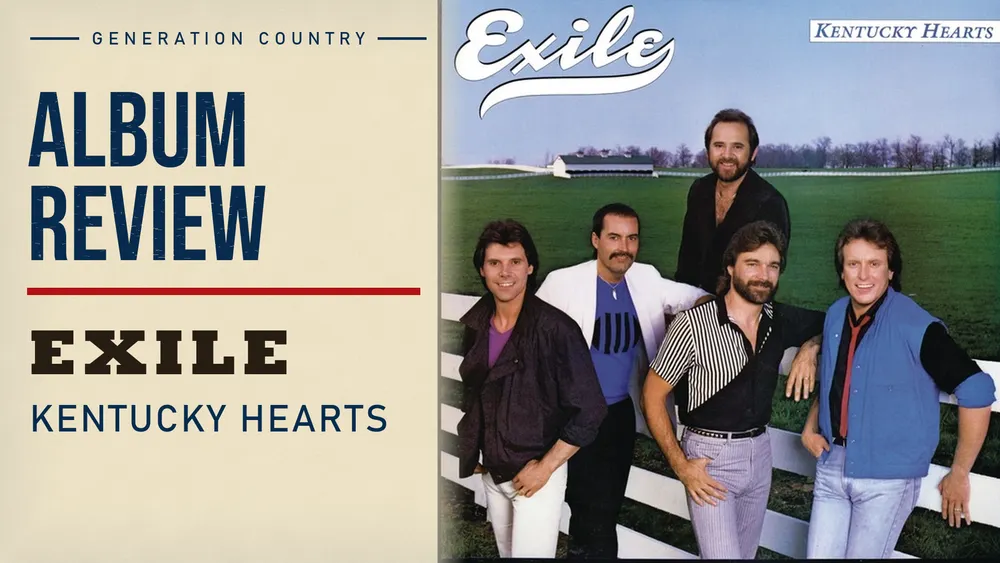
Epic Records (FE 39424) · September 1984
Produced by Buddy Killen for Tree Productions
10 tracks · approximately 32 minutes
“She’s a Miracle” opens side one of Kentucky Hearts. “Give Me One More Chance” opens side two. “Crazy for Your Love” closes the album. The three future No. 1 singles give the record a strong beginning, midpoint and finish rather than crowding its best-known songs onto the first side.
That piece of sequencing helps explain an album too easily reduced to its statistics. Kentucky Hearts spent three weeks atop Billboard’s country-album chart, produced three No. 1 singles and placed another future No. 1 in the hands of the Forester Sisters. Those are impressive numbers. The more interesting accomplishment lies between them.
Exile’s self-titled Epic debut had established its place on country radio. Kentucky Hearts built on that beginning with the confidence Les Taylor described in 1984.
Exile carried its pop hooks, road-band rhythm and soul-informed harmony blend into ten compact songs, nine written by J.P. Pennington and Sonny LeMaire.
The result is a focused record built around love songs, close harmony and the band's own rhythm section.
In the studio in 1984
Alanna Nash followed the record from the workroom to the finished LP. She reported from Nashville’s Soundshop while Exile was mixing it, then reviewed it in the December 1984 Stereo Review. Her first dispatch described rock-influenced hooks and punchy melodies joined to soulful harmony singing. Taylor told her the group had greater confidence and direction on this album.
The original jacket supports the point. It credits Pennington and Les Taylor on guitars and lead vocals, LeMaire on bass and backing vocals, Hargis on keyboards and Goetzman on drums. No outside rhythm-section players are named. Bergen White supplied string arrangements, Pat McMakin engineered the sessions and M.C. Rather mastered the LP at Custom Mastering. Killen shaped the record, but its pulse and vocal character belonged to the five men pictured on the cover.
Reviewing the finished album two months later, Nash praised Exile’s “sparkling vocal and instrumental work” and believed the record held about six potential singles. The band chemistry is evident throughout: rhythm, hook and harmony give each of these love songs its own movement.
Five songs, then five more
“She’s a Miracle” begins by discarding the language of luck. The narrator does not need a shooting star, a four-leaf clover, a crystal ball or public recognition; the wonder he needs is already beside him. It is a useful opener for an album made by musicians whose improbable second career was no longer hypothetical. The gratitude is personal, but the forward motion belongs to the whole band.
Cash Box grouped “She’s a Miracle” with the two-and-a-half-minute “I’ve Never Seen Anything” as the upbeat side of the album. That description catches the record’s prevailing temperament. Exile’s ballads rarely sink into stillness, and its declarations of love tend to arrive with a working rhythm section beneath them.
“You Make It Easy” extends the warmth before “Comin’ Apart at the Seams” takes a more troubled turn. Written by Taylor and Jerry Marcum, it is the only selection outside the Pennington–LeMaire partnership. Its place near the end of the first side brings a different emotional perspective before the train beat of “Just in Case.”
“Just in Case” began with a road joke. Exile's tour manager used false names when checking into hotels. “His fake name was Justin Case!” Sonny LeMaire tells Generation Country. He and Pennington turned the alias into a story about a man leaving emotional room for a lover who might return.
The band set the song to a train beat, a groove Pennington remembers Steve Goetzman playing especially well. Les Taylor sang lead, with Pennington and LeMaire behind him. Pennington also remembers recording electric-guitar overdubs while one of his heroes, Ray Flacke, was in the studio. The visitor’s presence made him unusually nervous.
The song had no Exile A-side campaign. It closed the first side of the LP and later backed “Crazy for Your Love.” Yet it proved that the writing on Kentucky Hearts could travel. The Forester Sisters recorded it for their 1985 debut and carried it to No. 1 in February 1986. Reviewing their single, Cash Box still heard the “Exile stamp” while crediting the sisters with claiming the song through their own high-harmony performance. LeMaire heard the same fit: “Their family harmony aligned perfectly with our song.”
Exile built the song around Taylor's lead and the three-part blend of Taylor, Pennington and LeMaire. The sisters' family harmony gave it another recognizable sound without losing the song.
“Give Me One More Chance” restarts the album in less than three minutes. Radio understood it immediately. Cash Box counted 30 station adds in August 1984 and 70 reporting stations by early October. By November, it was Exile’s next Billboard country No. 1. The song gets to its request, catches the hook and leaves before craft turns into display.
The second side then reveals more of the R&B vocabulary under Exile’s country surface. Cash Box singled out “Somethin’ You Got” and “Ain’t That a Pity” as the album’s soulful selections. “If I Didn’t Love You,” one of four cuts Epic highlighted in its original trade advertising, supplies the longer romantic center between them. The Gavin Report recommended it to programmers alongside “She’s a Miracle” and “Just in Case,” evidence that radio ears heard more than three prescribed singles in the set.
“Crazy for Your Love” makes the pop connection most openly. When the single appeared, Cash Box praised its harmonies, instrumentation and tight construction. That last quality runs through the entire album. The original LP timings total a little under 32 minutes. Most songs fall between two-and-a-half and four minutes, and none behaves as if brevity were an artistic compromise.
Exile's harmonies lock into the beat. The choruses feel played as much as sung, the result of musicians who spent years learning what could reach the back of a club and what could carry a three-minute record.
Written under pressure
The unity was not accidental. In a 1986 BMI profile, Pennington recalled skipping an industry appearance and going home with LeMaire to write for the sessions. They worked day after day, sometimes finishing two songs before the day was over.
That sprint should not be mistaken for their ordinary method. Killen described the pair elsewhere as selective writers with an unusually high percentage of their work recorded. Kentucky Hearts captures an exceptional period of concentration: two writers working under a deadline, writing for five musicians whose strengths they knew from inside the band.
Epic found the right sales pitch. A full-page advertisement stacked four verbs over the album: “PLAYED. SANG. COMPOSED. MADE.” The band name on the cover identified the people who supplied the record’s writing, rhythm and voices.
The album climbed through the Top 30, Top 20 and Top Five before reaching No. 1 in December. On Billboard's 1985 year-end country-album chart, Kentucky Hearts ranked sixth.
The awards season recognized the same double identity the record asserted. Exile appeared among the CMA finalists for Vocal Group of the Year and received recognition in the instrumental-group category as well. The nominations honored more than a vocal blend. They acknowledged five singers and players functioning as a complete unit.
What held up
What has lasted is the concentration. The debut had tested several possible versions of country Exile. Kentucky Hearts brought them together in brisk, melodic country-pop, with a strong rhythmic pulse and soul in the harmonies. The songs rarely advertise the work behind them, but years of playing together made that ease possible.
There is no song called “Kentucky Hearts” on Kentucky Hearts. The title instead names a place of origin and, intentionally or not, a method. Kentucky musicians carried pop economy, rock-band reflexes and soul harmony into country music. The three No. 1 singles tell how far the record traveled. “Comin’ Apart at the Seams,” “If I Didn’t Love You,” “Somethin’ You Got” and the exported “Just in Case” explain why the album surrounding them still warrants attention.
VERDICT: Kentucky Hearts captures Exile's country sound in full: compact songs, a lively rhythm section, distinctive leads and soul-bred harmonies. The three No. 1 singles are the familiar entry points. “Just in Case,” “Comin’ Apart at the Seams” and the R&B-flavored second-side cuts make the whole album worth returning to.
Essential tracks: “Give Me One More Chance,” “She’s a Miracle,” “Just in Case,” “Comin’ Apart at the Seams,” “Crazy for Your Love.”
Exile · Kentucky Hearts · Epic FE 39424 · 1984
Produced by Buddy Killen for Tree Productions