NGDB Records · Released October 24, 2025
Produced by Jerry Douglas · Recorded at Ocean Way Studios, Nashville, and The Tractor Shed, Goodlettsville, Tennessee
Featuring Matraca Berg
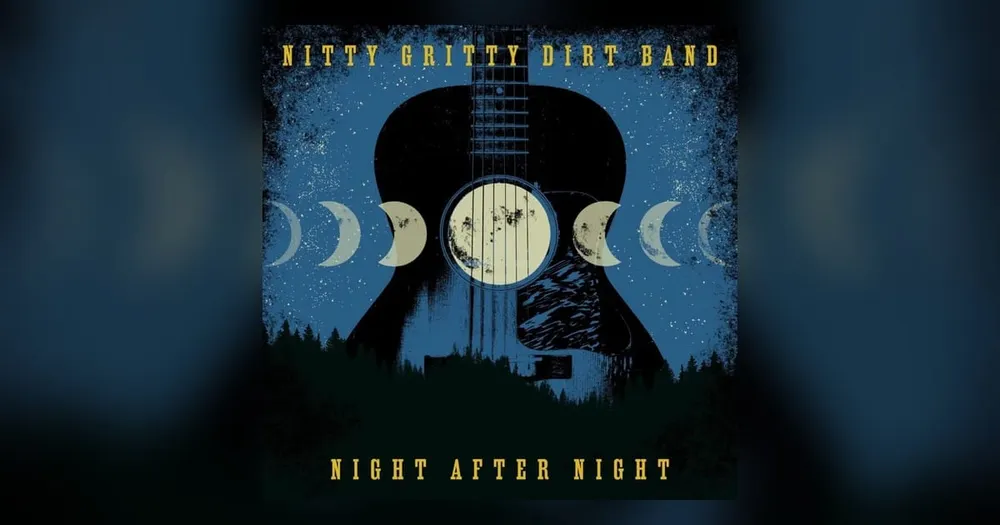
Sixteen years. That's how long it had been since the Nitty Gritty Dirt Band released new original music when Night After Night arrived last October — five songs, seventeen minutes, put out on the band's own imprint in the middle of a farewell tour. The economics run the other way. A band saying goodbye has every commercial incentive to ride the catalog out the door; the farewell business runs on greatest hits. Instead, sixty years in, they booked Ocean Way, called Jerry Douglas, and cut five songs nobody had ever heard. It is the least surprising surprise in their whole story, and it deserved more attention than it got.
The title track came in over the transom the way good songs have always found this band. Buddy Miller sent it to Jeff Hanna — "written by two of my favorites," Hanna said, and the band's reaction was an immediate "Oh, hell yes!" The two names on the credit explain why: the song was practically bred for this outfit. Paul Kennerley is the Englishman behind The Legend of Jesse James, a fistful of the Judds' early hits, and — from the years surrounding his marriage to Emmylou Harris — "Born to Run" and "In My Dreams." Daniel Tashian is second-generation Nashville craft, the co-architect of Kacey Musgraves' Golden Hour. His father, Barry Tashian, fronted the Remains — openers on the Beatles' final American tour — then spent nearly a decade singing harmony at Emmylou's shoulder in the Hot Band, and with his wife Holly, Daniel's mother, made a run of lovely duo records for Rounder. Both halves of the credit trace back to her world — the husband who wrote her hits, the harmony man's son — so the band's final title track arrived from inside the family. It had a prior life, too: it was the title track of Daniel Tashian's 2022 album Night After Night, his collaboration with Paul Kennerley, before Buddy Miller sent it to Jeff.
The song itself runs the oldest trick in the power-pop book: a lyric about heartbreak insomnia — a man lying awake until the dawn, reaching for somebody who's gone, calling her name into the dark: "Night after night / The stars above / Don't seem to know / I've lost your love" — set to music that refuses to mope with him. Straight-ahead drive from Fadden's kit, a melodic bass that won't sit still, acoustics compressed into that bright rhythmic shimmer, Ross Holmes's mandolin glinting inside it, and the harmonies stacked into a single gleaming block — Bob Carpenter and Jaime Hanna, the family blend doing pop duty. The easy comparison is heartland arena rock; the truer address is Nick Lowe circa "Cracking Up" — the Rockpile-era trick of a man coming apart over a groove that refuses to sit down — finished with a coat of Jeff Lynne-school sheen: drums dry and punchy, jangle kept clean, everything polished until it glows. Douglas's lap steel slices through it, trading licks with Jaime's electric, and Viktor Krauss walks the Tic-Tac bass underneath — not a second bassist but a doubling, an eighth-note line stacked over his own upright once the band had its take, the old Nashville trick for putting top end on an instrument that speaks softly into a microphone. And the title pulls a double shift no farewell record could have missed: night after night is the heartbroken man's clock, and it is also, of course, the job — the thing this band did for sixty years. Hanna's own verdict on the session holds up: "it's pretty easy to tell what a blast we had" — sorrow played as a blast being precisely the trick.
Then comes "Nashville Skyline," and the credit reads like a household chore chart: Jaime Hanna, Jeff Hanna, Matraca Berg. Even the title is a borrowing with a purpose — Dylan's 1969 Nashville album, its name picked up by the band that had just spent an entire record repaying him, and pinned to an elegy for the town his record helped certify. The song works a narrator who has started to feel like the skyline himself: the past fading on him like an old Polaroid, the wish for one more round among Broadway's ghosts, the downtown bars where the whiskey-era poets held court — "Them good old boys sure made some noise / Whiskey prophets singing poetry with a Southern accent" — and what sure sounds like a wink at Kristofferson's most famous Sunday folded into the chorus. Jaime takes the lead, father and son strumming side by side, and Berg — the featured guest — winds the high tenor through those choruses, the prettiest singing on the record, grief dressed as sweetness, while Ross Holmes's fiddle threads the whole arrangement. The dynamics do the storytelling: hushed verses, choruses that open into soaring stacked harmony, a bridge stripped to almost nothing so one long-held note can carry the song's hardest admission: "I came back here to find a song / I came back here to find it gone" — the thing he came back for isn't here anymore — and then the fiddle takes the outro alone, crying the melody out, the correct instrument for the job. The complaint carries weight because of who's filing it: between the three writers, this family has supplied that town with a meaningful piece of its actual catalog — and here they are, on the band's last record, singing the place a goodbye it has not entirely earned. It's the EP's centerpiece and it knows it.
"If You Hang Around Long Enough" pairs Hanna with Mac McAnally, whose "Down the Road" the Dirt Band cut years before Kenny Chesney carried it to No. 1; McAnally's resume runs from Jimmy Buffett's band to a stack of Sawyer Brown hits to, most recently, the producer's chair for Amy Grant's The Me That Remains. The title is the band's sixty-year thesis compressed into six words, and the song wears it lightly — a bright, foot-tapping country-rocker built from barroom vignettes: a beer bottle sailing past the narrator's daydreams, an elder of the three-chords-and-the-truth school explaining that overnight success runs on two decades of work and a little luck, and, best of all, an old couple celebrating an anniversary across the room, where the husband, asked the secret of their longevity, just smiles and lets his wife do the telling. The harmonica works the fills all the way through, the choruses lift into stacked harmony with a real Pure Prairie League shine — their own '70s cohort's dialect, spoken natively — and the whole thing comes off as wisdom played for a grin, a mode this band invented for itself sometime around 1966.
"Peace and Quiet" brings Berg back to the writing table, this time three-handed with Hanna and the Texas songwriter Drew Kennedy — her second co-write of the five, an unusually large presence on a farewell EP. She sang on Speed of Life in 2009, too — the band's last two records of original songs, sixteen years apart, and hers is a voice on both. It's the record's nocturne: fingerpicked acoustic floating on long, atmospheric sustains with a night-sky spaciousness, a weathered vocal working through the after-hours ledger of a man who spent all his second chances and came home to more house than company — and who is, verse by verse, learning to live with the quiet instead of against it. The register is late-period Guy Clark: an older man taking his own inventory, plainspoken, making no bid for sympathy. He re-runs old films from bed and re-edits the endings; the silence gets loud some nights; the title doubles as the verdict, because peace is exactly what he's making with it: "And I'm making peace with all this peace and quiet." The arrangement performs the same argument the lyric makes: it holds its hush for two minutes, swells once — a warm, slide-toned solo cresting over Hammond organ and mandolin, a single wave — and then settles back into the stillness it came from, acceptance scored as dynamics.
And the closer, "For All the Good It Did," carries just two names: Jaime Hanna and Alan Miller, the writing partner who goes back to Jaime's duo record two decades ago — and Jaime sings it, one of his two leads on the EP, tender and unhurried. It earned its place the honest way — the song from the family pile that wouldn't let go of Hanna and Douglas when they sifted the batch. In conversation the title drips sarcasm; the song plays it straight. Its narrator walks the wreckage of a love that failed — the question he'd rather not ask, the discovery that these verdicts never come back in black and white — and chooses to close the account on the credit side: a hard lesson he wouldn't trade, a love he intends to remember for what it gave. The final track on the final record of new Dirt Band music belongs entirely to the next generation, and the kid handles the last words gently.
Douglas first met this band at nineteen and played on "Long Hard Road," their first No. 1 — so when he produced these sessions like a man repaying a loan, the same warm, unvarnished job he did for John Hiatt on Leftover Feelings, the debt was personal as well as generational. He called the EP "the culmination of many years of brothership and trust." From the bass chair, Viktor Krauss — "honored to be asked," he tells Generation Country, the moment Douglas called — watched the method up close: a day or two of arrangement rehearsals at S.I.R., then the full band tracking together at Ocean Way, under a producer who strikes "a nice balance of letting the music happen naturally … but is willing to provide direction for a specific vision." And when the direction comes, the room takes it, for a reason Krauss states plainly: "As a player, he is so revered and respected. You always want to know what he has to say." The rooms matched the mandate: the EP was cut partly at Ocean Way, the 1911 Gothic Revival church on Music Row, and partly at the Tractor Shed in Goodlettsville, a converted farm shed behind Grandpa Jones's old home — a church and a shed, which has been this band's whole argument since 1966. That's the sound of it: no farewell bombast, no string section telling you how to feel, just a working band cutting good new songs because that is what the organism does until it stops. And the five songs share one subject, which is time — what it costs, and the terms you make with it. Every track looks backward and settles on some form of acceptance, which is not nothing for a band writing its own last chapter. Even the titles are in harmony with the moment — a tour called All the Good Times: The Farewell Tour, a closing song called "For All the Good It Did," a record called Night After Night from a band that played sixty years of them.
Most bands exit through the museum. This one left a light on.
VERDICT: Five new songs from a band with no commercial reason to make them and every musical reason — the family writing together, the son singing, Jerry Douglas keeping the air in the room. A small record that does a big thing: it ends sixty years with a beginning.
Essential tracks: "Nashville Skyline," "Night After Night."
Nitty Gritty Dirt Band · Night After Night · NGDB Records · 2025
EP released October 24, 2025 · Produced by Jerry Douglas
Personnel: Jeff Hanna, Jimmie Fadden, Bob Carpenter, Jaime Hanna, Ross Holmes, and Jim Photoglo
Guests: Jerry Douglas (lap steel), Viktor Krauss (acoustic and Tic-Tac bass), Matraca Berg (vocals on "Nashville Skyline")
Recorded at Ocean Way Studios, Nashville, and The Tractor Shed Studio, Goodlettsville, Tennessee
Mixed by Sean Sullivan with Jeff Hanna and Jerry Douglas
Songwriters: "Night After Night" — Daniel Tashian and Paul Kennerley; "Nashville Skyline" — Jaime Hanna, Jeff Hanna, and Matraca Berg; "If You Hang Around Long Enough" — Jeff Hanna and Mac McAnally; "Peace and Quiet" — Jeff Hanna, Matraca Berg, and Drew Kennedy; "For All the Good It Did" — Jaime Hanna and Alan Miller.