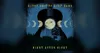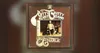
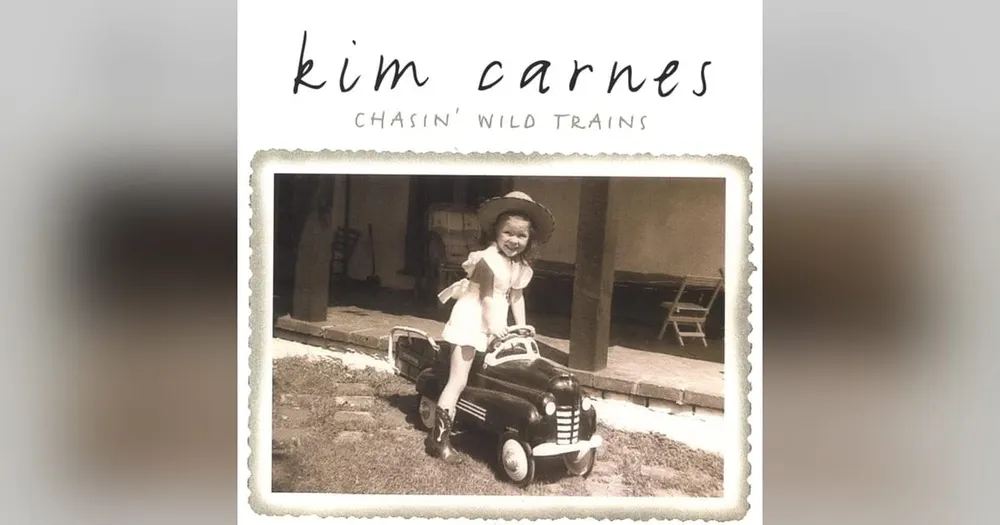
Sparky Dawg · Released 2004
Produced by Kim Carnes · "If I Was an Angel" co-produced by Matraca Berg · "Lucid Dreams" co-produced by Angelo Petraglia and Chuck Prophet
Recorded in Nashville · Engineered and mixed by Scott Baggett · Mastered by Jim DeMain at Yes Master
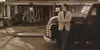
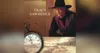
The cover is a photograph of a little girl, three years old, perched on a toy car and beaming like she has already worked out how the whole story goes. Kim Carnes came across it decades later while going through her mother's keepsakes and put it on the front of the record. The picture holds a secret: it's a toy honeymoon car, and the little girl was playing "wedding" that day with the boy next door — David Lindley, who grew up to be the most beloved slide player of his generation. She married into slide guitar at three; forty years on, the centerpiece of this record carries Jeff Hanna's slide across it. Chasin' Wild Trains — her thirteenth album, and her first in thirteen years — is Kim Carnes with nothing between her and the tape: every one of its twelve songs written or co-written by her, every call on it made by her. "It's my favorite album that I've ever made," she said. "Through all the albums, this is me."
It began with a single song and a jolt of certainty. Carnes had written "One Beat at a Time" with the Canadian songwriter Marc Jordan, took it into a studio with her working band, and the second she heard it come back the rest of the album arrived in one thought. "The minute I did it, I thought, Time to make an album," she said. "This is going to be cut one. Everything has to measure up to this." She cut it on her own little imprint, Sparky Dawg, named for the family dog — hers, homemade, answerable to no one. She sold it at her own shows in 2004, and the following year a Dutch label carried it across the Atlantic, where Europe treated the woman selling CDs off the stage in Tennessee like the returning legend she was. "It's the only album I did exactly the way I wanted," she has said. "Nobody told me no." She built it, in her own words, as a collaborative love project, and the love is not a slogan pasted on afterward. It is the actual construction method.
Here is how that method worked. When Carnes wrote a song with a friend, she brought the friend into the room to play it or sing it, so the album is assembled out of her friendships the way a quilt is assembled out of old shirts — every square cut from something that already mattered. Matraca Berg, Al Anderson of NRBQ, Kim Richey, Chuck Prophet, Angelo Petraglia, the New Orleans guitar-and-storm force Anders Osborne — each of them helped dream up a song and then turned up to help build it. Around that circle she set some of the surest hands in Nashville: Richard Bennett, who wired the menace into Steve Earle's Guitar Town, on guitar; the fiddle-and-cello weather of Tammy Rogers and John Catchings; and, back on the drum stool where he'd sat since her earliest hit records, Craig Krampf, a loyalty two decades deep. Her engineer, Scott Baggett, she called a brilliant angel who knew what she wanted before she said it. They had come to help a friend make the thing she heard in her head.
What she heard was spare and patient, a record that trusts a good song to carry itself across a mostly acoustic floor. The synthesizers that once defined her are gone; what steps into the space they leave is the voice itself — smoke coming off warm asphalt, a rasp with a whole life folded into it — given more room than any glossy production ever allowed it, and the closest kin to what it does here isn't anything on her own '80s records: it's the grown-woman poise of Bonnie Raitt, the roadhouse warmth the Eagles only found sitting down. The melodies stick on one listen, like they'd always existed and she'd just remembered them, and song for song the record stands with anything Nashville produced in 2004 — whatever aisle the store would have filed it in. The trade press said as much at the time: Country Music Today called it one of the year's best albums in any genre. "Just to See You Smile," written with Petraglia and Prophet, is the record at its most open-hearted, a plainspoken vow that asks for nothing but the chance to make somebody's day; she sings it low and unguarded, no performance in it, just the truth of the sentence.
Then the record proves it has spine to go with the tenderness. "Where Is the Boy? (Chris' Song)," the one song here she wrote entirely alone, steps inside the skin of a young man the world had already given up on — someone written off with the cruelest available word — and refuses to let him be reduced to it. She sings from his side of the glass, for the family still hoping and the boy still fighting, and turns a life most songs won't touch into three minutes of pure mercy. It is the bravest thing on the album. "Goodnight Angel," another solo write, performs a quieter act of imagination: with a whole genre of songs pointed at the soldier, Carnes turned the camera around to the one left at home. The song began life for a shelved companion album to the war film We Were Soldiers, and it outlived the assignment because the question underneath it wasn't about any one war. "What about the feelings of the partners that are left here," she asked, "missing somebody who's off in some terrible war?" Once she saw them, she said, the song came fast, and it keeps its whole heart with the one left behind.
"Lucid Dreams" is the one cut she handed to Angelo Petraglia and Chuck Prophet to co-produce, and it drifts in like a lost track from Tom Petty's Wildflowers — that same loose-strung, twilight ease — with Prophet's harmony carrying more than a little Petty in its grain. The album's single outside production, and not a seam shows. "All About Time" comes from the pen of Greg Barnhill — the writer behind "House of Love" for Amy Grant and Vince Gill and "Walkaway Joe" for Trisha Yearwood and Don Henley — and it walks off with the record's most infectious melody, Barnhill's own acoustic rhythm driving it while Tim Lauer's accordion breathes at the edges: the quilt method again, the friend who helped write it standing in the room playing it.
The title lives in "Runaway," a two-lane-highway song she wrote with Anders Osborne, where the dream of driving off after some untamed, unreachable thing gave the whole album its name. And the one that will matter most to anyone who knows the neighborhood is "If I Was an Angel," which Carnes first started years earlier with Matraca Berg — the same song that graced Berg's own Sunday Morning to Saturday Night (previously reviewed on this site), now sung by its other author. Carnes has told how it was born: she carried the chorus over to Berg's house, sure there was something in it worth chasing, and Berg disappeared for a minute and came back with a fistful of lyrics she'd already begun. They fit the two halves together on the spot. Here Berg co-produces it and sings the harmony climbing in beside her, and Jeff Hanna of the Nitty Gritty Dirt Band smears warm slide guitar across the whole thing. It is the summit of the album — two writers who found the song together, singing it home together — and Nashville heard it that way too: Peter Cooper, reviewing the record in The Tennessean, singled out "If I Was an Angel" as its highlight. Berg doesn't leave after her song, either; her harmony stays for "Too Far Gone," the sly Kim Richey co-write one groove later, two of Nashville's finest voices lining up behind a friend.
And then, to close out the album, she leaves you grinning and toes tapping. "Stepped Right in It," written with Al Anderson and Jeffrey Steele, is a wink and a shuffle, Anderson's guitar grinning right along with her, Steele on bass, a song about stepping square into trouble and being delighted about it, filled with infectious harmonies. And keeping time on percussion, per the credits, is Dave Ellingson — so the last track on the record she made exactly her way has her husband of thirty-six years playing on it, the same man who was standing in the New Christy Minstrels when she walked in. On a record with this much reflection in it, that last burst of mischief is not filler; it is the point, and it's pure joy.
VERDICT: A gift of a record, and the freest thing Kim Carnes ever put her name to — a dozen songs all her own, self-produced with nobody left to tell her no, cut in Nashville rooms with the friends who helped write them. The woman the world files under one enormous song she didn't write here answers with an album where every note is hers — tender toward the ones nobody sings for, light enough to end on a laugh. She spent a career catching other people's trains. On Chasin' Wild Trains she finally ran down her own, and the wild thing she was after all along turns out to be the sound of herself, home. One can only hope she does a follow-up.
Essential tracks: "If I Was an Angel," "Where Is the Boy? (Chris' Song)," "Just to See You Smile," "Lucid Dreams," "All About Time," "Stepped Right in It." Then start it over at "One Beat at a Time" and hear the song that convinced her the rest had to be this good.
Kim Carnes · Chasin' Wild Trains · Sparky Dawg · 2004
Produced by Kim Carnes · Engineered and mixed by Scott Baggett · Mastered by Jim DeMain at Yes Master
Sources: album booklet and credits (Sparky Dawg, 2004; CoraZong European edition, 2005); PopMatters, "Where the Heart Is," Kim Carnes interview by Christian John Wikane; The Daily News Journal (Murfreesboro), June 10, 2004; Peter Cooper, The Tennessean, January 10, 2005; Stephen L. Betts, Country Music Today, November–December 2004; period interviews, 2004–2005.