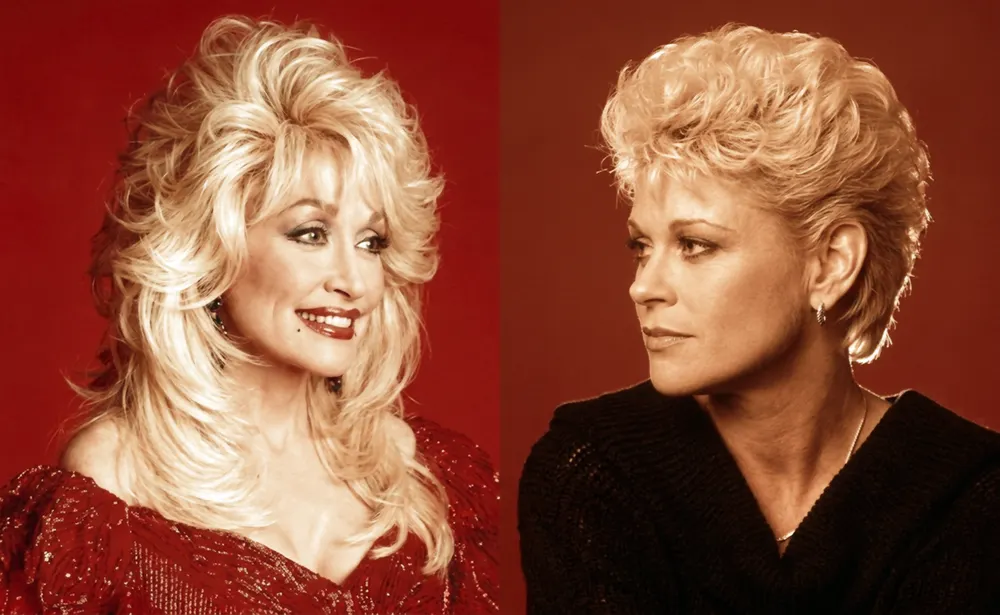
"Best Woman Wins" — Dolly Parton & Lorrie Morgan
From Eagle When She Flies (Columbia, March 7, 1991) and Something in Red (RCA, April 9, 1991)
Written by Dolly Parton · Produced by Steve Buckingham, Dolly Parton, and Gary Smith
Two of the biggest voices in country music cut a duet in 1991, put it on their albums, and then watched both records go platinum on the strength of other songs. The duet stayed put. It was strong enough to headline either album; it fronted neither. Between the two of them, Eagle When She Flies and Something in Red spun off eight singles across 1991 and 1992, and "Best Woman Wins" was not one of them. That is the whole case, and it starts, of all places, on an airplane.
THE FLIGHT
Lorrie Morgan told the story herself, and it is better than anything a publicist could have invented. She and Dolly Parton boarded a flight from Nashville to Los Angeles one day and found, by pure accident, that they had been seated right next to each other. They got to talking — about singing, about producing, about the whole business of making records — and somewhere over the country Parton floated the idea. "She kind of out of the blue said, 'You know, we ought to do a duet together sometime,'" Morgan recalled to Jack Hurst. Morgan had been around long enough to know how often that sentence gets said and how rarely it means anything. "People tend to say that a lot in the music business, and I really didn't take her seriously," she admitted. "I said, 'Yeah, maybe we should.'" Parton pressed it one step further: "I think I'll just write us a song, and we'll cut a duet together."
The next day, again by coincidence, the two of them ended up on the same flight home from Los Angeles to Nashville. They talked about it a little more, and then Morgan went back to her life, still filing the whole thing under things people say on airplanes.
A couple of months later she was on tour in Florida when a message reached her from her manager's office in Nashville: Dolly Parton was trying to get hold of her. Parton had done exactly what she said she'd do. She had written the song, cut a demonstration recording of it, and she wanted Morgan to hear it — with a grace note attached. "She said, 'If you don't like it, just tell me and we won't do it — no hard feelings. We'll come up with something else,'" Morgan remembered. Morgan got the tape, played it, and heard what it was. "It was a great song," she said. "I said, 'Yeah, I'll jump at the chance to do a duet with Dolly.'"
Nobody schemed this into being. Two women who happened to be flying the same routes on the same days turned a hallway pleasantry into a real record, and the only thing standing between the idea and the tape was Dolly Parton sitting down and writing the thing.
THE SONG
What she wrote suits both of them exactly. "Best Woman Wins" is a face-off — two women eyeing the same man and, instead of clawing at each other over him, agreeing to settle it clean and let the better woman walk away with him. It is a premise with a wink built in, and it hands each singer her own corner to work. Parton's voice comes in bright and knowing; Morgan answers with that big, clear, faintly regal tone that started as an inheritance and ended as a signature. The song lets them spar without ever turning mean, which is the trick of a good rivalry number — you have to believe both of them could win, and you have to like them both while they try. On this record you do.
It was produced by Steve Buckingham and Gary Smith, the team behind Parton's Eagle When She Flies, with Parton herself in the producer's chair alongside them, and it was built to sit comfortably inside two very different albums at once. It does. On Morgan's record it plays like the moment her old-school country poise gets to loosen up and trade jabs with the woman half of Nashville grew up idolizing. On Parton's, it's the sound of a legend reaching down a generation and pulling a rising star up level with her. The song works both ways because it was written to.
WHY IT NEVER GOT ITS SHOT
Here is where the "should've been" lives. Each album already had its singles mapped out before "Best Woman Wins" ever reached a programmer's desk, and each did just fine. Morgan's Something in Red was a genuine event for her — it reached No. 8 on the country albums chart, went platinum, and delivered four Top Ten singles: "We Both Walk" at No. 3, the George Jones cover "A Picture of Me (Without You)" at No. 9, "Except for Monday" at No. 4, and the title track at No. 14. Parton's Eagle When She Flies did something she hadn't done in over a decade — it went to No. 1 on the country albums chart, her first solo album to top it since 1980, and it went platinum too, carried by "Rockin' Years," her chart-topping duet with Ricky Van Shelton, along with "Silver and Gold," the title song, and "Country Road."
So both albums were fully stocked, and the duet had a second problem no A&R department could wave away: it belonged to two labels at once. Morgan was on RCA; Parton was on Columbia. A single needs one label to own it, push it, and count it, and a shared duet living on two separate flagship albums is exactly the kind of song that falls into the gap between two promotion departments, each of them busy working the hits it already had. Nobody killed "Best Woman Wins." It simply never had one desk whose job it was to carry it to radio, because the credit — and the work — would always have had to be split down the middle.
The result is a duet by two of the format's marquee women that a whole generation of country fans owns on two different albums and has still, somehow, never heard on the radio.
LORRIE
Morgan had earned her spot in that airplane seat the hard way. She was born into the Opry — her father was George Morgan, the honey-voiced star of "Candy Kisses," and he brought her out on the Grand Ole Opry stage at thirteen to sing "Paper Roses" to a house that rose to her before she'd finished. She lost him young, and she came up through the clubs and the road with a voice too big to stay anybody's daughter. Then country handed her the cruelest possible chapter: she married Keith Whitley, one of the most gifted singers of his generation, watched him become a star beside her, and lost him in 1989 to alcohol, a widow with a small son and a career she now had to carry entirely on her own.
She carried it. Something in Red was the album that turned Lorrie Morgan from George Morgan's daughter and Keith Whitley's widow into a headliner in her own name — four hits, platinum, and a voice that critics and fans finally agreed belonged at the very front of the format. Sharing a microphone with Dolly Parton that year wasn't a favor handed down to a newcomer. It was two peers, one just arriving at the top and one returning to it, meeting in the middle of a song.
DOLLY
For Parton, 1991 was a homecoming. She had spent the back half of the eighties out in the wider pop and Hollywood world, and White Limozeen in 1989 had begun steering her back toward straight country. Eagle When She Flies completed the turn and then some — a heart-on-the-sleeve country album that reminded everyone the woman behind the wigs and the one-liners was one of the greatest singer-songwriters the format ever produced. It gave her the first No. 1 country album of her career in ten years, and it did it in the thick of the Garth Brooks juggernaut, her single week at the top interrupting what would otherwise have been more than a year of Brooks holding the spot.
That she spent part of that comeback writing a song to give away half of — sitting down after an airplane conversation to build a showcase for a younger singer to share — is its own small monument to how Dolly Parton has always worked. Morgan didn't pass. Who would.
THE VERDICT
Some songs miss because they aren't good enough. This one missed because it was too well shared — a duet with two homes and no single owner, dropped onto two platinum albums that each already had their hits lined up, at a moment when both women had every reason in the world to look the other way and let it ride as an album cut. It rode. Thirty-plus years later it's still there on both records, waiting, a friendly duel between two of the best voices country had in 1991 that radio never got around to.
It should've been a single. It had two stars, a hook you can't shake, and a backstory that begins with the two of them buckling into adjacent seats by accident and ends with one of them writing the other a hit. The only thing it never got was a label willing to call it theirs.
Best woman wins. On this one, both of them did — and the rest of us just never got to vote.
Dolly Parton & Lorrie Morgan · "Best Woman Wins" · written by Dolly Parton · from Eagle When She Flies (Columbia, 1991) and Something in Red (RCA, 1991) · produced by Steve Buckingham, Dolly Parton, and Gary Smith