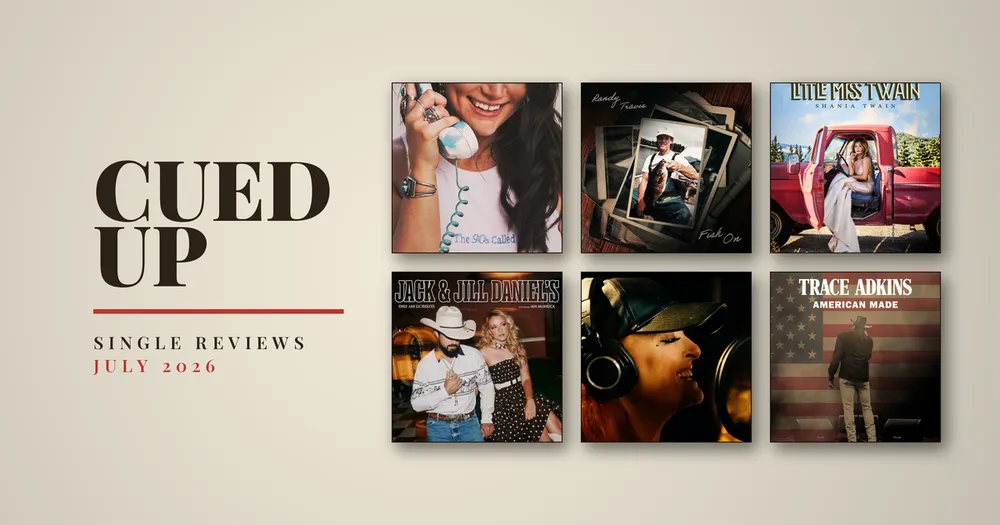
Cued Up is Generation Country’s recurring roundup of new country singles, from major-label releases and returning legends to independent artists making their first real noise. We follow the credits, listen closely and put each record in the context it deserves—who wrote it, who played on it, where it came from and whether it holds up when the story ends and the speakers take over. If it’s covered here, it’s worth a listen.
MAE ESTES / "The 90s Called"
Writers: Aaron Raitiere/Benjy Davis; Producer: Paul Sikes; Label: Blue Highway
She found this one herself, standing in Aaron Raitiere's kitchen talking about how straight-up country used to be — "like writers do when they get onto what they really love" — and asking whether he had anything she oughta hear. Raitiere and Benjy Davis wrote it, and the two of them met around Ashley McBryde's kitchen table during the week that produced Lindeville, which tells you the pedigree without a list; between them sit a Grammy for "I'll Never Love Again" and No. 1s for Cody Johnson and Jake Owen.
This gal is the real deal — just ask Vince Gill. He's been in her corner a while now: he's sung with her at the Opry; he wrote "A Million Tears Ago" with her, cut it on his own record, and put her harmony on it — it came out in March on Lonely's What I Do. His explanation runs one line: she really loves the old-school spirit of the music. Then this month, in a T-shirt and shorts and a borrowed house cap, he carried a griddle cake over to her booth at Noshville, delivered the syrup and the butter, and told her — deadpan, when she pressed him on the temperature — that it was lukewarm. Then he sat down next to her. Somebody filmed it and she put it out with five words over the top: the 90s served me breakfast. Twenty-two Grammys and a Hall of Fame plaque, and he's running plates for her.
The instrument is the reason it all holds up. Estes sings out of the chest — warm and woody, thick enough to sit inside the band rather than float above it — and places it bright and forward, so the twang cuts clean through a heavy kick and bass without ever thinning out. Gretchen Wilson's brass is in there, and Heidi Newfield's, and Terri Clark's habit of hitting a consonant like it owes her money. The verses amble, Womack-like; then the chorus arrives with Jo Dee Messina's forward push and she opens all the way up, no seam showing where the registers change. The vibrato is the tell — she holds a note dead straight and lets a fast little quiver in at the very tail of it, a discipline most singers her age haven't got yet — and even wide open, there's more voice in reserve than she's spending. Vowels stay Southern and unslurred, she slides up into a note rather than dropping onto it, and running under all of it is K.T. Oslin's dry adult wit. She sings the jokes straight-faced, which is the only way this works.
The track's a party — kick drum out front, Joe Spivey's fiddle grinning, the tempo of a room that has already decided to have a good night. It's also sly. Nobody human speaks until the bridge: a jukebox gripes at a neon sign, a phone goes off on a landline jack, a junked Chevrolet turns over and hollers through the gate. Then two rounds of they want their trucks become we want our trucks, and a song about a decade turns into a show of hands.
On the flip side she takes Brooks & Dunn's "She's Not the Cheatin' Kind" and turns every pronoun around. She becomes I, and the woman Ronnie Dunn sang about in 1994 finally gets to tell it herself. That's the Oslin move exactly — hand the woman the first person — from an Arkansas singer who knows precisely which tradition she's claiming. Answer the phone.
SHANIA TWAIN feat. TANYA TUCKER / "Little Miss Twain"
Writer: Shania Twain; Producer: Zach Dawes; Label: Republic Nashville
She wrote this one alone. The verses are a poor kid's inventory: she dreamt of riding horses, black ones shiny as glass, the kind she couldn't afford back then. The chorus is her mother push-starting an old, heavy Chevy to drive her to sing in bars, chain-smoking and coaching it into her, "honey, you're gonna go far," calling her the next Tanya Tucker. But there's a fear running under the prophecy: she hears Janis Ian's "At Seventeen" and wonders if she'll be invisible for life, stuck in a frozen little town where every year someone disappears, five days' drive from the Nashville waiting for her. The bridge is where the title pays off — the big round conference table at a major label, "Little Miss Twain, please sign your name."
Sharon died in a car accident in 1987, before any of it came true. Tucker herself turns up to sing that prophecy back to her. Wistful Mellotron and pedal steel underneath, and an unlikely producer to put them there. Zach Dawes played bass in Mini Mansions and The Last Shadow Puppets, has worked with Brian Wilson and Sharon Van Etten, and earned an Album of the Year Grammy nomination for producing Lana Del Rey's Did You Know That There's a Tunnel Under Ocean Blvd, after work on her Norman Fucking Rockwell! too.
Thirty years after Mutt Lange built her a stadium sound, one album after the digital sheen of Queen of Me, she hired a Los Angeles indie-rock bassist to walk her back toward country. Her framing is that it reaches for the rock and R&B she loved at fifteen and keeps the Western twang. Fifteen tracks, July 24, with Josh Homme and The War and Treaty also aboard. She sounds like she meant every word of it.
TANYA TUCKER, DENNIS QUAID & KRIS KRISTOFFERSON / "On My Way to Heaven"
Writer: Dennis Quaid; Label: Gaither Music Group
Quaid started writing this in the nineties for his mother, finished it for the 2018 film I Can Only Imagine, cut it with his band DQ and the Sharks, then cut it again on his 2023 Gaither gospel album Fallen: A Gospel Album for Sinners. It's a redemption testimony, a man freed from the chains on a broken heart and given a brand-new start — the hard image is the prison of it, a solitary cell where he's sentenced "by the judge and jury of myself" — bound now for heaven and, in the last verse, turning to ask whoever's listening to come along. Kris Kristofferson is why this version is the one that stays. His vocal was recorded and his performance filmed in Malibu in 2019, with Tucker — who had the vision for the video's storyline — finishing the rest in Nashville. Getting him took ten minutes: Tucker heard Quaid's record, called Connie Nelson to ask whether Kris was still singing, and had a yes before she hung up.
John Carter Cash, a longtime family friend, directed the video, and the Opry broke its own habit to host the premiere on its big screen, a first for a stage built on live, unscripted performance. His wife Lisa said the session put the sparkle back in his eyes. Kristofferson spent sixty years writing about mortality; here he sings it, Tucker and Quaid on either side. Quaid, an Emmy and two-time Golden Globe nominee with a whole other career as a touring musician, called recording it one of the most meaningful experiences of his career.
RANDY TRAVIS / "Fish On"
Writers: Randy Travis/Ron Avis; Producer: Kyle Lehning; Label: Warner Records Nashville
This is Randy Travis singing: a vault recording made before the 2013 stroke, and his first original recording issued in eighteen years. Kyle Lehning, who produced everything that ever mattered in the catalog, went into the tapes and assembled, remixed and remastered it, with a full album of these behind it. Ron Avis drove Travis's tour bus. That's the co-writer credit, and what the two of them built is a back-porch honky-tonker on fiddle, twangy electric guitar, piano and a wailing steel, close enough to the old records that you could slip it between "Forever and Ever, Amen" and "Deeper Than the Holler" without anyone blinking.
The lyric is an open invitation more than a fishing report: ocean to ocean and all points in between, come along for the ride, room for everyone, chores can wait. To announce it, Randy and Mary hid forty collectible Travis bobbers across Nashville and gave whoever found one an early listen; the week before, his socials had posted a photo captioned with a line about going fishing in the vault and thinking they'd caught something. Forty years past Storms of Life, weeks after the Nashville Palace opened its Randy Travis Room, that voice comes out of the speakers exactly as it left. Nobody's competing for Song of the Year. Everybody's just glad to hear him.
DAN SEALS with ALABAMA / "Still Reelin' (From Those Rock & Roll Days)"
Writers: Dan Seals/Allen Shamblin; Producer: Kyle Lehning; Label: Melody Place
Dan Seals died in 2009. Working with the estate, Lehning lifted his original vocal and built a new duet around it for Dan Seals & Friends: The Last Duet, out August 28, an eighteen-song tribute that also pulls in Luke Bryan, Jamey Johnson, Tanya Tucker, Blake Shelton, Sara Evans, Marie Osmond, John Ford Coley, Suzy Bogguss, Vince Gill and The Castellows, and closes on this one, track eighteen. The title is not a metaphor about his own career. The rock and roll days are the night a boy watched Elvis sing "Blue Suede Shoes" on a black-and-white TV and knew nothing would be the same, and the all-night radio he fell asleep to. What the song's really about is everything downstream of that: empty rooms in the old house, granddad's Chevy, Main Street gone quiet, a man wondering how far he's come and where he still fits. It hits harder knowing it's sung by the man who was once the England Dan half of England Dan & John Ford Coley, a soft-rock star before he ever cut a country No. 1. He was a Texan who played a right-handed twelve-string left-handed, upside down and backwards, as he liked to say, and never had much use for doing a thing the ordinary way.
The co-writer is Allen Shamblin, the pen behind "I Can't Make You Love Me," "The House That Built Me," "Don't Laugh at Me" and Randy Travis's "He Walked on Water." Randy Owen has said he loved the heartfelt delivery in Dan's voice and felt honored to be asked, and Alabama, the most decorated band in country history with forty-three No. 1s to its name, does not lend that voice lightly. There's family history in it too, since Seals's cousin Troy wrote Alabama's "When We Make Love." Owen and Teddy Gentry singing behind a man sixteen years gone could have gone badly. It doesn't.
WYNONNA / "Am I Missing Out"
Writer: Wyatt Moser; Producer: Cactus Moser; Label: ANTI-
From The Hard Truth, out October 2, her first solo album in a decade. Where she made it is the thing to notice: ANTI- is the imprint Brett Gurewitz of Bad Religion built off his punk label Epitaph, and it has spent the years since 1999 housing Tom Waits, Merle Haggard, Mavis Staples and Solomon Burke. Husband Cactus Moser produces, and if that name only registers as "Wynonna's husband," correct the record. He drummed in Highway 101 when they were running off hits, and he has called these sessions the most important work of his career.
The method was to strip away, layer by layer, the lush production of her earlier records, hold the embellishment down and let the storytelling and the vocal carry it. "Am I Missing Out" is the one song on the album she had no hand in writing, credited entirely to Wyatt Moser, the outlier on a record otherwise built by her and Cactus with a circle of collaborators including Sarah Siskind and Melissa Forette. It's a quiet, searching thing: a woman holding onto what she shouldn't, watching the days slip by, eyeing sunshine in the distance she can't quite reach, and wondering flat out whether there's a life out there she's missing. The imagery stays small and interior, her own reflection in the glass, throwing rocks by the river while the rain comes down. She sings someone else's ache like her own confession anyway. The album opens with a prelude called "All Downhill From Ashland," and she is playing Ashland, Kentucky on release day. The best voice of her generation, back where she belongs.
CHARLIE WORSHAM / "Wrap My Porch Around"
Writers: Charlie Worsham/Jesse Frasure/Jaren Johnston; Label: ONErpm
It's a proposal, and Worsham builds it out of specifics rather than sentiment: he's saving every dollar for a pawn-shop ring and cans tied to a C-10, and what he's pitching is a fixer-upper on a half-acre at the edge of town, hound dog howling in the yard, wine from a Dixie cup, the Opry on the radio, one name on the mailbox and eventually two in the tree, a guest room he'll paint blue or pink. That last detail is the whole song, a man talking himself and her toward kids without quite saying it. He cut it two ways, and the sequencing is the argument. The modern-country version is 2:41 and sits third on the record — the domestic dream in radio dimensions. The Travelin' McCourys version runs 5:56 and closes the album at track twelve, more than double the length, the same dream turned into a picking session among friends. The porch, in other words, gets bigger. He's called Once Upon a Second Time Around a record about his relationships — as husband, father and grown son, but also with the industry, his mentors, old friends and his younger self — and "Wrap My Porch Around" is that thesis made physical: marriage, kids, home, inheritance, and musicians playing in a room together.
The dual-version scheme is a deliberate nod: Vince Gill cut "High Lonesome Sound" twice, and Dierks Bentley likes to close records with bluegrass, and both men, Worsham says, have given him a home stage over the last five years — the two he'd most recently joined at the Station Inn. The bluegrass take was cut at Gill's house, where Worsham left his own dreadnought in the case and played one of Gill's old D-18s. He's got the hardware to indulge it — 2024 CMA Musician of the Year, two-time ACM Acoustic Guitar Player of the Year — but the point isn't the trophies, it's that "Wrap My Porch Around" is one of the most autobiographical songs on his first record as an independent artist, out August 7. Play the McCourys one twice.
COLTON DAWSON / "Piece of Heaven"
Writer: Colton Dawson; Label: Warner Records Nashville
Dawson posted a cover of Alan Jackson's "Remember When," it cleared a million views across platforms, and Randy Travis turned up in the comments. Then he opened for Clay Walker at a sold-out Ryman, took two standing ovations, and went on to sign his first major-label deal, at Warner Records Nashville. It follows two earlier singles, "Might Be In It" and "It's Gonna Rain," and the runway behind him is real: support runs for HARDY, Josh Turner and Jake Worthington, and a summer of select dates alongside Lainey Wilson. "Piece of Heaven" is the third single, written when he was sixteen on a houseboat during a fishing trip in Canada, the second song he'd ever finished.
It's a breakup told through what's left in the rooms: a dog on the porch and a swing built for two, then a suitcase in the hallway, a U-Haul in the driveway packed to the brim, her out on the town throwing dirt on his name. The hook — "our little piece of heaven is done gone to hell" — turns the whole domestic postcard sour, and it's a sharp line for a kid whose Instagram still opens with "All Glory to God." He aims all of it at nineties country and none of it at what's currently getting adds, and there are no co-writers, no committee and no producer trying to modernize him. Not the Devin Dawson who turns up further down on the Langley record — this is the one who writes the nineties like he was there, and he wasn't, he was a kid on a houseboat.
EMILY ANN ROBERTS feat. IAN MUNSICK / "Jack & Jill Daniel's"
Writers: Emily Ann Roberts/Jeremy Spillman/Ryan Beaver/Trent Willmon; Label: Records Nashville/Sony Music Nashville
The pun sits in the title and the song runs the nursery rhyme through a distillery. Jill is the prettiest girl in a poor coal town, Jack puts a ring on her, and when she skips town on a midnight train, he climbs the hill not for a pail of water but to build a still and drink off the heartbreak, and the byproduct of getting left turns out to be Old No. 7. Every shot of Jack, the song figures, traces back to a Jill. The craft is in how it stacks its images — coal into diamonds into shine, fire in the heart into burn in the bottle, heartbreak as both a curse and the thing that makes the whiskey — so it plays less like a drinking song than an invented origin myth, a comic tall tale passed off as folklore. At the January 2025 retreat, Ryan Beaver and Jeremy Spillman supplied the premise: maybe Jack made the whiskey to get over Jill. Roberts's own line is that a good country story is allowed to stretch the truth. Producer Brandon Hood cut the original with a first-call Nashville band — Tom Bukovac on electric, Bruce Bouton on steel, Larry Franklin on fiddle, plus Gordon Mote, Chris McHugh and Mark Hill in support — which is why something this tall-tale silly sounds this lively and this polished.
The duet changes what kind of story it is. The solo version on last fall's Memory Lane EP has one singer handing down the legend; the duet lets two voices quarrel and flirt inside it, which is the difference between reciting a tall tale and acting one out. It exists because Roberts learned Munsick was a fan, they sang it together the night before the ACMs, and that back-and-forth convinced her it deserved a proper cut. The voices are built for it: her tone is bright and clear enough to cut a mix, with a smoky lower register she drops into when a line wants it, all of it out of the Smoky Mountains and raised on gospel and Patsy Cline; his is the mile-high Wyoming tenor that slides up into a yodel-kissed falsetto, ranch-raised and unmistakable the second it arrives. A whiskey song with a sense of humor and no hangover.
PARKER McCOLLUM & LEE ANN WOMACK / "Killin' Me"
Writers: Parker McCollum/Monty Criswell/Randy Rogers; Producers: Frank Liddell, Eric Masse; Label: MCA
It's a sultry, self-destructive desire song — one more last time, black dress on the bedroom wall, real love and true lies, "if I can't have you forever, can I have you tonight" — a man who knows he should walk and can't. McCollum has said his wife Hallie Ray is the muse behind the album's love songs, though the lyric plays as something more forbidden than settled. Smoky and seductive is the label's own description of the original, which is why the duet works as an answer rather than a harmony: Womack's voice turns the swoon into a two-way pull. "Killin' Me" comes off McCollum's self-titled ACM Album of the Year, co-produced by Frank Liddell, who is Lee Ann Womack's husband. Womack and her daughter Aubrie Sellers sang background vocals across the record, Aubrie sings behind him on the road, and her youngest, Anna Lise, co-engineered it. The family was in the building long before anyone thought to hand Womack a verse of her own, and the first song McCollum ever learned on guitar came off a Chris Knight album Liddell produced.
The writers are the Texas end of the operation. Randy Rogers has run one of the state's most durable dancehall bands for twenty years. Monty Criswell is a Satsuma, Alabama boy who turned down law school in 1993 and has since put his pen on George Strait's "I Saw God Today," Eric Church's "Hell of a View" and "Like Jesus Does," Scotty McCreery's "Five More Minutes," Craig Morgan's "Tough," Trace Adkins's "Just Fishin'" and McCollum's own "Handle on You." They premiered it at the ACMs in May with Aubrie on harmony. Womack doesn't do favors for material that can't hold her; she showed up, which tells you where the song ranks.
JOE NICHOLS / "Say La V"
Writers: Brett Warren/Jason Sellers/Lance Miller; Producers: Jason Sellers, Joe Nichols; Label: Quartz Hill
He didn't want to record it. Benny Brown heard otherwise, and Brown gets to win that argument: he founded Broken Bow in 1999 and ran it to more than thirty No. 1s, signed Nichols to its Red Bow imprint in 2012, and then, after selling up and losing his wife, called him in late 2020 to say he was starting over and did he want in. Nichols told him to put him in, coach. What Brown talked him into is the loosest thing Nichols has put out in years: a man who's found out about his girl's something-something on the side and walks out on a shrug instead of a screaming match, running through every way there is to say goodbye — bon voyage, adios — before landing on the one he loves most, "I'll call you, don't call me." The one flash of teeth is him hoping it tears her world apart every time a bar band strikes up. Nichols nearly passed: he first heard it over the phone on a school trip with his fourteen-year-old, said it sounded too young, and hung up, then called back twenty minutes later to put a hold on it. The horn section that ended up out front includes Roy Agee, who played for Prince.
Brett Warren is half of The Warren Brothers, and past the serious stuff — "Highway Don't Care," Chris Young's "Sober Saturday Night" — he and brother Brad are two of the four names on "Red Solo Cup," which is the exact muscle a song like this needs: the ability to make something deliberately dumb and completely irresistible. Lance Miller wrote "Drink To That All Night," a No. 1 and the 2014 SESAC Song of the Year, plus Tim McGraw's "I Called Mama." Jason Sellers came up in Ricky Skaggs's road band, made two BNA albums of his own in the late nineties, and has been cut by Lonestar, Kenny Chesney and Montgomery Gentry. Sellers also wrote Nichols's "Sunny and 75," and he owns a third of Quartz Hill alongside Benny and Paul Brown, so when he carried this title into a room in March he was pitching his own label on an artist he'd already given a hit. Sellers calls it the sharp contrast on an otherwise introspective forthcoming album. Roll the windows down.
TRACE ADKINS / "American Made"
Writers: Trace Adkins/Krista Marie Oswald/Johnny Cummings; Producer: Mickey Jack Cones; Label: Caliburn Records
Thirty years past Dreamin' Out Loud, Adkins breaks a roughly five-year non-holiday-single drought with a flag-waver aimed at the nation's 250th, and the debut matched the ambition: the West Lawn of the Capitol for PBS's A Capitol Fourth, backed by the National Symphony Orchestra under Jack Everly. Some distance from the Ark-La-Tex honky-tonks, the oil rig, and the knife accident that cost him a pinky he had reattached at an angle so he could keep playing guitar.
Adkins wrote it with Krista Marie Oswald and Johnny Cummings; she hosts the syndicated series The Song TV, now in its seventh season, telling the stories behind other writers' hits. The two of them also wrote "Blanket of Stars" for Craig Morgan this same season, with Cones producing both. Cones stocks the session with heavyweights, Jim "Moose" Brown on keys and Jeff King on guitar, and builds the track on battlefield snare rolls, stately piano and guitars that come in hot. The subject is labor: farmers, veterans, the people who did the work nobody wrote songs about. Adkins owns one of the four or five great baritones in the format's history, and this is the register it was built for.
THE BAND PERRY & KAITLIN BUTTS / "You Lie (Forever Version)"
Writers: Aaron Henningsen/Brian Henningsen/Clara Henningsen; Producer: Beau Bedford; Label: Nashville Harbor
Kimberly Perry texted Kaitlin Butts and asked her to help re-record it, and what came back is the 2010 breakthrough with a newly expanded second verse written in for Butts. The song is a woman itemizing a cheater's lies in a run of similes — he lies like a Persian rug on a rich man's floor, like a coon dog on the porch, like a penny in a grocery-store parking lot — down to the perfume that isn't hers, and by the bridge she's parked on a mile-long bridge slipping the ring off her finger and flinging it into the water. The signature fiddle line survives untouched, so it still announces itself the way it did on country radio fifteen years ago, but Bedford stacks denser guitars and a fuller arrangement around it and holds the payoff for the bridge, where the two voices finally braid instead of trade. Perry is the arena frontwoman; Butts is the theater kid.
The Band Perry is now Kimberly and her husband Johnny Costello, back with their first new music in nine years and returned to the label where it started, since Nashville Harbor is what Republic Nashville became by way of Big Machine. Last November "If I Die Young" went Diamond on the CMA stage, making Kimberly the only woman with a solo-written Diamond-certified country song. Bedford runs Modern Electric Sound Recorders in Dallas, assembled The Texas Gentlemen for Leon Bridges, Nikki Lane and Paul Cauthen, and led that band behind Kris Kristofferson at Newport in his first appearance there since 1969. Butts, a Tulsa native, turned her third album Roadrunner! into a seventeen-song country reimagining of Oklahoma! with Vince Gill along for a track. She used to belt this song over boys who had no idea she existed. Perry calls it what it sounds like when girlhood becomes womanhood.
ELLA LANGLEY / "Loving Life Again"
Writers: Ella Langley/ERNEST/Devin Dawson; Producers: Ella Langley, Miranda Lambert, Ben West; Label: SAWGOD/Columbia
The title came out of her own mouth as a throwaway. ERNEST asked how she was doing and she said it looked like she was back to loving life again, and everybody in the room heard a song. She had canceled two weeks of dates in 2025 and gone home to Alabama to put herself back together, and Miranda Lambert checked in during the worst of it to tell her she mattered more than the job. Lambert then co-produced the track with her and Ben West, who anchored all of Dandelion, so the mentorship shows up in the credits rather than only the press release.
Devin Dawson fills out the writing room with more range than he gets credit for: he played bass in a deathcore band before he ever moved to Nashville, broke through with the platinum "All on Me," featured on HARDY's "One Beer," and co-wrote Blake Shelton's "God's Country." Langley debuted it at the Ryman in November with ERNEST climbing onstage beside her, and shot the video barefoot at her grandfather's piano in an Alabama field. When the big old world gets to be too much, she drifts back into memory — the song she used to play, summertime-blue skies, home — and just like that she's back to loving life again. It sits on Dandelion, the album carrying "Choosin' Texas," which as of the July 25 chart had tallied a fourteenth week at No. 1 on the Hot 100 — tying Whitney Houston's "I Will Always Love You" and Mariah Carey's "We Belong Together" for the longest run ever by a solo woman with no man on the billing, holiday records aside. She had two more in the top ten alongside it, "Be Her" and the Morgan Wallen duet "I Can't Love You Anymore." A good song about the way back, which is harder to write than the collapse.
RILEY GREEN & HANNAH McFARLAND / "Go Again"
Writer: Riley Green; Producer: Dann Huff; Label: Nashville Harbor
Green teased this one in September of 2024 and people have been asking about it ever since. It's the morning after a one-night thing between two people passing through on tour — last night's red wine still in his head, her flight back to LA and his ride back to Tennessee both waiting — and the whole song is the two of them laying the same choice at each other's feet: leave it a memory and call it the end, or go again. He wrote every word alone, which in this town is worth a mention. The production is deliberately underfed, warm acoustic guitar and some subtle slide, the arrangement left open so the lyric stays dead center, and they trade verses from opposite sides of the same bed rather than harmonizing their way out of it.
Dann Huff produced the parent album, That's Just Me, nineteen tracks due September 18, written and cut during the biggest tour of Green's career and the same stretch that saw him make his acting debut on CBS's Marshals. Hannah McFarland takes the other half. A fellow Alabamian and Green's longtime opener, she released the Broken Hearts EP in early 2025, sang on Brett Young's "In Case You Didn't Know 2.0" and Green's "I Just Need You," cut "Foolin'" with Chase Rice, and has toured behind Kip Moore, Chase Rice and Tucker Wetmore. They played it at CMA Fest and Nissan Stadium sang it back. Green wrote himself a great goodbye song and handed half of it to the woman he's been putting on stages for years; she takes it from him and doesn't give it back.