

Thirty years ago today, on July 26, 1996, Deana Carter arrived with a first single that sounded nothing like a record designed to introduce anyone.
It was nearly five minutes long. It moved in waltz time. It took a teenage girl's desire seriously, then let the woman she became wonder whether the longing she carried was for the boy or for the self she had been before him. It did not hurry, simplify or apologize.
In July 1996, Capitol Nashville had roughly two weeks to change the first chapter of Deana Carter's career.
The safer choice had already been made. “I've Loved Enough to Know” was concise, approachable, the sort of song a record company could use to introduce a singer without asking radio to take a risk. The plan was to get Carter's name on the air, build familiarity, and save the strongest material for later.
Then the radio people told Capitol that later might never come.
There were 29 country singles scheduled for release between July 15 and July 29, the label's promotion chief Bill Catino counted. A new artist could no longer lead with her second-best song and expect anyone to wait around. If Carter was going to get one chance at country radio, the label was told, she had better arrive with the record that made people stop.
The song Capitol chose instead was nearly five minutes long. It was a waltz. Its melody took an unexpected turn in the bridge, its story moved at the pace of memory, and its teenage lovers were not safely theoretical. Nashville had passed on it often enough that its writers had learned to think of it as an album cut.

Deana Carter had learned something about being passed over, too. In the five years since Jimmy Bowen signed her to Liberty Records, she told Billboard, she had gone through the new-artist ritual so many times that she had made four different debut videos. Executives changed. The label changed its name. Carter recorded and rerecorded while somebody else kept deciding whether she belonged on the roster.
“I just survived the cut,” she said when Scott Hendricks took over Capitol Nashville. “I felt the scissors behind me.”
So this was the introduction: a singer on her fourth introduction, carrying a song almost everyone agreed was too much of something. Too long. Too specific. Too strange for a first single. Too honest about what a seventeen-year-old girl might want and remember.
Capitol announced “Strawberry Wine” for country radio on July 29, 1996. The commercial single followed on August 6. Carter dates the record itself to July 26.
It was exactly the wrong song until it became the only possible one.
LUCK, WISCONSIN
The story began with Matraca Berg, who had been writing No. 1 country songs since she was eighteen and had already learned how to place a whole life inside one exact detail. Before “Strawberry Wine,” her songs had been carried by Reba McEntire, Patty Loveless, Trisha Yearwood and Suzy Bogguss. Her partnership with Gary Harrison had already produced “Wrong Side of Memphis”; “Wild Angels” and “Everybody Knows” would follow. Berg was not waiting to become a great songwriter. She was one, reaching back toward a dairy farm outside Luck, Wisconsin, where she had spent part of her summers with her grandparents.
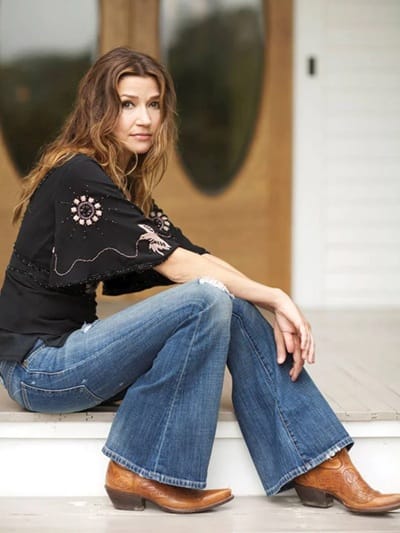
There were aunts close enough to Berg's age that they became something closer to sisters when she visited. As children, they hid among hay bales and played kickball in the loft. As teenagers, they found the gravel pit. There were boys there, and cigarettes, and the sorts of experiments that become either family secrets or country songs.
Berg's grandfather kept Old Milwaukee in an old refrigerator in the milk house. The girls helped themselves. Boone's Farm entered the story, too. So did an older boy working on the farm, and a first love that belonged to one summer because first loves so often do. For the record, Berg's grown-up verdict on the drink itself is unsentimental: “Strawberry wine is terrible.”
Years later, reporters would ask how much of “Strawberry Wine” was true. Berg never had much reason to protect the song from its own life. The farm was real. The boy was real. The cheap wine was real. What she and Gary Harrison did was not transcribe a diary. They found the shape inside the memory.

Berg had carried the title and a couple of lines for some time. During a regular writing date in early 1995, Harrison recalled for the Tennessean's Story Behind the Song series, they began talking about “the passing of innocence and how that relates to life's big picture.” They were not working from the classic Music Row method of choosing a hook and building outward. Harrison said their method was to pick up guitars, tell jokes and stories, and wait for a song to fall out.
This one took four or five hours.
The title did more than identify the bottle. “Strawberry Wine” could hold the whole contradiction: sweetness and fermentation, innocence and knowledge, something green on the vine remembered only after it has ripened and disappeared. The song's narrator is not simply mourning a boy. She is trying to decide whether she misses him, the girl she was with him, or the moment before she understood that everything leaves.
That last uncertainty is what lifts the song out of nostalgia. The farm's fields have grown over. Time has touched almost everything. Yet the memory remains vivid enough to taste, which is not the same thing as wishing to live it again.
Berg knew the emotional territory from the inside. In the finished song, her collaboration with Harrison gave that memory distance and architecture. He had come to Nashville from Memphis in 1973 to attend college, then learned the song business from both sides of the desk. By 1996 he was Mercury Records' director of A&R as well as a songwriter with No. 1 credits including Mark Chesnutt's “I Just Wanted You to Know,” Suzy Bogguss' “Hey Cinderella” and Doug Stone's “I Thought It Was You.” He credited much of his own success to producer Tom Collins and publisher Pat Higdon.
That history matters. Harrison knew what publishers could place, what labels could use and what radio was likely to resist. He still heard “Strawberry Wine” as an album cut. Their partnership made room for autobiographical detail without letting the song collapse into diary, but neither person in the room mistook craft for commercial certainty.
When they finished “Strawberry Wine,” both understood that it was good.
Neither understood that it was a single.
THE SONG NOBODY KNEW HOW TO USE
The objections were not invented after the fact. They were the ordinary rules of country radio in 1995 and 1996.
The song was a waltz, for one thing, moving in three rather than the format's sturdier four. It required nearly five minutes in its full form, a substantial piece of airtime for an established star and an almost comic demand for an unknown singer. The verses were patient. The chorus did not race toward a slogan. And the bridge went somewhere new right where radio likes a song to settle down.
And the story belonged to the girl.
She was not somebody's daughter being warned away from trouble, or somebody's abandoned wife looking back with regret. She remembered her own desire without apology. The song allowed a seventeen-year-old girl to be curious, willing, altered by the experience and still in possession of her story years later.
Berg ran down the verdicts for the Chicago Sun-Times: too controversial, too long, not catchy enough, melodically odd. Nobody went for it. Harrison expected that perhaps somebody — Lorrie Morgan, Patty Loveless, Martina McBride — might use it as a good album cut someday. Berg had been bruised by another collapsed record deal and told her publisher, Pat Higdon, to sell everything. She had once wanted “Strawberry Wine” for herself. At that point, getting the songs out mattered more.
Higdon arranged a pitching event under a tent, inviting label people and artists to hear material. In Berg's telling, exactly one artist came.
Deana Carter knew Berg. They had attended high school together. Carter had heard enough carefully engineered songs during her years in record-company suspension to recognize one that lived beyond its engineering. She heard Berg sing “Strawberry Wine,” and the song hit her “right between the eyes.”
Carter had spent summers on her own grandfather's farm. She had known a boy she was smitten with. The circumstances were not identical, but they did not need to be. The song made the listener supply her own gravel pit, her own September, her own version of thirty looking impossibly old.
In the same Tennessean series, Berg said Carter put the song in her back pocket. When it finally shook loose, she took it into the studio and “killed it.” Harrison heard the same fit, calling it one of those harmonic connections. Carter, he said, was “the perfect voice.”
What Carter heard was the reason the industry objections would fail. “Strawberry Wine” was intensely specific and widely inhabitable at the same time. It did not flatten one girl's memory into a generic coming-of-age song. It trusted that the details were the door.
FOUR DEBUT VIDEOS
There was never much mystery about whether Deana Carter came from music.
Her father, Fred Carter Jr., was one of Nashville's most admired guitarists — that is him playing the guitar figure on Simon & Garfunkel's “The Boxer.” Willie Nelson, Paul Simon, Neil Young, Ray Price, Bob Dylan and members of the Carter Family moved through the family's musical world. She grew up singing in church choirs and school productions, assuming that music would eventually become her work.
An attempt at seventeen fizzled. Carter went to the University of Tennessee and studied rehabilitation therapy, inspired in part by wanting to help elderly people like her grandmother. She became a therapist. The work mattered to her, but the daily heartbreak wore her down.
She returned to Nashville in 1989 and found that being born near the business did not make the business move faster. While trying to become a songwriter, she waited tables, worked in child care and cleaned offices, including the urinals — whatever covered rent and student loans. Jimmy Bowen signed her to Liberty in 1991. Most of 1993 disappeared into demos while the company tried to decide where to put her.
One of those demos reached Willie Nelson, who had known her since childhood. Carter's audition unfolded over dinner and a jam on Nelson's bus, with Willie handing her Trigger. She passed. In 1994, he invited her to Farm Aid VII as the show's only female solo artist. It did not solve the record-company problem, but it was a reminder from one of the people who knew the difference that Carter belonged on a stage.
An early version of her debut finally came out in Europe in 1995. Carter toured Britain, opened for Jimmy Nail and headlined London's Jazz Cafe. Then the company went through major changes: Liberty reverted to the Capitol Nashville name, its Patriot imprint disappeared, and Carter returned from an overseas release to another uncertain beginning at home. Her recordings went through changes with the label.
When the American version finally took shape, Carter did not simply wait to be repackaged. She chose Chris Farren, then based in Los Angeles, because she thought too many Nashville records were beginning to sound alike. Farren heard in her a “freshness, focus and sense of artistry.” Only three tracks survived from the European album. Carter had waited years for an American introduction, and when it came she helped determine how it would sound.
She had written or co-written six of the album's songs and fought to keep its title — Did I Shave My Legs for This?, a joke that told you exactly who she was before the needle dropped. Choosing a Berg-Harrison song to introduce her was not evidence that Carter lacked material of her own. It was evidence of taste: the songwriter in her could hear when somebody else had written the song only she should sing.
By the time Scott Hendricks examined the inherited roster, she was an artist whose debut had become a recurring event without an arrival. Hendricks did not immediately know what to make of the tape. Then the uncertainty became the attraction. Carter's voice, he said, had a “magnetic vulnerability” and did not sound like anybody else.
Carter eventually made peace with the delay. “I'm glad it took this long now,” she said after the breakthrough. “I hadn't lived enough.” The years had not merely postponed the voice Hendricks heard. They had made it.
That vulnerability is the essential instrument on “Strawberry Wine.”
Carter does not sing the opening as though she already knows the moral. The voice sits low and close at the start, sweetness with a little rasp under it, and she takes the first verse at the story's walking pace. She steps up into the chorus instead of launching at it; there is no show note anywhere on the record. She saves it all for the bridge. That is where the song finally asks its question out loud — is it him she misses, or the girl she was — and instead of answering, Carter lets go of the words entirely: one long, unguarded “yeah” trailing off the end of the line, the sound of somebody who has asked herself the same thing and come up empty. It is the only moment on the record where she stops holding steady, and it is the moment people remember.
Farren built the record the same way. It sways instead of marching, acoustic guitars out front, and the band comes in a little at a time — you don't catch the record getting bigger until it already has. Nothing peaks before the bridge does. By the long instrumental finish, it is a full band working, and it still doesn't feel like a different song.
Carter called the full version the country “Free Bird” because the quiet waltz opened into an extended rock finish. The musicians knew in the studio that the song carried unusual weight. They also shared the writers' practical thought: radio would never go for it.
Capitol had its more conventional first single ready.
Then the label's radio advisers listened.
THE STRONGEST SONG
The switch to “Strawberry Wine” was not a romantic rejection of commerce. It was a hard commercial judgment about how little attention an unknown artist could expect.
Bill Catino's promotion team had planned to use “I've Loved Enough to Know” to gain exposure, establish Carter, and return with the bigger record. Radio told him that strategy was obsolete. In a crowded release window, the polite introduction would disappear. A new singer had to come with the song that explained why she existed.
“Strawberry Wine” did that in a way a biography could not.
It placed Carter immediately: contemporary but rooted, gentle without being passive, feminine without packaging the woman into a role country radio already understood. The record did not sound like the other debuts competing for an add that week. Its supposed flaws made it identifiable before a disc jockey said her name.
Capitol's campaign was unusually direct. Because early testing showed a strong response from women, regional promotion representatives planned to hand-deliver cassette singles to every woman working at country stations, along with program directors' and general managers' wives. It was an unmistakably 1996 plan, but the instinct underneath it was right: women heard themselves in the song quickly, and they did not require a marketing department to explain it.
The first chart evidence arrived almost immediately. In the August 9 issue of Country Airplay Monitor, “Strawberry Wine” debuted at No. 70 with 143 detections on 27 stations. That was not a hit yet. It was a signal that a slow waltz by a long-delayed newcomer had made it into the race.
Then listeners began calling.
An August Capitol advertisement in Country Airplay Monitor collected the first reports from programmers. KLLL in Lubbock said it had taken 25 calls in one night and called the song the station's largest request record of the year. WKML in Fayetteville said every third or fourth request was for Carter after only a few days. KSON in San Diego had tried the song in a limited daypart and moved it into regular rotation when the calls came anyway. WYCD in Detroit said it lit up the phones “like a Christmas tree.”
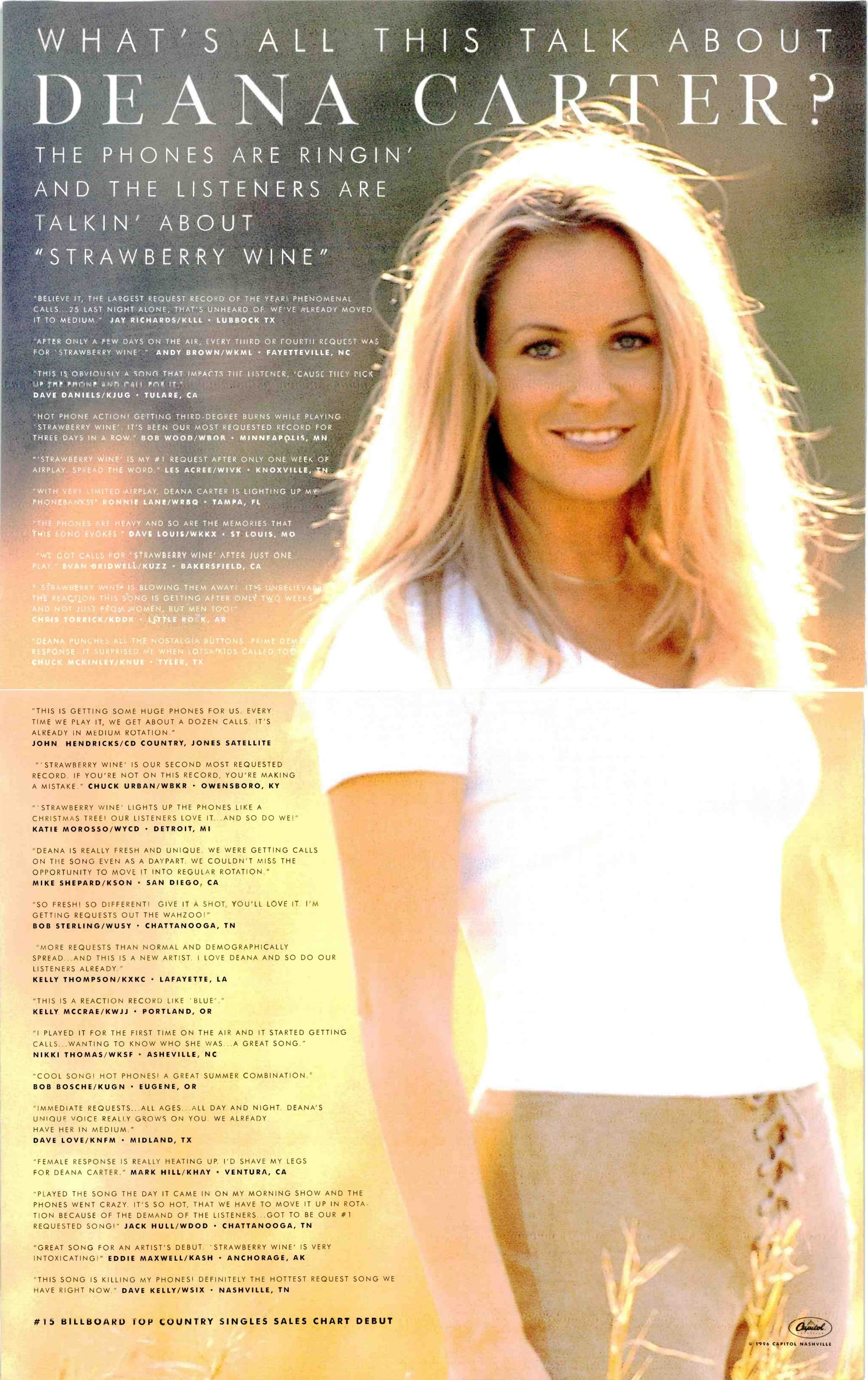
These were testimonials inside a label advertisement, selected because Capitol wanted the industry to see them. They were still evidence of the mechanism that broke the record: not a critic's campaign or an established star's leverage, but women hearing the first chorus and asking to hear it again.
On September 3, the day Carter's album reached stores, she played an acoustic set at Nashville's Tower Records while WSIX broadcast live. A disc jockey ran a strawberry-eating contest. Fans jumped barefoot into a vat of strawberries to begin making wine. It was the sort of promotional spectacle a label creates only after a song's private image has become public property.
Not everyone in the crowds that season was a civilian. Vince Gill has told the story of hearing the record on his car radio, not knowing the singer, and being stopped by it — he learned she was performing at a local record store, changed course, drove over and stood in line to introduce himself. “Your voice sounds so cool,” he remembers telling her. “That song is so good. I just had to meet you.”
The chart climb kept going. By late September, the record had reached No. 26, heard on 151 monitored stations with 2,601 detections for the week. In November it reached No. 1 on Billboard's Hot Country Singles & Tracks chart and stayed there for two weeks. On the separate country singles sales chart, it displaced LeAnn Rimes' “Blue” after that record's extraordinary twenty-week run and held No. 1 for two weeks of its own.
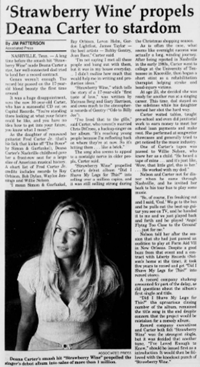
The song everyone thought might be too long for an album cut had become the record that introduced Deana Carter to the country.
WHAT THE VOICE KNEW
There is a reason “Strawberry Wine” could start Carter's career when it is hard to picture it starting anybody's.
The song asks a singer to be two ages at once. The girl in it is seventeen and can't imagine being thirty. The woman singing it knows exactly how short that summer was. Play it too young and it turns into a kid's song. Play it too knowing and it turns into a lecture. Oversing it and it turns into a power ballad, which is the one thing it must never be.
Carter holds both ages at once, and she doesn't pick sides. She doesn't apologize for the girl, and she doesn't correct her from twenty years down the road. She doesn't even answer the song's big question — is it him she misses, or who she was back then? The record leaves it open, because that is how remembering actually works.
That is also why the song outlived the novelty records and the bigger productions of its year. It isn't nostalgia for decoration's sake. It is about what remembering costs. The farm is still right there in her memory, and she still can't get back to it.
The waltz does the same thing the words do. Three-quarter time keeps circling back to where it started, and the story can't. Every measure comes home. She doesn't.
That is a lot of freight for a debut single.
It is also why no safer song could have done the job.
SONG OF THE YEAR
Success did not make the song less unusual. It made the size of the risk — and the wisdom of taking it — easier to see.
The Nashville Songwriters Association International named “Strawberry Wine” its Song of the Year. At the ceremony, Berg heard it placed in a medley with a quarter-century of winners, including songs by Kris Kristofferson and Bob McDill. A memory from a Wisconsin dairy farm had entered the lineage she grew up admiring.
The Grammys nominated Carter for Best Female Country Vocal Performance and Berg and Harrison for Best Country Song. LeAnn Rimes won the vocal award for “Blue”; Bill Mack, who wrote it, won the song award. It was a reminder that two of 1996's defining country arrivals had been carried by songs Nashville initially misunderstood in different ways.
Then, on September 24, 1997, the Country Music Association gave “Strawberry Wine” both prizes that revealed how much it had accomplished. Carter's recording was Single of the Year. Berg and Harrison's composition was Song of the Year.
A year after she survived the scissors at Capitol, Carter came to the CMA Awards nominated for the Horizon Award, Female Vocalist, Album, Video and Single of the Year. She left with the record that launched her career recognized as both performance and writing. Berg became only the third woman ever credited on a CMA Song of the Year winner, after K.T. Oslin and Gretchen Peters. Harrison, who had thought they might have written somebody a useful album cut, now had his name attached to one of the small number of songs country music officially keeps.
Carter's next single, “We Danced Anyway,” also reached No. 1. “Count Me In” wen to #2, and “How Do I Get There” later gave her a third No. 1 from the project. The run — and five million albums sold — established that she was not a one-record accident. But “Strawberry Wine” had supplied the first and hardest proof: listeners would follow her into a story radio had learned to consider risky.
The record changed the scale of Carter's life. It also completed one of the most remarkable songwriting years Nashville had seen. Berg placed five songs at No. 1 within twelve months, the first woman to do it. The writer whose own recording career had been stalled or mislabeled kept finding her voice in the women who knew what her songs could carry. “Strawberry Wine” did not create Berg's stature. It made it impossible for the industry to miss.
Harrison received a Triple Play Award for three No. 1 records within twelve months. His catalog would grow beyond 300 major-label cuts, with sixteen BMI awards and songs recorded by a roll call that ran from Brenda Lee and Conway Twitty to Emmylou Harris, George Strait and Ashley McBryde. The scale is important because Harrison's work seldom announces the labor behind it. On “Strawberry Wine,” his generosity may be the clearest evidence of his craft: he kept pointing back to Berg's life as the source and to Carter as the perfect voice.
WHAT IT PROVED
“Strawberry Wine” is usually remembered as a song about first love. It is also a song about first chances — and about how rarely the music business recognizes one while it is happening.
Deana Carter had not been waiting passively for discovery. She had sung, studied, worked as a therapist, been signed, recorded, re-recorded, repackaged and subjected to four versions of a debut. Matraca Berg and Gary Harrison had not stumbled into a miraculous hit. They had spent years learning how to make experience specific enough to become universal. The song did not arrive because the machinery worked smoothly. It survived several turns of that machinery before the right people could hear how singular it was.
The tent matters for that reason. In Berg's recollection, Pat Higdon invited the industry and one artist came. The song's future depended less on a roomful of consensus than on the right singer recognizing her own life in somebody else's.
The late single change matters, too. Capitol's original plan was rational: begin with something easy, then earn the freedom to be distinctive. Radio's answer was harsher and, in this case, wiser. An unknown artist might never receive a second introduction. Carter had already received several that led nowhere. The strongest song could not be saved for the career. It had to create the career.
Thirty summers later, “Strawberry Wine” still returns to country radio, playlists and stages when July gets hot. Berg has said that every summer people begin requesting it again. The season was built into the song from the start, but repetition alone does not explain the hold. Listeners who first heard it at seventeen now hear it from the age the narrator once considered old. Then their children find it and supply new fields, new boys, new versions of September. The next generation of writers found it too — when Mickey Guyton was building her own drinking song, “Rosé,” she wrote a nod to Carter's record into it, asking herself, “If we don't put strawberry wine in this song, is it even a country song?”
The details remain Berg's: the Wisconsin farm, the older boy, the cheap sweet wine. Harrison's craft holds the years together without calling attention away from the life inside them. The voice remains Carter's: open, slightly weathered, refusing to choose between pleasure and loss. Farren's record still makes nearly five minutes feel like the length of one memory returning.
Thirty years later, Carter can begin the song almost anywhere and a room understands. Berg's summer has not stopped being hers. Harrison has not disappeared behind the story. Carter's voice has not aged out of either the girl or the woman. The record holds all three, which is why listeners have been able to find themselves inside it for thirty years.
That was the introduction.
It still is.
Sources: Chet Flippo, “Deana Carter Finally Gets Her Debut,” Billboard, July 27, 1996, pp. 26, 30 and 90; Billboard, April 29, 1995, and August 10, October 12, November 9, November 16, November 23, November 30 and December 28, 1996; Ken Beck, “Deana Carter Serves a Fine ‘Wine,'” The Tennessean, December 8, 1996; Dave Paulson, “'Strawberry Wine' Story Was Berg's,” The Tennessean, August 7, 2016, p. E8, adapted from Bart Herbison's interviews for the Nashville Songwriters Association International's Story Behind the Song series; Robbie Woliver, “Strawberry Wine, Women, and Song,” Country Weekly, January 28, 1997; Dave Hoekstra, “‘Wine' and Notices,” Chicago Sun-Times, September 14, 1997; Jim Patterson, Associated Press profile of Carter, January 12, 1997; Chris Kraft, “The Legacy of Strawberry Wine in American Music,” Garden & Gun, August 2021; Country Airplay Monitor, August 9, August 30, September 6, September 27 and December 13, 1996; Radio & Records, September 20, 1996, p. 62; 32nd Academy of Country Music Awards program, 1997, p. 110; Gary Harrison biographical materials published by The Bluebird Cafe and Famous Music; Nashville Songwriters Hall of Fame and Country Music Hall of Fame profiles of Berg; CMA historical winner records; Recording Academy artist and award archives; David Zimmerman, CMA Awards report for USA Today, September 26, 1997.