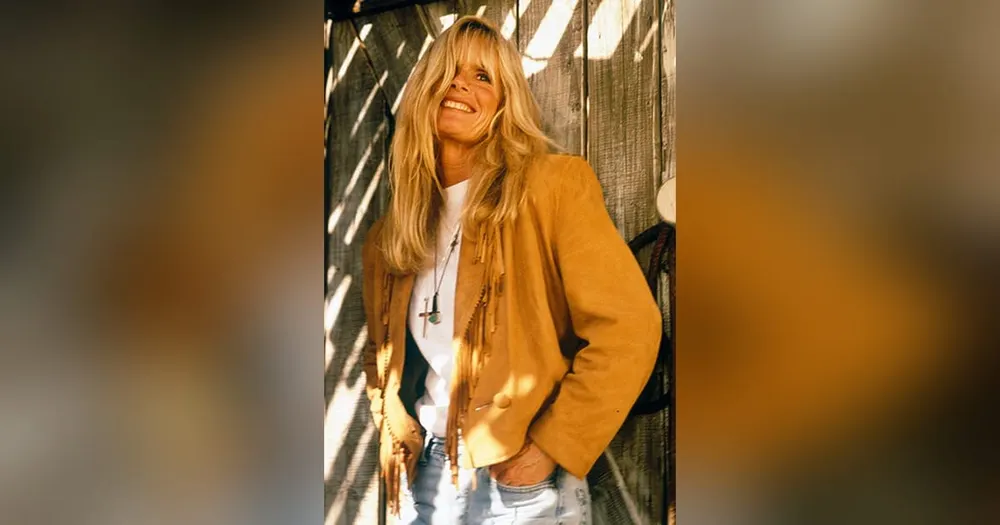
She sang the biggest single of 1981 and didn't write a word of it. Nearly everything she did write, she handed to somebody with a bigger name — Streisand, Sinatra, Kenny Rogers, Reba. This is the story of the catalog behind the voice.
On the night of the 24th Grammy Awards, February 1982, a limousine sat idling outside the Shrine Auditorium because the zipper on Kim Carnes's tuxedo pants had broken. She was dressed for the biggest evening of her life — black tux, black boots, a slash of leopard print — and the car could not move, so her husband and her producer went to work. Dave Ellingson, who had married her fourteen years earlier and written half her catalog with her, and Val Garay, who had produced the record that put her there, crouched down and fixed her trousers, and then she walked in and won the two biggest awards in American music.
She got to keep half of what they meant. Record of the Year went to the record — to Carnes, who sang "Bette Davis Eyes" into a nine-week phenomenon, and to Garay, who produced it. Song of the Year went to the song — to Donna Weiss and Jackie DeShannon, who had written it back in 1974, seven years before Carnes ever touched it. That is the honest way to split those trophies, and nobody has ever argued otherwise. But look at the shape of the evening. The most famous thing Kim Carnes ever sang, she did not write. When Garay went up to accept, the orchestra played him off before he could finish thanking her. And the songs she actually wrote were, that very night, out in the world doing their work in other people's mouths.
She has spent a career as the person who made the thing first and watched it leave in somebody else's voice. In the Hollywood songwriting rooms of the early seventies, the unit of currency was the demo — the rough version you sang so a publisher could imagine a bigger name singing it later. Carnes was one of the best demo singers in town, and the pattern set in early and never really broke: she'd cut a song, and the song would walk out the door with a marquee attached. It happened with Streisand. It happened with Frank Sinatra. It happened, most improbably, with Smokey Robinson, who once explained his own biggest solo hit in one sentence: the record that went number one for me is a demo for Kim.
She turns eighty-one this month, and it is long past time somebody told the story with the songs in front and the one enormous hit off to the side.
THE GIRL WHO ALREADY KNEW
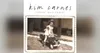
She was three years old and singing on a local television variety show when she decided the matter, permanently. "I just got hooked on the whole thing at that tender age," she said decades later. There is a photograph from around then of a small girl on a toy car, grinning like she's already read the last page. Carnes found it going through her mother's keepsakes and loved it enough to put it on a record. The car was a toy honeymoon car; the wedding being staged that day was to the boy next door, a kid named David Lindley, who grew up to be the most beloved slide guitarist of his generation. She was certain, at three, that her life would be music, and she turned out to be right years before anyone was willing to agree.
She grew up in San Marino, a starched and moneyed pocket of Los Angeles County where a girl got classical piano and not much else in the way of encouragement. Her father, James Raymond Carnes, was an attorney; her mother ran a hospital. Neither understood the child they had. "My mother didn't get my career," Carnes has said, "and my father, who was an attorney, didn't think singing and writing was even a job." She did the acceptable thing with the piano and then the unacceptable thing with the rest of it — writing songs, singing at school functions, cutting jingles and demonstration records before she was old enough to know how odd that was.
There's a story she tells about the first time she tried to make a record, skipping school with a friend named Jan to cruise the Sunset Strip, the two of them under the impression that a recording studio and a record company were the same thing. They found a place, walked in, announced they wanted to make a record, and were told to come back that night with a hundred dollars each. "So we went home and talked our parents out of $100 each and came back," she remembered. She sat at the piano, Jan played bongos, they cut three songs, and the man told them he was leaving for Australia for six months but they'd be his first project when he returned, and he'd make them big stars. Five months later she went back to check. The place had already turned into a travel agency.
Her first actual record, in 1967, was a duet with Art Linkletter's son Bob called "Mystic Winds of Nowhere." "Needless to say, it went nowhere," she said, and pinched her nostrils shut to rate it. By then she had already spent a year inside the New Christy Minstrels, the scrubbed folk juggernaut she'd auditioned into in 1966 and never once pretended to enjoy — a year, as she remembered it, spent "singing about slavery with eight other kids with these big smiles pasted on our faces." What redeemed it was the lineup. Standing in it were a young Kenny Rogers and a singer named Dave Ellingson.
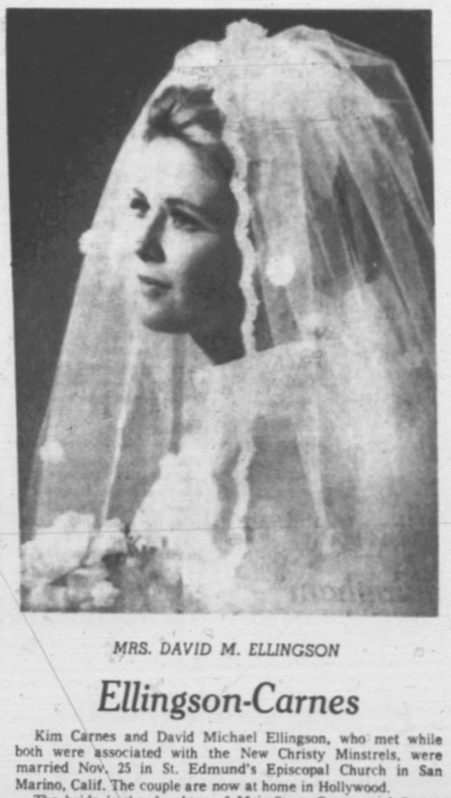
Carnes and Ellingson married on November 25, 1967, at St. Edmund's Episcopal Church in San Marino — she wore a gown she'd bought in Germany on tour, honeymooned in Santa Barbara — and left the group to become a duo, Kim & Dave: husband, wife, and writing desk folded into one working unit. Their first steady gig was a Manhattan Beach club called The Fringe, where the stage was a rowboat bolted on top of a grand piano and they climbed up into it to play five sets a night. She used to sing "More Love" up in that rowboat, years before it would mean anything to anyone.
THE ROOM
Her real education happened in a rented room. Carnes signed a publishing deal with the producer Jimmy Bowen, and Bowen dropped her into the demo rotation with the other young writers on the roster — among them two future Eagles, Glenn Frey and Don Henley, and their running mate J.D. Souther, none of them anybody yet. "Hollywood, in the '70s, was the mecca for songwriters," she has said. "We all shared demo time and sang on each other's songs. The spirit was everybody rooting for everybody else." They ate at a Hollywood dive called Martoni's and traded verses and waited. And the trade she worked steadiest in those years was the one twenty feet from the spotlight: session background singing, alongside Maxine and Julia Waters — the family of backup singers the world finally met decades later in 20 Feet from Stardom.
She waited a long time. Her records went nowhere and the frustration was real — everybody in the business seemed to love the songs, she'd say, right up until she released them herself, at which point they vanished. One night at Martoni's, low, she got it from Bowen straight. "It might not happen on this album, and it might not happen on the next one," he told her. "You might have to do a lot of work before this happens." She has said she never took the warning as bad news. She never had a moment's doubt it would work.
The first proof that the songs, at least, would find a home came in shapes she couldn't have drawn up. The first artist to ever record one of her compositions was Kenny Rogers, back in his First Edition days. Her first cut to reach a wide audience arrived in 1971, not in her own mouth but in Big Mama Thornton's — "Sing Out for Jesus," on the soundtrack of the road film Vanishing Point, sung by the blues matriarch who'd cut "Hound Dog" before Elvis got to it. Carnes has been cheerfully baffled by that one ever since. "I don't know where that song came from. I am not a religious person," she said. "When I play it for friends who know me now, they look at me and go, Huh?"
That same year, Bowen put her voice somewhere stranger still. The Sugar Bears were a bubblegum act invented to move boxes of Post's Super Sugar Crisp — a cartoon quartet fronted by the cereal's mascot — and Carnes was one of the real humans behind it, writing several of the songs and singing as a character named Honey Bear, alongside Mike Settle from her old folk-group days. For a stretch there her voice was coming off the back of a cereal box, on flimsy cut-out records kids punched out and spun. Her songs kept going into the world under any name but her own; this time the name was a bear.
WE NEED TO TALK ABOUT DAVID
Before the hits, a job taught Carnes and Ellingson how to hold a room that hadn't come to see them. Not long after The Partridge Family turned a twenty-year-old named David Cassidy into a global scream machine, the two songwriters were hired to open his weekend concerts and sing behind him, flying red-eyes with a teen idol who spent his weekdays being Keith Partridge.
The first show set the terms. "We were greeted with thousands of screaming girls: 'We want David!'" Carnes recalled. "It was like, 'Oh, shit! What are we doing here?'" Ellingson worked out the fix on the spot, stepping to the mic to explain that David was backstage getting ready and wanted everyone to listen to his friends' songs while he prepared. It bought the newcomers their fifteen minutes. So did a bit of guerrilla marketing: the couple ghost-wrote a column, "Kim and Dave on Tour with David Cassidy," for a magazine under the Tiger Beat umbrella, Carnes sitting up in bed inventing the fan questions and then answering them herself. What she kept from the tour wasn't the hysteria; it was the man under it, who envied them a freedom his fame had priced out of reach. "The problem," she remembered him saying, "is my name is David Cassidy, and nobody takes what I do seriously." She'd come to know that complaint from the inside.
OTHER PEOPLE'S VOICES
A&M signed her and put out records the critics liked and buyers ignored. Sailin', in 1976, was produced by Jerry Wexler — the man who'd recorded Aretha Franklin — and he was smitten. "I don't think I've ever enjoyed greater rapport with a singer," Wexler wrote later. "A nod of my head and she understood what I was saying. She's a fine musician, her sultry voice a marvelous instrument." None of it sold. Her last album before the breakthrough, St. Vincent's Court, moved about forty thousand copies; not one of her seventies records cracked the Billboard 200.
The songwriting, meanwhile, was quietly getting rich off her demos. Executives kept hearing the rough cuts and picturing bigger names, and the bigger names kept saying yes. "Love Comes from Unexpected Places," a Carnes–Ellingson ballad, won the grand prize at the American Song Festival and Best Composition in Tokyo — and then went to Barbra Streisand, who cut it in 1977 and came back for their "Stay Away" the year after. Frank Sinatra recorded a Carnes–Ellingson song; Nancy Sinatra cut one of Ellingson's; Anne Murray, Rita Coolidge, Johnny Mathis, and Engelbert Humperdinck all dipped into the catalog. On an Andy Williams album she wrote the song, arranged the vocals, and sang the backgrounds herself — writer, arranger, and backup singer on a track that went out under his name. The writing fit almost any mouth — Sinatra's phrasing, the hard-rock swagger of Bad Company years later — every mouth but her own.
GIDEON
The break, when it came, came through the folk group she'd been embarrassed to join. At a party in the spring of 1978, Carnes fell into conversation with Kenny Rogers, by then the biggest crossover act in the country, and he asked her and Ellingson to write him an album — not a few songs, a whole one, built around a fictional cowboy.
They spent six months on it. They read Western histories, studied photographs, and screened The Misfits on a loop for the Gable of it. "We came up with a character who's a modern cowboy," Carnes said, "something like the Gable character with some rascal in him, like the Maverick character James Garner used to play." They named him Gideon Tanner and wrote a life for him — the record opens at his funeral; somewhere in the middle he does time for cattle rustling — and Carnes and Ellingson wrote every song on it. When Rogers heard the demo she'd sung, he stopped the tape after one track and asked her to sing it with him. The song was "Don't Fall in Love with a Dreamer," and it went to No. 4 pop, No. 3 country, No. 2 adult contemporary. Gideon went platinum and kept climbing — three million copies, by the accounts that have followed it — and made Rogers's year. "To get to write a whole album for somebody of that status," she said, "is insane." Over the years Rogers would record thirteen of her songs.
It also made the invisibility permanent: her authorship kept being news even to the people closest to it. Rogers admitted he'd had no idea she could write like that until the album landed in his lap. Decades on, Deana Carter told her the same thing from the other side, on a shared bill in Mississippi — I had no idea you wrote that entire album for Kenny. As long as I've known you, I never knew that. Carnes, for the record, has never accepted the moral of her most famous song. "I'm a dreamer, all my friends are dreamers," she's said. "I think it's a wonderful thing to dream big."
The duet cracked the door, and she shoved through it with a cover. In 1980 she cut Smokey Robinson's "More Love" — the song from the rowboat — and it became her first solo Top 10 hit. Radio played it partly because so many listeners assumed the raspy voice belonged to Rod Stewart, and partly because the Rogers duet had made her, at last, a name. The purists sniped that she was chasing formulas, recycling an R&B oldie off the back of a superstar duet, and she was in no mood to apologize. "You can't say no to an opportunity to make a single with a superstar like Kenny Rogers," she snapped back. The real answer was underneath: "I have all these songs I want people to hear." She had been the source for fifteen years. She wanted, for once, to be the destination.
A DEMO FOR KIM
Smokey Robinson likes to tell a story on himself.
He was so taken with what Carnes did to "More Love" that he wrote four songs with her in mind and carried them to a producer's studio to cut demos she could hear. One was "Being with You." The producer, George Tobin, listened and wouldn't give it back. Let Robinson tell it: "I said, 'No George, I wrote it for Kim.' We went through fifteen minutes of, 'No you,' 'No Kim.' Finally, he said, 'Come to my studio tonight, we'll make a demo for Kim.'" Robinson went. Robinson sang it. Tobin released it — on Robinson. "The record that went number one for me," Robinson said, "is a demo for Kim."
It reached No. 2. The only thing standing between "Being with You" and the top of the chart, that spring of 1981, was a song Kim Carnes was singing that she hadn't written either.
THE BORROWED FACE
"Bette Davis Eyes" had been sitting around since 1974, when Jackie DeShannon and Donna Weiss wrote it and DeShannon cut it in a loping, vaudeville-ish arrangement nobody remembers. Weiss slipped Carnes the demo with something else on the tape, almost as an afterthought. There was very nearly a toll on it: George Tobin — the same producer who'd talked Smokey Robinson out of "Being with You" — offered to deliver Carnes for the song if the writers signed over half its publishing. Weiss and DeShannon refused, and Carnes only learned of the maneuver years later, when Weiss phoned to tell her. "Thankfully," Carnes said, "it didn't happen." She loved the lyric and wanted to gut the melody. "At rehearsal I said, 'This sounds like a 1950s song,'" recalled her keyboard player, Bill Cuomo, who moved it onto a Prophet-5 synthesizer and found the icy signature hook. Carnes has always been careful to hand him the credit: "The minute he came up with that, it fell into place. Everybody went, 'That's it!'"
The band rehearsed it three days and cut it live in essentially one take — voice, percussion, synth, all at once, no overdubs. The night they worked it up happened to be the night John Lennon was murdered; someone walked in mid-rehearsal and told them. The core four in the room — Cuomo, guitarist Josh Leo, drummer Craig Krampf, and Ellingson on harmony — knew right away they had something. The record went to No. 1 and stayed at or near the top for nine weeks, the biggest single of 1981 and, by Billboard's math, second only to "Physical" as the biggest of the decade. The critics reached for the voice every time. Newsweek's Jim Miller called it "a hoarse shrug of pleasure." Time's Jay Cocks noted approvingly that "she does not try to camp it, or torch it." Karen Stabiner, in Rolling Stone, heard in the rasp "a fault line running through it."
And then the strangest tribute of her career came in the mail. Bette Davis, seventy-three, wrote to thank her. "I received a call from Ms. Davis after the song hit the airwaves," Carnes remembered, "and for many years, she and I would visit each other." Davis, oblivious to radio and MTV until her grandchildren told her, wrote to all three of them — Carnes and both songwriters — to thank them for making her "a part of modern times"; the record had made her cool to the grandkids, which delighted her more than any review ever had. After the Grammy sweep she sent each of them a single rose. "It was just fabulous," Weiss remembered. The two women became friends, and Davis hung Carnes's gold and platinum records on her own wall. What Carnes says she took from the older woman was spine: "I learned how to stand up for my principles in dealing with the music industry." Shortly before Davis died in 1989, Carnes stood at a tribute in her honor and sang the song to her face — the one night the borrowed face and the woman it was borrowed from shared a room.
THREE AT ONCE
For one week in January 1985 she did something no one had done: three simultaneous singles on the Hot 100, in three different formations. Solo, with "Invitation to Dance." As a trio, with "What About Me," alongside Kenny Rogers and James Ingram. And as a duo, with "Make No Mistake, He's Mine" — a Streisand collaboration, and a song Carnes had written.
She wrote it in about two hours, terrified of losing it before she could get it down. "I was so afraid I would lose it if I got up from the piano that I yelled out, 'Somebody please bring me a yellow pad and a pencil!'" she said. "I knew, as much as I could ever know anything, that it was the only song we could ever sing together." Two years later Rogers called again — he was cutting a duet with Ronnie Milsap, did she have anything two men could sing? A one-word change turned "He's Mine" into "She's Mine," and Milsap and Rogers took it to No. 1 country and won a Grammy for it. "Who knew," Carnes said, "when I got a call to write a song for Barbra Streisand, that it would end up being a Number One country record." The handoff again, and this time it landed in Nashville.
That same season she stood in a circle at A&M Studios for "We Are the World," fighting a sinus infection through the two top notes at the end of her line and singing it anyway, beside Huey Lewis and Cyndi Lauper. "I felt horrible," she said, "but there was no way I was going to stay home."
By then her sons were in the grooves, too. On 1985's Barking at Airplanes, the voice that opens "Crazy in the Night" — the near-top-ten hit — belongs to her boy Collin, and his brother Ry, named for Ry Cooder, sings with his mother on "Rough Edges."
THE TRADE
The hits thinned as the decade wore down, and Carnes did the thing that defines the back half of her life: she followed the songs to the town that valued them most. View from the House, in 1988, turned back toward the folk and country she'd started in, sparked by an album she couldn't shake — Rosanne Cash's Seven Year Ache — and made room for two John Prine covers, one of which flattened her. "The speed of the sound of loneliness? Lyrically, that blew me away."
In May 1994 she and Ellingson left Los Angeles for good, buying a Williamson County estate that had once belonged to Jimmy Buffett. The move began in grief. "We were in a couple of days and literally the movers had been gone about an hour when I got a call from California that my dad had died," she said. "It was just a complete insane way to start a move." It was, in another sense, a homecoming she'd been circling for years — her first chart single, the Gene Cotton duet "You're a Part of Me," had been cut in Nashville, and so had "Don't Fall in Love with a Dreamer." The town had been recording her for two decades before she admitted she lived there.
What had started as an accident of the business became, in Nashville, a trade she chose on purpose. She put the whole thing plainly: "I wasn't writing country songs, but country artists were recording them." It had been true since the late seventies: Dottie West cut one of her songs in 1979, and in 1980 Loretta Lynn — Owen Bradley producing — recorded the Carnes–Ellingson "What Am I Gonna Do" on Lookin' Good. She and Donna Weiss — her "Bette Davis Eyes" co-recipient — wrote "The Heart Won't Lie," and Reba McEntire and Vince Gill took it to No. 1 in 1993.
"Still Hold On," a song she'd first cut herself on Mistaken Identity, got passed hand to hand by Tanya Tucker, Sawyer Brown, and Suzy Bogguss. Pam Tillis cut her "No Two Ways About It." Deana Carter closed her five-million-selling debut with "To the Other Side," a Carnes–Greg Barnhill co-write; Carter, who put Carnes and Matraca Berg on the record together, called the two of them her "creative sisters." Lila McCann sang "Just One Little Kiss." Tim McGraw recorded "You Don't Love Me Anymore," with Carnes singing behind him. Collin Raye cut "Gypsy Honeymoon" — a song she wrote with her son Collin, and mother sang the backgrounds on the son's song. Carolyn Dawn Johnson took "Little Bit of This, Little Bit of That," and Kevin Sharp recorded one for his 1998 album Love Is. She co-wrote with a Who's Who — Matraca Berg, Kim Richey, Al Anderson, Jeffrey Steele, Greg Barnhill — and started turning up on small stages in the round with them, telling the stories of who ended up cutting what.
The town, at least, knew whose room it was. Nancy Sinatra put a finger on the thing that separates a Carnes song from the pack: "Her songs can turn a corner in a few bars, not just verse, chorus, verse. She always surprises us." Jackie DeShannon — who wrote the song that made her famous, and whose "When You Walk in the Room" became a No. 2 country hit for Pam Tillis in 1994 — called her "the perfect voice with the perfect emotion to propel the record." Melissa Etheridge admitted a Carnes song "used to bring me to my knees. I wanted so badly to sing a song that would make people feel that way." The peers never had the amnesia the public did.
THE ONE SHE KEPT
Then there's the record she wouldn't hand to anybody.
In 2004, thirty years after she started cutting demos for other people, Kim Carnes made Chasin' Wild Trains — a dozen songs, every one written or co-written by her, self-produced on a homemade imprint named for the family dog, built out of the friendships that had carried the rest of her Nashville life. She sold it off the stage at her own shows. Europe treated her like the legend America kept misplacing. "I've really gone full-circle," she said around then, "and am back to being a true singer-songwriter. It makes me so happy to work with my best friends." The face she chose for the cover was that three-year-old on the toy honeymoon car — the girl who already knew.
That record gets more than a paragraph at the end of somebody's life story; our full review of Chasin' Wild Trains runs separately. The short version: the woman whose whole working life was the demo finally cut one she made for herself, and kept it.
She never stopped giving songs away either. The year after Chasin' Wild Trains she wrote and sang a barely-heard number called "The Silver Cord," a co-write with the Nashville songwriter Hunter Davis — whose own lyrics have gone to Willie Nelson and Reba McEntire — for the soundtrack of Loggerheads, an indie drama about a birth mother and the grown son she'd given up for adoption. The old phrase means the tie said to bind a body to its soul; in her lyric it opens outward — family and estrangement, the prodigal come home — and its sharpest turn is a confession about the rest of us: the cord holds whether we honor it or not, and we spend our lives building walls against the one thing that never stops pulling. It all gathers up under the refrain: "a silver cord connecting everyone." And it is among the most beautiful things she ever put her voice to: a melody that keeps lifting where you expect it to settle, the way her best ones always have, carried in the softest register that worn voice owns. Nobody needed her to make it that good. She did anyway. Nobody put it on a chart; the song deserved one. Shelve it beside Emmylou Harris's "The Connection," where Randy Sharp and Jack Routh run the same idea through solid matter — their song travels from the heel of a boot up through a chair, along a wall, out the door and down every road in America to one balcony rail in the city, an unbroken chain of touching things between two people who never let go. Carnes says the cord is spirit; Sharp and Routh prove it with furniture and asphalt. Two answers to the same question, and both belong on the short list of songs a lifetime of listening shouldn't miss.
The Rogers story got a last chapter no one could have scripted. He died in March 2020, and in 2023 his widow collected his final unreleased recordings into a posthumous album, Life Is Like a Song. The very first sound on it — the opening track of Kenny Rogers's farewell — is a hard-driving thing called "Love Is a Drug," which Carnes wrote with Tim Nichols and Josh Leo. Leo is the guitarist who cut "Bette Davis Eyes" beside her in 1980; four decades on, he was still writing with her. And the man who'd first heard her write on a Minstrels tour bus, and staked a whole album on her with Gideon, chose one of her songs to open the record he left behind — released three years after he died.
There's a coda writing itself as we speak. This October, a British label puts out Universal Songs: The A&M, EMI America & MCA Years — the first box set of her career, ten discs covering 1975 to 1988, much of it music that has been out of print and nearly impossible to find on CD for decades. It was assembled with her full cooperation, down to a foreword in her own hand, and the copy selling it leans on David McGee's old line about the voice: "worn, aged, soulful, defiant, utterly lacking smooth edges." A catalog the business let slip out of reach is being pulled back together and handed to her, in a box, with her name on the front and nobody else's.
Carnes and Ellingson never stopped writing, and this year, after three decades in Nashville, they moved back to California. At eighty-one she's still married to the man she met in the folk group she couldn't stand, still working. The motto they've kept for nearly sixty years is two words: laugh a lot. The public will always know her for four minutes she didn't write. Run the tape of the last half century, though, and the person who comes through isn't the voice on that one enormous single — it's the writer standing just off the mic, the one who made the song first and handed it on. "We're the luckiest people in the world," she said once, about getting to do the only work she'd have done whether it paid or not. She knew that at three, up on the toy car, grinning like she'd read the last page. Everybody else needed a few more decades.
Keep up with all things Kim Carnes at her website and Facebook page.
ALBUM REVIEWS
 Jared Ingersol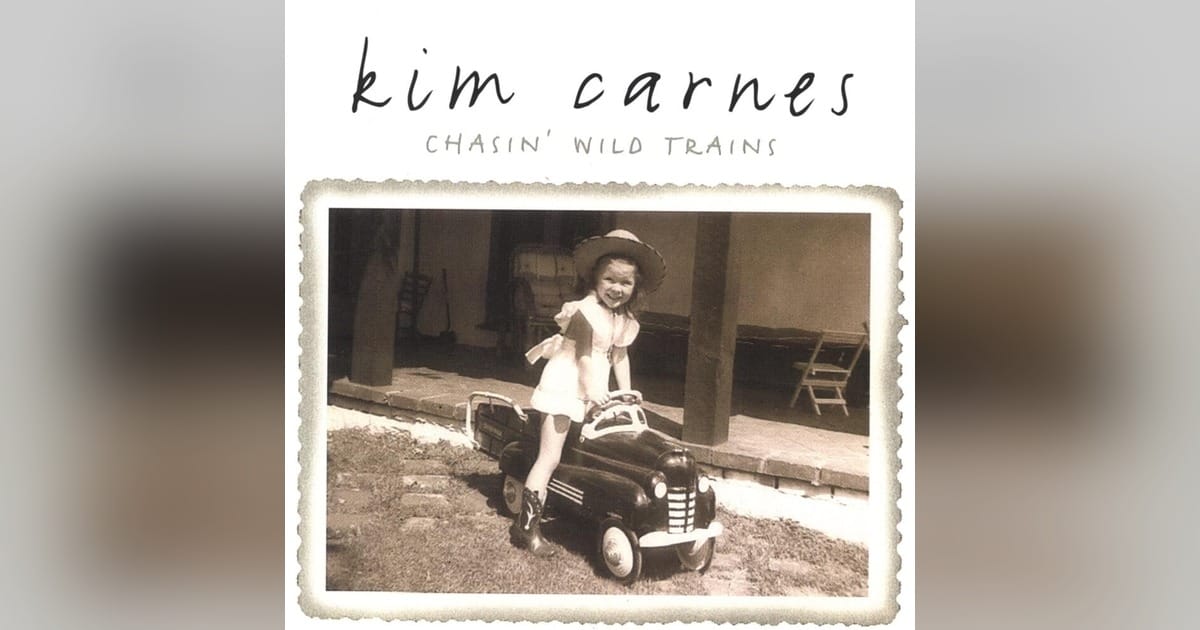
RECOMMENDED LISTENING & VIEWING
"Gideon Tanner" - Kenny Rogers
"More Love" — Kim Carnes
"Stepped Right In It"
"Gypsy Honeymoon" - Collin Raye
"Make No Mistake, She's Mine" — Ronnie Milsap & Kenny Rogers
"Love Is a Drug" — Kenny Rogers (the posthumous farewell's opening track, 2023)
"You Don't Love Me Anymore" - Tim McGraw
"Still Hold On" — Tanya Tucker
"Little Bit Of This, Little Bit Of That" - Carolyn Dawn Johnson
"To The Other Side" - Deana Carter
"You're A Part of Me" - Anne Murray
"If I Was an Angel" — Kim Carnes (from Chasin' Wild Trains)
"The Silver Cord" — Kim Carnes (from the Loggerheads soundtrack, 2005)
"Divided Hearts"
"Sing Out for Jesus" — Big Mama Thornton (the very first cut, 1971)
Sources: Grammy.com; The Tennessean — "Carnes: Band shared joy of chart-topping Grammy winner" (February 11, 2007), "Carnes has got Music City eyes" (October 9, 1994), "Kim Carnes makes a quiet comeback" (January 12, 2001, by Peter Cooper), and the Chasin' Wild Trains review (January 10, 2005); The Flint Journal, "Breaks make 'More Love' right move for singer," by Dennis Hunt (August 10, 1980); Wisconsin State Journal / Fremont Tribune, "Kim Carnes now big star," by Yardena Arar, AP (August 1980); Daily News, "She's got 'Bette Davis Eyes,'" by Andy Secher (June 23, 1981); The Des Moines Register (March 6, 1994) and The Plain Dealer (March 18, 1994); The Atlanta Constitution (December 8, 2006) and The Index-Journal (March 22, 2015); The Free Lance-Star (April 25, 2013); Douglas County Sentinel (April 21, 2017); wedding announcements, Independent Star-News (November 26, 1967) and The Register-Guard (December 24, 1967); Rolling Stone (2015 and 2017); PopMatters, "Where the Heart Is," by Christian John Wikane (2017); Blair Jackson, "Classic Tracks," Mix (September 1, 2003); Mike Ragogna's interview with Smokey Robinson, The Huffington Post (August 26, 2014); Jerry Wexler with David Ritz, Rhythm and the Blues (1993); Newsweek (Jim Miller), Time (Jay Cocks), and Rolling Stone (Karen Stabiner); Bette Davis, This 'N That (1987); Songfacts and Jackie DeShannon's account via Uncut; Deana Carter interviewed in Rolling Stone (2018), with the "To the Other Side" credit confirmed via Taste of Country and The Boot; Keith Tuber, Orange Coast (1993); box-set details and the David McGee quotation via SuperDeluxeEdition and the Universal Songs release materials (Demon/Edsel, 2026); "The Silver Cord" (co-written with Hunter Davis) via the Loggerheads (2005) soundtrack and AllMusic credits; Kenny Rogers, Life Is Like a Song (UMe, 2023), via Billboard and Universal Music materials; Loretta Lynn's Lookin' Good (MCA, 1980) credits; additional cut credits (the Sugar Bears' Presenting the Sugar Bears, 1971; Andy Williams; Johnny Mathis; Engelbert Humperdinck; Bad Company's Company of Strangers, 1995; Dottie West; Kevin Sharp's Love Is, 1998; Barking at Airplanes booklet credits, 1985; Collin Raye's Can't Back Down, Epic, 2001) via AllMusic and Discogs; kimcarnes.com; Billboard chart archives. Gideon is certified Platinum by the RIAA; the three-million figure comes from the accounts and the artist's own materials.