
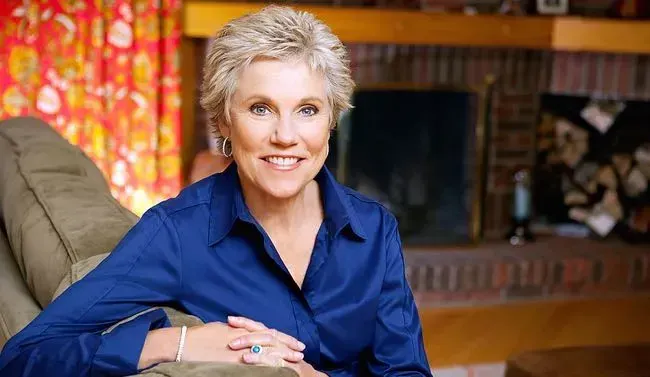
Anne Murray never set out to be a star. She was a physical-education teacher from Springhill, Nova Scotia, a coal-town girl with a low, unhurried alto who had more or less talked herself out of a music career before a Canadian television show and a song about a snowbird changed her mind. She grew up the only daughter among six children, raised by the town doctor and a nurse, and she came to music the proper way a doctor's daughter was supposed to: piano lessons, classical voice training as a teenager, none of it pointed at fame. The practical road came first. She earned a physical-education degree from the University of New Brunswick and went off to teach gym in Summerside, on Prince Edard Island. When the music offers came, she was in no hurry to take them. She had a salary and a classroom, and she made the music prove it was worth giving those up.
Springhill was a mining town that bred a flintiness, and Murray carried it with her wherever the career took her. Her route into the business ran entirely through Canadian regional television — the CBC's Singalong Jubilee and Let's Go — never through Nashville. The shows' musical director, Brian Ahern, heard what was there, talked her out of quitting, and produced her early records. On camera she looked faintly amused by the fuss. She sang plainly and without performance, none of the ingénue about her, and that plainness turned out to be the whole act.
"Snowbird" was the one that broke the door down. Her fellow Maritimer Gene MacLellan wrote it, by her own telling, in about twenty minutes while walking on a beach. It crossed into the United States in 1970, reached number eight on the pop chart, and held six weeks atop adult-contemporary; country radio claimed it almost by accident and pushed it into the Top 10 besides. The song made her the first Canadian woman to earn an American gold record, and the first to reach number one on an American chart. She made her U.S. television debut that October on Glen Campbell's variety hour, and the snowbird never quite let her go; for the rest of her life it was the song people meant when they said her name.
The strangest part of her country career is that she never asked for it. Murray resisted the label outright. She cut Beatles and Monkees covers, recorded folk and pop, and bristled at being filed anywhere. "When I sing a pop song, I'm a pop singer," she said. "When I sing a country song, I'm a country singer. I've been very lucky to cross over, because by doing that, you can't be pigeonholed." And yet the further she drifted from twang, the more reliably country radio claimed her. Her first country number one, in 1974, was "He Thinks I Still Care," a gender-flipped reading of the George Jones standard, and it was buried as a B-side before programmers flipped it over and sent it to the top.
The producer Jim Ed Norman took over her sound at the end of the decade, and the run that followed was as commercially dominant as any woman's in the format. "You Needed Me" came out of a box of demos a songwriter had marked "listen to again." It went to number one on the American pop chart in 1978 and won a Grammy, pulling her out of a four-year hit drought. The country chart-toppers came in a near-unbroken line after it. She took a Carpenters song to number one and freely admitted it didn't sound country to her. For the Urban Cowboy soundtrack she cut "Could I Have This Dance," won another Grammy, and handed a generation its wedding-floor standard. By the time anyone counted, she had placed ten singles at the top of the country chart and twenty-five inside its Top 10. Anne Murray's Greatest Hits went multi-platinum several times over, and in 1987 she became the first woman in country music to earn a triple-platinum album.
The peak was "A Little Good News." Written by Tommy Rocco, Charlie Black, and Rory Bourke after a grim morning-news broadcast, it was a weary little hymn against bad headlines. At the Grand Ole Opry House in the fall of 1984 she became the first woman ever to win Album of the Year at the CMA Awards, beating out the likes of George Strait and Merle Haggard. "This is a real shock to me," she said from the stage. "It's only taken me 14 years to get it in my fat little hands, and it feels really good." In the four decades since, only a handful of women have won it: Patty Loveless, the group then known as the Dixie Chicks, Lee Ann Womack, Taylor Swift, Miranda Lambert, Kacey Musgraves, and Maren Morris. Her last country number one, "Now and Forever (You and Me)," arrived in 1986, the tenth notch on a record almost nobody saw coming when a gym teacher from Nova Scotia first walked into the picture.
Through all of it she stayed recognizably herself, treating stardom like a job she was good at and would happily leave at the office. No costume changes, no manufactured drama. She raised a family and kept her sense of humor about the whole improbable business. Fame never tricked her into thinking it made her interesting. Other singers of her era chased reinvention every few years; Murray mostly declined, on the theory that she already knew what she sounded like and saw no reason to argue with it.
The trophies undersell her, and the trophies are staggering. She holds more Juno Awards than any artist Canada has produced, four Grammys, a Companion's place in the Order of Canada, and induction into Canada's music and country halls of fame. The United States Country Music Hall of Fame is not on the list. The women who came up behind her tend to bring it up themselves: Shania Twain, who would outsell every other woman in the genre, recorded "You Needed Me" as a duet with her, and k.d. lang has never made a secret of who she was following.
She walked away in 2008, on her own terms and with the voice still intact, and seemed finished with it. The honors arrived anyway. In March 2025, Sarah McLachlan presented her with the Lifetime Achievement Award at the Junos, and a room full of Canadian singers rose for the woman who had gone first.
Then the past came looking for her. A superfan combing through her old Capitol masters, held in an archive at the University of Calgary, turned up a stack of recordings she had no memory of making, cut at the height of her career and never released. The tapes became Here You Are, announced on her eightieth birthday in 2025 and released that September. That October the Grand Ole Opry filled a stage with stars to sing her catalog back to her, an evening billed as "The Music of My Life." Trisha Yearwood and Randy Travis and k.d. lang were there, and George Jones's widow, Nancy Jones, turned up unannounced to say plainly that the Country Music Hall of Fame ought to be ashamed for leaving Murray out. "You plowed the road before I got there," k.d. lang told her. Murray, eighty years old and retired from the stage for nearly two decades, watched the whole thing from a seat in the audience.
She had gone from Springhill to the top of the American charts and home again to Nova Scotia, and across every mile of it she stayed the gym teacher who could, the moment she opened her mouth, quiet a room. That was always the trick of her. It still is.
Anne Murray with Kenny Rogers.
The music video for "A Little Good News".