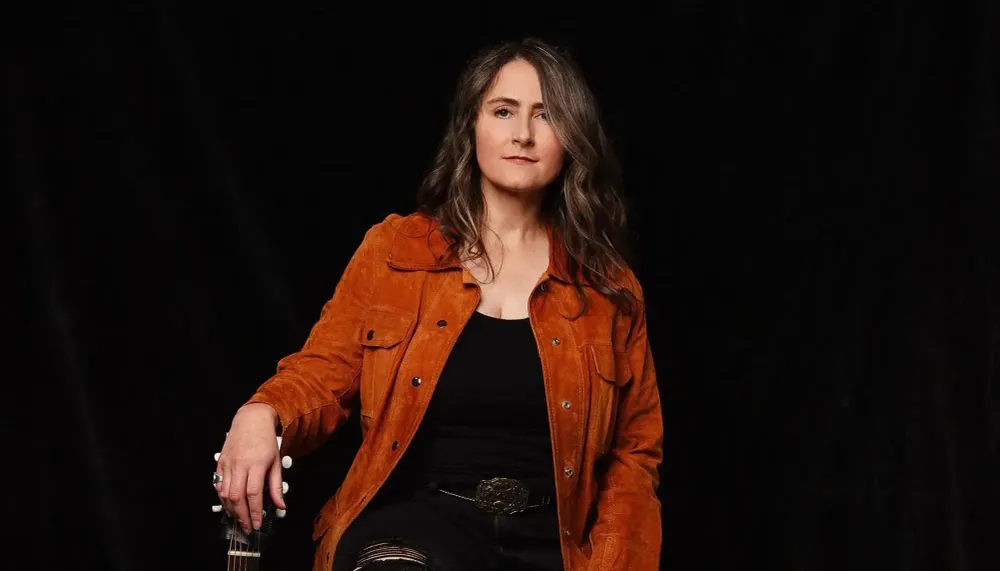
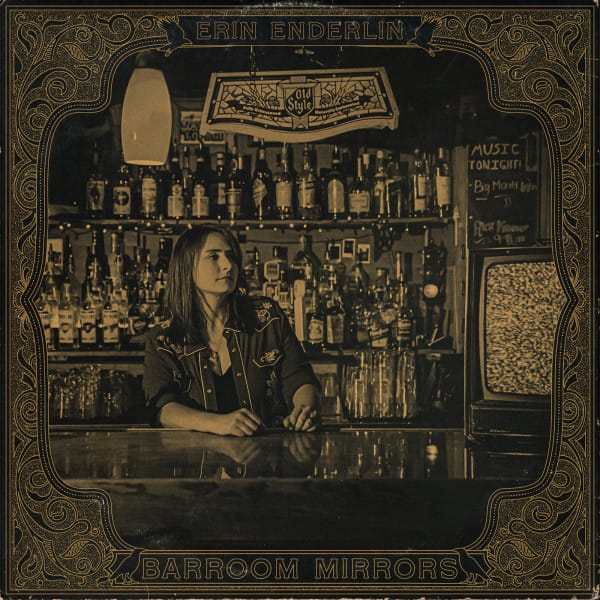
When one of the genre's most trusted emotional architects finally builds her own cathedral, the result is both intimate and monumental. For Erin Enderlin in 2023, after years of crafting heartbreak for some of the biggest names to ever roll down Music Row, that meant constructing something deeply personal. "Barroom Mirrors" (expanded from a 2021 EP) arrives less as career calculation than as artistic necessity. It's the sound of a master songwriter turning her forensic lens inward. Where Alan Jackson, Luke Bryan, and Lee Ann Womack have long relied on Enderlin's pen to capture authentic emotion, this album reveals what emerges when the writer keeps the song for herself.
The album announces its intentions with "White Wine Fever," a groove-driven opener that establishes Enderlin's range right out of the gate. Built on a tight shuffle rhythm with twangy Telecaster licks and a walking bassline, the track channels classic honky-tonk and country blues with infectious authority. The fiddle dances between verses like controlled chaos. She sells the song's mischievous narrative about indulgence as inevitability with a conversational, sassy delivery that turns inflection into its own instrument. The vintage arrangement recalls those great '70s bar-band stompers, proving traditional country structures can still sound urgently contemporary when executed with this level of craft. Enderlin wrote it with Sunny Sweeney and Ben Chapman; in Sweeney, the Texas honky-tonk singer working the same hard-country wavelength, you can hear an old friend daring her toward the next round.
Understanding Enderlin requires understanding her pedigree, and it's the kind of story this business loves to tell. This is no Music Row striver. She's country music's secret weapon, and one of its most quietly beloved—the writer behind Alan Jackson's "Monday Morning Church" (penned when she was still a teenager), Lee Ann Womack's Grammy-nominated "Last Call," plus cuts for Willie Nelson, Reba McEntire, and Randy Travis. After years without a record deal, she worked the door as a Grand Ole Opry hostess and guided tours through the Country Music Hall of Fame, soaking up the tradition she now champions a few feet from where it's made. Raised in Conway, Arkansas, where she's become the most-awarded artist in Arkansas Country Music Awards history—a 14-time winner and perennial Songwriter of the Year—Enderlin grew up on her grandfather's collection of Johnny Cash, Waylon Jennings, and Conway Twitty records. She represents a traditionalism the era mostly stopped making room for.
Working as her own producer—running the session, and her career, on her own terms—Enderlin called in the kind of players reserved for the true believers. CMA Musician of the Year Jeneé Fleenor plays fiddle. Justin Schipper's pedal steel becomes a character in its own right, weeping and wailing one minute, offering false comfort the next. Harmony vocalist Melonie Cannon adds depth without overwhelming Enderlin's crystalline lead vocals. The arrangements honor the golden era without museum-piece stiffness.
"Cut Through Me," featuring four-time Grammy winner Rosanne Cash, operates as the album's emotional apex, and the story of how it came together is almost as compelling as the song itself. Cash discovered Enderlin after hearing her name-checked in "Queen of Marina del Rey," went looking, and what she found stopped her cold. That's how the best word still travels on the Row—song to song, ear to ear. She passed the music to Elton John, secured Enderlin a podcast invitation, and eventually the two of them found their way onto the same song. Enderlin wrote it with Leslie Satcher, the Texan whose pen gave George Strait "Troubadour" and Martina McBride "When God-Fearin' Women Get the Blues," a name whose presence on a lyric sheet is its own kind of credential. The song itself functions as a masterclass in vulnerability through restraint. The instrumentation stays sparse: fingerpicked acoustic guitar, mournful violin from Jeneé Fleenor, the lightest touch of percussion. It leaves negative space where emotion pools. Enderlin's imagery transforms a lover's impact into elemental force: "Like dark whiskey cuts through ice / Like a train whistle cuts right through a delta night." Her vocal performance achieves a rare purity, a breathiness that draws listeners into confession rather than performance. Cash's harmony vocals complete the emotional circuit, two interpreters finding communion in shared devastation.
"Somebody's Shot of Whiskey" turns bar-stool philosophy into a defiant mission statement. Co-written with Ben Chapman, the track opens with wordplay worthy of Kristofferson: "It's a Blue Ribbon morning, after a black label night." But this transcends clever writing. It's a country-rock manifesto built on crunchy electric guitars and a rhythm section that provides Southern rock muscle beneath honky-tonk wisdom. Enderlin's vocal shifts from intimate verses to powerhouse chorus with the ease of someone who understands dynamics as emotional tool. The central metaphor—preferring to be someone's shot of whiskey over everyone's cup of tea—becomes a creed for authentic living. Chapman is the most frequent foil here, the most visible of a circle of like-minded writers Enderlin leaned on across the record, with Kayla Ray turning up on a couple of the barstool numbers and Kimberly Kelly on "If I'm Not in Hell."
"Weddings, Funerals, & Empty Hotel Bars," co-written with Stephanie Lambring, achieves the kind of literary precision that elevates country songwriting to poetry. Lambring is one of the most quietly fearless writers in town, and her own records turn an unsparing eye on faith and marriage and the things people would rather not say out loud. The title alone evokes transient loneliness, but Enderlin finds in it a universal truth about spaces where life's biggest emotions ambush the unprepared. Like John Prine's finest character studies, the song finds profundity in observation, creating what becomes the album's thematic touchstone—those liminal spaces where joy and sorrow intersect. The steel guitar work here doesn't accompany so much as narrate, telling its own story of rooms left too soon and memories that check in but never leave.
Throughout, Enderlin demonstrates remarkable vocal discipline. Where contemporary country often equates emotion with vocal gymnastics, she practices the opposite—control as a conduit for feeling. The cleaner she keeps the vocal, the more of the hurt gets through. This restraint generates its own tension: someone recounting their worst moments while maintaining composure. Whether navigating the country-rock terrain of "Somebody's Shot of Whiskey" or the whispered confessions of "I'd Do It Different," she maintains this essential balance between control and chaos.
The title track serves as both philosophical center and emotional culmination. Co-written with Jordan Lehning and James Dupré, "Barroom Mirrors" recasts the dive-bar setting as a meditation on inescapable truth. The arrangement is deliberately sparse, fingerpicked acoustic guitar over Jeneé Fleenor's keening fiddle, and the whole thing hangs in temporal suspension. Enderlin's vocal achieves that fragile purity that defines her ballad approach, using subtle tremors and controlled vibrato to convey profound sadness without artifice. The central metaphor unfolds with devastating simplicity: "Barroom mirrors tell the truth / Even if you don't want them to / You can look away / But you can't look through / All the things you can't undo." Each word resonates in the space created by minimal production, forcing listeners to confront their own reflections. The concept echoes the territory Enderlin explored on her previous album, Faulkner County—named for the Arkansas county she was raised in, which took its name from Sandford "Sandy" Faulkner, an Arkansan with no relation to the Mississippi novelist. And yet the other Faulkner haunts the record anyway: that Faulknerian inevitability of being confronted with inescapable truths about yourself, unable to outrun the weight of what cannot be undone.
What elevates "Barroom Mirrors" beyond mere heartbreak collection is Enderlin's treatment of honky-tonk spaces as what sociologist Ray Oldenburg termed "Third Places"—those locations separate from home and work where community and catharsis converge. The honky-tonk becomes a secular sanctuary, the barroom mirror a confessional. Even the jukebox does the work of a hymnal. These songs aren't merely set in dive bars—they're birthed from that specific alchemy of neon and cheap whiskey and the kind of truth that only comes out at closing time.
Her gift lies in elevating mundane details to mythic status. "White Wine Fever" doesn't describe drinking but presents indulgence as contagion, something contracted rather than chosen. In "Cut Through Me," emotional impact becomes natural force: rivers breaching levees, roses reclaiming graveyards. This turn from the ordinary to the archetypal marks Enderlin as more than storyteller—she's making modern mythology from honky-tonk raw materials, and the smaller the detail, the bigger the truth she gets out of it.
Contemporary Nashville has largely abandoned the uncompromising traditionalism Enderlin represents, making "Barroom Mirrors" feel both timeless and urgently necessary, the kind of record that reminds you what the city sounds like when it stops chasing radio and starts telling the truth. The album proves country music doesn't need updating. It needs people willing to say the hard thing and mean it. Her inclusion in the Country Music Hall of Fame's American Currents exhibit—the only independent artist selected alongside Reba McEntire—confirms institutional recognition of her importance. By refusing to soften the edges or brighten the dark, she's made a record that moves the tradition forward instead of just dusting it off—and she's done it as the artist out front, not the writer in the back room.
VERDICT: Erin Enderlin has made a masterpiece that proves traditional country remains vital when wielded with intelligence and fearlessness. This is honky-tonk existentialism at its finest—where barroom becomes laboratory for examining the human condition.
Essential tracks: "White Wine Fever," "Cut Through Me," "Somebody's Shot of Whiskey," "If There Weren't So Many Damn Songs," "Weddings, Funerals, & Empty Hotel Bars," "Barroom Mirrors"
"If There Weren't So Many Damn Songs", with Terri Clark.