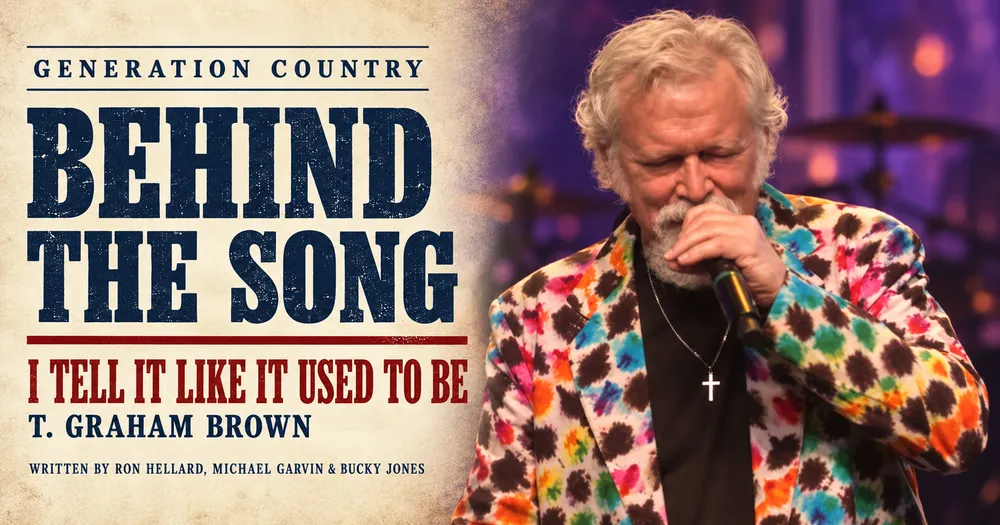
From I Tell It Like It Used to Be (Capitol, 1986) · written by Ron Hellard, Michael Garvin and Bucky Jones · produced by Bud Logan
The man in “I Tell It Like It Used to Be” prides himself on telling the truth. Ask about the woman who left him, though, and he answers in the wrong tense.
He describes the relationship as it used to be, or as it ought to be. What he cannot say is how it is. Ron Hellard, Michael Garvin and Bucky Jones found a whole character inside that conversational turn. Bucky had already used the title once, but he was certain there was a better song in it.
The title Bucky Jones kept
Hellard, Garvin and Jones were all working for Tree Publishing and had written together before. The song was created in 1983, according to its U.S. copyright registration.
“We wrote it at Tree in Curly Putman’s office,” Hellard recalls to Generation Country. “No, Curly was not in the office that day!”
Jones brought in the title “I Tell It Like It Used to Be.”
“Michael Garvin and I jumped on it right away,” Hellard says. Then Jones revealed that he had already written a song with that title.
“Bucky hated the song he wrote and wouldn’t play it for us, but wanted to rewrite the title, so we did.”
“The title unlocked the song,” Hellard says. “I did, in a flash, write the entire chorus lyrics and melody, which just kind of fell out of me. We all wrote the verses together.”
The character grew from the title rather than from one writer’s personal experience. By the second verse, he admits that real strength would mean telling people she is gone. He cannot manage it yet. Anyone who wants the complete story will have to ask her.
A week in the 1950s
“We decided to write ‘1950s’ songs all that week,” Hellard says. “We wrote three additional songs and had a degree of success with all of them.”
The others found their own paths. “I Got a Million of ’Em” became a Top 10 single for Ronnie McDowell. Mickey Gilley and Keith Whitley both recorded “Quittin’ Time,” and Brown’s own recording appeared on the other side of “I Tell It Like It Used to Be.” “Rock ’N’ Roll Money” was recorded by Johnny Lee and, as Hellard puts it, “believe it or not, Jerry Lee Lewis.”
“And T sang on all of our demos!” Hellard says.
“We wrote ‘I Tell It Like It Used to Be’ with Fats Domino in mind, knowing he wouldn’t cut it.” That helps explain the song’s rolling piano feel and its easy overlap of country, early rock and roll and rhythm and blues.
Brown was a natural choice for the demo. “Graham was much in demand as a demo singer back then, especially soul music recordings,” Hellard says. The three writers heard his voice and decided he was right for their song.
“We knew he would get an artist deal with that kind of talent and surely wanted him to record it.”
Brown sang the demo at Tree’s studio. “The demo sounded exactly like the record,” Hellard says.
The singer comes back to the song
Producer Bud Logan later selected the song for Brown’s Capitol project.
“Bud came to Tree looking for songs for his artists and put ‘I Tell It Like It Used to Be’ on hold for T,” Hellard says. “Bud produced the record.”
“I’m certain T remembered it, as he was always complimentary of the song,” Hellard says. “He told me once this was his ‘signature song.’”
The record
The original album’s track credits connect the title song to guitarist Brent Rowan, bassist Joe Osborn, drummer Clay Caire, keyboardist John Barlow Jarvis, steel guitarist Larry Sasser and a horn section of Barry Green, Don Jackson and Terry Mead.
Jarvis’s piano gives the verses their rhythm-and-blues roll. Sasser’s steel keeps the record rooted in country, while the horns widen the chorus. Brown sings the verses conversationally, matching the narrator’s claim that he is simply telling the truth. When the chorus arrives, his voice opens and the composure gives way.
That contrast was evident when the record was new. In its October 5, 1985 review, Cash Box singled out Brown’s country phrasing in the verses, the way he cut loose in the chorus, and the horns and Fats Domino-style piano surrounding him.
Four months to No. 7
The record built slowly. In the October 4 reporting week, Radio & Records showed 20 stations playing it and 17 new adds. Billboard and Cash Box reviewed it the next day. It entered Billboard’s country chart at No. 69 on October 19.
On February 1, 1986, its 16th chart week, it reached No. 7. It completed an 18-week Billboard run and also peaked at No. 7 in Radio & Records and No. 10 in Cash Box.
“I Tell It Like It Used to Be” became Brown’s first Top 10 country single and the title track of his 1986 debut album. “I Wish That I Could Hurt That Way Again” followed it to No. 3, then “Hell and High Water” and “Don’t Go to Strangers” both reached No. 1.
“We were hopeful it would be a hit, and once we heard it on the radio and started following charts, we knew it was,” Hellard says.
“We were grateful to have a breakthrough hit for this soulful young artist. And thankfully we all have successful careers.”
A signature song
The industry recognition followed. A 1986 BMI advertisement named Hellard and Garvin among the Nashville Songwriters Association International’s Outstanding Songwriters of 1985 for the song. The following year, BMI honored Hellard, Garvin and Tree for one of the period’s most performed country works, while ASCAP separately honored Jones and Cross Keys.
Brown kept singing it. The song appeared on Live at Billy Bob’s Texas and received a stripped-down reading on his 2020 album Bare Bones. Brown has said that the acoustic setting drew listeners’ attention to his phrasing, which had changed over the years. He also sang it during the celebration of his 2024 Grand Ole Opry induction, nearly four decades after recording the Capitol single.
Fan Fair
Brown’s connection with Hellard continued. He also recorded “Later Train,” which Hellard wrote with fellow Tree writer Gary Nicholson.
“We were talking about growing old in the music biz,” Hellard says. “That’s where ‘Later Train’ came from!”
The success of “I Tell It Like It Used to Be” led to an unexpected performance at Fan Fair.
“My co-writers and I were all going to Fan Fair that year, as T was scheduled to perform our song and we were going to be on stage with him,” Hellard recalls. “I arrived and soon was told that T was stuck in traffic and apparently so were Michael and Bucky.”
“I’m not sure how it happened, but I ended up performing ‘I Tell It Like It Used to Be’!”
T. Graham Brown · “I Tell It Like It Used to Be” · written by Ron Hellard, Michael Garvin and Bucky Jones · produced by Bud Logan · Capitol B-5524 · from I Tell It Like It Used to Be (Capitol, 1986). Hellard’s recollections were provided to Generation Country in October 2026 and have been lightly edited for punctuation and clarity. Recording and publishing details were checked against the 1983 copyright and lyric record, the original Capitol album credits, contemporary coverage in Billboard, Cash Box and Radio & Records, and Brown’s official site.