One weekend on American Country Countdown: the records Bob Kingsley played, the people behind them, and what happened next.
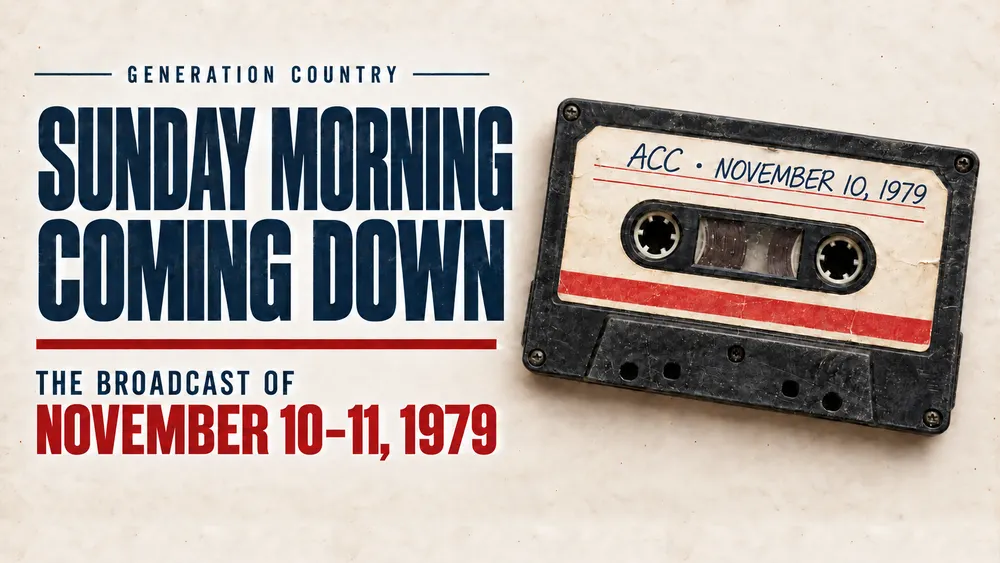
On the American Country Countdown broadcast of November 10–11, 1979, Kenny Rogers held No. 1 with “You Decorated My Life.” Crystal Gayle held No. 2 with “Half the Way,” Waylon Jennings climbed to No. 3 with “Come With Me,” and Gene Watson reached No. 4 with “Should I Come Home (Or Should I Go Crazy).” Merle Haggard’s “My Own Kind of Hat” rose to No. 5.
Anne Murray’s “Broken Hearted Me,” Emmylou Harris’ “Blue Kentucky Girl,” Mel Tillis’ “Blind in Love,” Joe Stampley’s “Put Your Clothes Back On” and Hank Williams Jr.’s “Whiskey Bent and Hell Bound” completed the Top 10.
Rogers and Gayle were reaching pop listeners as well as country fans. Haggard brought a wry honky-tonk shuffle, and Watson sang his troubled homecoming with a tenderness that made every uncertainty count. Harris had made an album devoted to traditional country songs. Hank Jr. was building the sound that would carry him through the next decade. All of them belonged in the same Top 10.
“You Decorated My Life” began with Debbie Hupp, a Kentucky mother of five whose jobs had included nightwatchman at a liquor distillery and licking envelopes at home. She sent her lyrics to Nashville, where Combine Music paired her with Bob Morrison. He was already an established writer, with more than 175 songs recorded and an ASCAP songwriter-of-the-year honor. Most of their work together happened by mail and telephone.
About six months into the partnership, Hupp sent the idea that became “You Decorated My Life.” Morrison helped shape it, but even he doubted that anyone would record a song built around the word decorated. Some listeners laughed at the title. Morrison recorded his own version for Monument; by his count, perhaps three stations played it.
The song waited two years. Producer Larry Butler first heard it as a possible Dottie West record. It did not become one. He took it to Rogers instead.
Rogers initially found the song a little too sweet, but he kept coming back to it. The lyric compares a life without love to plain paper and an unfinished song. Another person supplies the color and harmony. Rogers sings it simply, letting the warmth and slight rasp in his voice keep the sentiment personal.
“When I found out that Kenny Rogers had recorded my song, it was probably the most incredible moment of my life,” Hupp told Billboard that September.
The record gave Rogers another country No. 1 and reached No. 7 on the pop chart. At the following year’s Grammy Awards, Hupp and Morrison won Best Country Song. Their long-distance collaboration had produced a song that millions of listeners could make their own.
At No. 2, Crystal Gayle was introducing a new label without abandoning the team that had helped define her sound. “Half the Way,” written by Ralph Murphy and Bobby Wood and produced by Allen Reynolds, was the first single from Miss the Mississippi and her first Columbia release after years at United Artists. The record was country-pop in the literal sense: it rose to No. 2 country and would reach the pop Top 20.
Gayle asks for a love without reservations, keeping her vocal poised over the insistent rhythm. During the week of this countdown, the trades carried photographs from her recent appearance at New York’s Bottom Line, part of the touring behind Miss the Mississippi. Country radio had already made “Half the Way” a major hit. The pop audience was catching up.
Emmylou Harris, at No. 7, had deliberately made a more traditional record. Her earlier albums had drawn on the Beatles, Chuck Berry and new songwriters as well as country music. For Blue Kentucky Girl, she turned toward the Louvin Brothers, Gram Parsons and Dallas Frazier, while also finding room for the Drifters’ “Save the Last Dance for Me.”
The title song had been recorded by Loretta Lynn in 1965. Harris sings the lonesome woman’s plea with clear, sustained tenderness, leaving room for the melody and the harmonies around her. She later explained the album’s purpose on Fresh Air, borrowing a Waylon Jennings phrase: she wanted to make a record that could not go pop with a mouthful of firecrackers.
Blue Kentucky Girl became a Gold album, reached the country Top 10 and won Harris the Grammy for Best Female Country Vocal Performance. On this countdown, its title track stood three places behind Gene Watson and three places ahead of Hank Williams Jr. A determinedly traditional performance was reaching listeners alongside two very different kinds of country singer.
Hank Jr.’s “Whiskey Bent and Hell Bound” rose to No. 10 while the album of the same name was just arriving in stores. The song continues the self-portrait begun by “Family Tradition,” but the brag is shadowed by consequence. Night falls, the lights come on, the old songs come out, and the narrator knows exactly where the ritual leads. His father’s voice remains present in the records he reaches for; the son’s voice is becoming unmistakably his own.
The run that followed was extraordinary. “Family Tradition” and “Whiskey Bent and Hell Bound” began what the PBS Country Music biography describes as a virtually uninterrupted run of 29 Top 10 hits lasting through 1988. “Whiskey Bent and Hell Bound” would reach No. 2. Its honky-tonk arrangement and his roughened vocal were becoming the familiar sound of a new phase in his career.
Several of the week’s newer singers arrived by carrying older songs. Reba McEntire moved three places to No. 22 with “Sweet Dreams,” Don Gibson’s composition most closely associated with Patsy Cline’s 1963 recording. McEntire had previously reached the Top 20 in a duet with Jacky Ward. “Sweet Dreams” would become her first solo Top 20 hit.
The choice says something about the singer she was becoming. The long phrases require control, and the melody keeps returning to the same impossible wish. McEntire eventually began closing concerts with an unaccompanied version. Here, at 24 years old and still several years from her first No. 1, she was already finding something of her own in a song listeners knew well.
At No. 28, up six, Lacy J. Dalton was making her first country chart appearance with a song she wrote with Mary McFadden. “Crazy Blue Eyes” introduced a forceful, blues-influenced singer who had spent years performing before Nashville heard her. There was a rasp in her voice and a strong feel for rhythm, qualities that would make her records immediately recognizable.
Nashville moved quickly once the right tape reached the right desk. As Cash Box later recounted, Dalton had recorded an album’s worth of material in a garage studio in 1978 and mailed tapes to music-business contacts. One reached David Wood, an attorney friend, who called Emily Mitchell in A&R at CBS Nashville. Mitchell listened and put the tape on Billy Sherrill’s desk. Sherrill became Dalton’s producer at Columbia.
She had been recording as Jill Croston before adopting the name Lacy J. Dalton. “Crazy Blue Eyes” became a Top 20 hit and helped her earn the Academy of Country Music’s Top New Female Vocalist honor. This countdown catches the beginning of that success, with her debut single still climbing and most of her country career ahead of her.
Brenda Lee’s “Tell Me What It’s Like” jumped five places to No. 33. Lee did not require an introduction. By then, she had been a child star, a rockabilly firebrand, a pop headliner and a country hitmaker. The new single would bring her another substantial country success.
MCA president Jim Foglesong brought her back to the label and paired her with producer Ron Chancey. Lee felt immediate musical chemistry with him. Chancey placed elements of soul around her voice without obscuring the urgency that had been there since “Sweet Nothin’s” and “I’m Sorry.” “Tell Me What It’s Like” would reach No. 8, her first country Top 10 in nearly five years, and earn a Grammy nomination.
Lee’s comeback shared the lower chart with another reinvention. Dottie West entered at No. 40 with “You Pick Me Up (And Put Me Down),” written and produced by Brent Maher and Randy Goodrum. Her duet success with Rogers had introduced her to a wider, more contemporary audience. West wanted her own records to acknowledge the change.
“You Pick Me Up” was the first single from Special Delivery, the album that also contained “A Lesson in Leavin’,” West’s first solo Billboard No. 1. Goodrum and Maher wrote six of the album’s songs and gave her a brighter, more rhythmic setting. When Cash Box reviewed the album that November, it singled out the new single among the best cuts and noted West’s move toward pop-oriented material.
Stephanie Winslow had already carried a pop song into the upper half. “Say You Love Me,” at No. 14, was Christine McVie’s Fleetwood Mac composition. Winslow’s version would become her only country Top 10. Lynn Anderson entered at No. 39 with “Sea of Heartbreak,” the Hal David-Paul Hampton song Don Gibson had made a hit in 1961. The Statler Brothers entered at No. 36 with “Nothing as Original as You.” Country radio had room for a Fleetwood Mac song, a familiar country favorite and a new Statlers record in the same hour.
At No. 37, Ernest Tubb returned to “Walkin’ the Floor Over You” with Merle Haggard and Charlie Daniels. Tubb had made it a country cornerstone in 1941. Now two musicians who had grown up with his music were helping him record it again.
The session belonged to producer and steel guitarist Pete Drake. Major labels had shown little interest in a new Tubb project, so Drake signed him to First Generation Records and brought Tubb and the Texas Troubadours into the studio to cut fresh basic tracks of his standards. Then, while Tubb was away working the road, Drake invited an extraordinary company of country singers and players to add parts without telling him.
The finished double album, The Legend and the Legacy, was introduced at a celebration of Tubb’s 65th birthday in February 1979. Willie Nelson, Waylon Jennings, Loretta Lynn, Johnny Cash, George Jones, Marty Robbins, Conway Twitty, Chet Atkins and many others joined the tribute. On “Walkin’ the Floor Over You,” Haggard joins Tubb on the vocal. Daniels and Atkins were also among the guests credited on the recording.
The single would reach No. 31, bringing Tubb back into the country Top 40. His Texas drawl still cuts straight through the band, and Haggard’s answering vocal makes the performance feel like a conversation between friends. Listeners could hear a country standard in the voice that had made it famous, alongside singers and musicians whose affection for it was plain.
Conway Twitty’s “Happy Birthday Darlin’” stood at No. 25, up fourteen places, the largest move on the countdown. Chuck Howard’s lyric offers a gift that cannot be wrapped: the singer promises to take away suspicion, lonely moments and the harm his words have caused. By December, it would become Twitty’s 23rd solo Billboard country No. 1 and remain there for three weeks, including Christmas.
The record is an apology with candles on it.
THE SAME WEEKEND, DOWN THE YEARS
1973. Six years earlier, Marie Osmond reached No. 1 with “Paper Roses.” Anita Bryant had taken the song into the pop Top Five in 1960; Osmond’s country version made her a chart-topper at fourteen. Directly below her were Mel Tillis’ “Sawmill,” Dottie West’s “Country Sunshine” and George Jones and Tammy Wynette’s “We’re Gonna Hold On.”
Several names from 1979 were already in different positions. West was No. 3, six years before entering at No. 40 with a new production style. Brenda Lee was No. 14 with “Sunday Sunrise,” six years before “Tell Me What It’s Like” began her return. Lynn Anderson stood at No. 10 with “Sing About Love”; in 1979 she would enter near the bottom of the countdown with “Sea of Heartbreak.”
The lower chart showed what was coming. Waylon Jennings rose eight places to No. 23 with “You Ask Me To.” Willie Nelson climbed eight to No. 26 with “Stay All Night (Stay a Little Longer).” Merle Haggard jumped seventeen places to No. 30 with “If We Make It Through December.” Don Gibson moved into the Top 40 with “That’s What I’ll Do.” Six years later, his “Sweet Dreams” would give Reba McEntire her first solo Top 20 hit.
1990. Eleven years after the main broadcast, Joe Diffie reached No. 1 with “Home,” his debut single. Don Williams was No. 2 with “Back in My Younger Days,” Reba McEntire was No. 3 with “You Lie,” and Garth Brooks stood at No. 6 with “Friends in Low Places.” The new boom and several voices from the previous era occupied the same Top 10.
Randy Travis and George Jones made the generational exchange explicit at No. 8 with “A Few Ole Country Boys.” Travis sings of learning from the voices already on the radio; Jones answers that the distance between them is smaller than it appears. Mark Chesnutt was No. 9 with “Too Cold at Home,” and Exile was No. 10 with “Yet,” the band’s final Top 10 country single. We tell Exile’s longer story in EXILE: The Songs Got There First.
Outside the Top 10 were Clint Black at No. 13, Alan Jackson at No. 15, Vince Gill at No. 19, Garth at No. 28 with the new “Unanswered Prayers,” and Patty Loveless entering at No. 37. George Strait appeared twice. Travis Tritt, Kathy Mattea and the Kentucky Headhunters were there too.
Reba’s two records show how much had changed in eleven years. At No. 22 in 1979, “Sweet Dreams” was still climbing toward her first solo Top 20 placing. At No. 3 in 1990, “You Lie” had just spent a week at No. 1. The newcomer of the earlier countdown was now one of country music’s established stars.
BACK TO THE RADIO
The November 1979 program offered more than the forty current hits. After Brenda Lee’s new single, the cue sheet called for her older “That’s All You Gotta Do.” Tom T. Hall’s “You Show Me Your Heart (And I’ll Show You Mine)” was followed by “Ballad of Forty Dollars.” Marty Robbins appeared with both “Buenos Dias Argentina” and the album cut “The Dreamer.”
Those selections gave listeners a little more time with voices they knew. Around them were Dalton’s debut, McEntire’s first solo Top 20 on its way, West’s new production team and the latest No. 1 for Rogers. Together, they filled three hours with new records, old favorites and stories worth hearing.
Next week, another weekend, another year. We’ll leave the radio on.
Sources: American Country Countdown cue sheets for November 3 and 10, 1979, November 10, 1973, and November 3 and 10, 1990; the American Country Countdown fan archive; Billboard, September 15, 1979, for Debbie Hupp and Bob Morrison, and November 10, 1973, for the earlier chart; Cash Box, August 16, 1980, for Dalton’s signing, and November 24, 1979, for West’s album; contemporary coverage of Gayle and Tubb in Cash Box, Record World and Radio & Records; Harris’ Fresh Air interview; PBS’ Hank Williams Jr. biography; uDiscover’s Rogers song history; the Recording Academy and Academy of Country Music award archives; artist biographies, original recording credits and country-chart reference works.
Sunday Morning Coming Down is an independent journalism feature about historical radio broadcasts. It is not affiliated with or authorized by Billboard, the producers or distributors of American Country Countdown, or the estate of Bob Kingsley; program and chart names appear only to identify the broadcasts discussed.