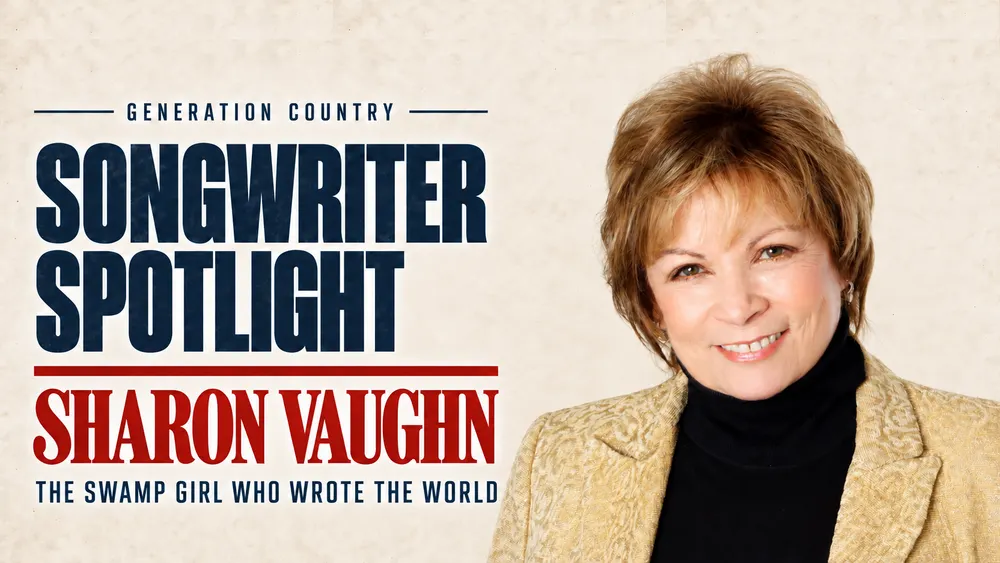
Sharon Vaughn was about 60 when she sold her art collection, put her furniture in storage and lit out for Stockholm with her dog. She had spent decades writing hits and singing on Nashville sessions. What she wanted now was a chance to do something she had never done.
“I was getting really bored with Sharon in Nashville,” she tells Generation Country. “Every time I tried to make some sort of quantum leap, people wanted what was back here instead of what was up there. So I sold my art collection, got my dog a passport, stored my furniture and moved into a little apartment about the size of my dining-room table.”
“My dog and I were sitting there, she had jet lag, and I was going, ‘What on earth have I done this time?’” Vaughn says. “Within four months, I had ‘Release Me,’ and that song has been the biggest song of my career.”
Vaughn, Swedish producer Anders Hansson and singer Agnes Carlsson wrote the dance record that reached No. 3 in the United Kingdom and topped Billboard's American dance-club chart. Vaughn counts hits in 48 countries.
“My life started over completely when I was 60,” she says.
SWAMP GIRL
The working title of Vaughn's unfinished memoir is Swamp Girl, after the Florida country that reared her.
She was born Mary Sharon Vaughn in Orlando in 1947, the oldest of six children. Florida cattle country supplied the horses, ranchers and Sunday match races she would later draw on for “My Heroes Have Always Been Cowboys.” Her father played guitar, led singing in a Baptist church and, she says, possessed “a voice like a Vince Gill.” He had wanted to be a cowboy singer before the responsibilities of a family took precedence. Vaughn believes he later lived part of that dream through her.
“My father was a young man when I was born, and he was a swamp boy,” Vaughn says. “He was a builder by trade, and later on he bred racehorses. But his passion was growing things, living things. He taught me to track, to know the names of things, what they did, how they sounded, their habits, all that earthy stuff that drives people crazy when they ride in a car with me.”
When she wanted privacy, she holed up in a fort made of sabal palms beside the Little Econ River. Her father’s lessons in close observation took root. Decades later, she would picture a character's dress, nail polish or boot soles before writing a line.
Vaughn says she grew up with Cole Porter and the Great American Songbook in one ear, and Jimmie Rodgers, Hank Williams and Willie Nelson in the other. You can hear both educations in her work: compact melodies, precise language and stories built around a character, a problem and a turn.
At seven, she wrote “Three Little Monkeys in a Tree.” She clambered onto her father’s chest and spun bedtime stories for him. He was her first audience. She still describes the scenes that arrive in her mind as little films.
Before Nashville, somebody else saw it too. Chuck Glaser, of the Glaser Brothers, came calling at the Vaughn home and told the young singer something she had not yet learned to call herself: You're a songwriter. It mattered, but singing still looked like the road out.
By 1969 she was working full time at Orlando's WDBO, attending college at night and singing weekends at the San Juan Hotel and the Ponderosa Steakhouse Lounge. Her radio job sometimes had her wrangling visiting talent. When Porter Wagoner, Mel Tillis and Jim Stafford came through town, she invited them to her show.
That night the Ponderosa's swinging doors actually swung, and Tillis walked in with his entourage. Vaughn and Tillis sang together for the rest of the evening. A few days later she returned to collect her $30 check. The bartender said she had a phone call.
Tillis told her she was the best harmony singer he had ever heard and asked her to come to Nashville to record with him.
She was 22, “green as grass,” and gone.
THE COKE CRATE
In the Nashville studios Vaughn entered, background singers built their parts together around one microphone. They might receive a number chart, a lyric sheet or nary a thing. They listened, hashed out the arrangement and rehearsed with the rhythm section before recording the master.
She worked at WSM-TV and moonlighted in a jazz band that included the station’s weatherman, Boyce Hawkins. His brother Hoyt sang with the Jordanaires.
Jim Glaser called because soprano Eileen Hardin could not make a date at Bradley's Barn. Owen Bradley was producing. Could Vaughn fill in, and did she know the Nashville Number System? She said yes and trusted her ear. She had never worked a master session and initially thought the “number system” might mean counting from one to ten. On “Christopher the Christmas Tree,” she found the top of the harmony and learned enough of the system to finish the date.
Vaughn became the soprano and lead voice of the Lea Jane Singers and also worked with the Nashville Edition, the Jordanaires and larger composite groups assembled for lavish sessions. She remembers 10-to-one, two-to-five and six-to-ten bookings, four or five days a week. On breaks, singers ran to a telephone to check their answering services and learn where they were due next.
“I wore four-inch heels, and I'd stand on my tiptoes because I was the soprano,” Vaughn says. “One day Ron Reynolds at Columbia Studios said, ‘Come here a little bit.’ He showed me he had built me a riser out of a Coke crate and covered it with carpet. We sang on one mic. There was no tuning. We had to get it right.”
On one Dolly Parton session, Vaughn heard a suspended harmony inside the chord and kept trying it. Lea Jane Berinati, who had perfect pitch and knew exactly what was and was not written, kept reining her in. Producer Porter Wagoner mashed the talkback button.
“Lea Jane, you let that girl sing anything she wants to,” Vaughn remembers him saying. “She could sing harmony with a rooster.”
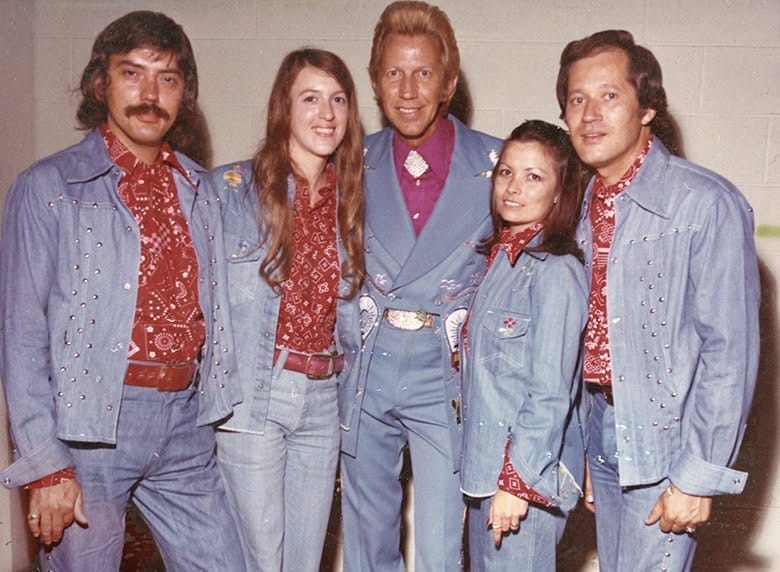
The skill underneath the joke was practical: if a lead singer drifted flat or sharp, Vaughn had to follow, because a technically perfect interval would only expose the voice she had been hired to support. She learned to read a singer's breath from the instant the lips closed at the end of a phrase and keep the blend from calling attention to itself.
Vaughn can still pick herself out on records from a half-century ago. One she treasures is Parton's 1976 recording of Emmylou Harris's “Boulder to Birmingham,” from All I Can Do, which credits the Lea Jane Singers.
“If I'm good at anything, it's harmony,” she says.
Those years also taught her to write.
“We made up the arrangements,” Vaughn says. “The producer might come in with no lyrics, and I would feverishly write them down. Then we'd write the number chords, go over it two or three times with the rhythm section, and record. We did every bit of that arranging ourselves, on the spot. Those were master sessions, not demos. I attribute that to really informing my writing career, because I learned how to write songs from the bones out. You can put skin on it, fancy clothes, diamonds or rhinestones, but you've got to get the bones right. The bones, to me, are the story.”
Vaughn also made records of her own. Her 1974 Cinnamon Records duet with Narvel Felts, “Until the End of Time,” reached No. 39 on Billboard's country chart. ABC/Dot signed her in 1975. Her singles included Jerry Foster and Bill Rice's “Go to Your Room and Play,” which eavesdropped on a marriage breaking apart from the child’s bedroom, and “The Fire That Burns at Home,” whose “soft but dynamic” vocals drew praise from Cash Box.
For one afternoon that artist chapter doubled back into family life. Cash Box reported that Finger Lakes Racetrack named a purse for Vaughn; she presented the trophy, and her father was training horses there.
Commercials made her a familiar face in Nashville. An April 1975 Billboard report listed work for Kentucky Fried Chicken, Fruehauf trucks and Fram filters alongside a local campaign for Ray Batts Furniture. When the ad man asked whether she had worked on camera, Vaughn said yes and learned on the job. She wrote and sang the jingle and became known to musicians as the furniture-store girl. When she quit, she remembers the store calling to report that business had fallen 37 percent. She kept doing the spots a while longer.
That local visibility helped “My Heroes Have Always Been Cowboys” reach Waylon Jennings.
SEVENTEEN MINUTES
Vaughn wrote “My Heroes Have Always Been Cowboys” for Bobby Bare. Her producer was preparing a Bare album and sent her home with one marching order: write a cowboy song. Bare did not record it.
“It was one of those gushers,” Vaughn says. “I can tell you exactly how long ‘Heroes’ took: 17 minutes. I'm a dyed-in-the-wool clock-watcher. I'm never late.”
The picture had already developed. She saw an old cowboy on a sheetless mattress in a flophouse, boots still on, soles dirty, toes curled, ankles crossed, hands behind his head, staring at a bare bulb. The lyric follows his memories of the romance boys are sold, the solitude men discover and the slow-moving dreams they keep one step behind.
“My Heroes” was not even Vaughn's first reason for walking into Waylon Jennings's office. She had brought him her new ABC/Dot recording of a song credited to Jennings and Troy Seals. Jennings listened and told her he had not written it. Vaughn ordered him to sit tight, ran past the receptionist, future country journalist Hazel Smith, and fetched the “Heroes” reel from her car. Smith recognized Vaughn from television and announced her as the Ray Batts girl. That bought a hearing.
Jennings played the demo, stopped it and asked who had written it. By Vaughn's telling, he made her answer three times before he believed her. Then he got Cowboy Jack Clement on the horn in Beaumont, Texas, and had him fly in. They recorded the song that night.
While the song was still new, Vaughn and Ed Bruce crossed paths in a studio parking lot after separate voiceover jobs. Bruce wanted to play her a cowboy song he had just written: “Mammas Don't Let Your Babies Grow Up to Be Cowboys.” Vaughn answered with “My Heroes.” Neither had an inkling what the other was writing. She still calls the two songs stable mates.
Jennings placed it on Wanted! The Outlaws, the 1976 compilation that became country's first RIAA-certified platinum album. Its first life was as an album cut people would not stop remembering. Four years later Willie Nelson recorded it for The Electric Horseman. His version spent two weeks at No. 1 on Billboard's country chart and crossed to No. 44 on the Hot 100. Vaughn first heard his recording in a movie theater after somebody told her she ought to see the film. Her song opened the picture, returned at its climax and seemed to contain the character's whole life. She remembers being pinned against the seat.
Then came the cowboy Vaughn had been chasing since childhood.
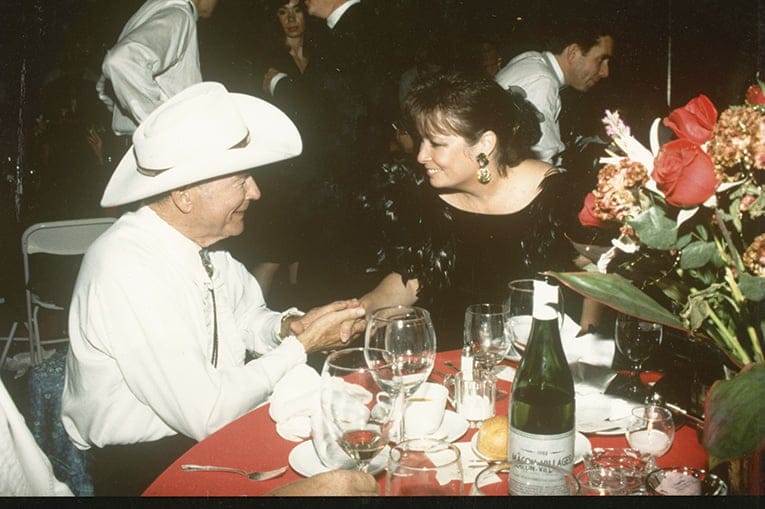
At a BMI event, Roy Rogers began singing her song back to her. Vaughn, gussied up in green velvet and feathers, shook. There is a photograph of the moment, she says, with the cowboy hero she had watched as a child singing the song she wrote as an adult.
The Western Writers of America placed “My Heroes Have Always Been Cowboys” among its Top 100 Western songs.
THE SALOON
“Y'all Come Back Saloon” was the first song anyone committed to record, Vaughn remembers, although “My Heroes Have Always Been Cowboys” beat it out of the gate.
Its title began at a Chattanooga café called the Y'all Come Back Inn. Vaughn left itching to write the phrase before she had a story to contain it.
“I don't play an instrument, but I know chords,” she says. “I wrote the lyrics and then the numbers of the melody and the chord underneath the syllables. Then I went home and went to sleep. I always keep a notepad by my bed, and I wrote the bridge practically in my sleep. I woke up the next morning, and there it was.”
The girl in the song took after Vaughn: Coca-Cola-colored hair, a head full of a million tunes, a knack for singing jazz in a ball gown on Friday and country in rodeo pants the following night.
“I see these films in my head,” Vaughn says. “I see these characters. In ‘Y'all Come Back Saloon,’ I saw that old guy sitting in a dark corner, outside of the activities going on in that bar, watching that girl, not lusting after her, but longing for something. There's a whole big difference. He was lonely.”
Her Baptist childhood helped furnish the scene: a barroom like a chapel, its regulars fallen angels and “Faded Love” the loser's evening prayer. Vaughn had not written the song with the Oak Ridge Boys in mind, but their gospel raising made them particularly suited to it.
She brought a guitar-vocal work tape to Farah Productions, the company handling her artist career. The songplugger heard it and chased the Oaks' bus until somebody listened. “Y'all Come Back Saloon” became the first single from their 1977 album of the same name, reaching No. 3 on Billboard's country chart and No. 2 in Canada. It began the group's first sustained country run.
SHARON RICE
For a long stretch of the discography, Sharon Vaughn disappears. Sharon Rice takes her place.
They are the same writer. During her marriage and working partnership with songwriter Bill Rice, labels and publishers credited her as Sharon Rice, Mary Sharon Rice or M. Sharon Rice. A 1997 trade notice announcing MCA Music Publishing's renewed deal made the bridge explicit: “Sharon Vaughn (formerly Sharon Rice).” Anyone squinting at old album jackets without that knowledge can mistake one remarkable career for two incomplete ones.
Sharon and Bill wrote and published in a circle that included Jerry Foster and Roger Murrah. Reba McEntire took “I'm Not That Lonely Yet” to No. 3 in 1982 and “There Ain't No Future in This” to No. 12 the next year. Leon Everette reached the Top 10 with “Soul Searchin'.” Mark Chesnutt later took “Broken Promise Land” to No. 10. Bill Medley, Tom Wopat and others carried Rice credits onto the country chart.
When Vaughn pictured the brokenhearted woman in “I'm Not That Lonely Yet” being asked to dance, she saw the woman's blue dress and knew the color of her fingernail polish. If a writer cannot see a character at that resolution, she told The Tennessean, the song is not ready. She held the cowboy songs and the Rice catalog to the same yardstick.
One song required two records and a death before the world heard its full weight.
Leon Everette released Bill and Sharon's “'Til a Tear Becomes a Rose” in 1985. Billboard called it a beautiful, sincere devotional and some of his best work; the single reached No. 44. Five years later RCA built a posthumous Keith Whitley compilation around unreleased and previously issued material. Whitley's widow, Lorrie Morgan, added her voice to his recording. The single reached No. 13, gathered an emotional force far beyond any chart number, and won the 1990 CMA award for Vocal Event of the Year. It also received a Grammy nomination for Best Country Vocal Collaboration.
BONE HONEST
By the 1990s, the credits on the labels were turning back into Sharon Vaughn.
“Lonely Too Long,” written by Vaughn, Bill Rice and Mike Lawler, gave Patty Loveless a No. 1 in 1996. Its two grown-ups wake after a night together and reassure each other that they have nothing to hang their heads about.
“I love to write things that are just bone honest,” she says. “If that calls for a little discomfort, then so be it. A song like ‘Lonely Too Long’ had to be bone honest. That's just human stuff. If I can do that instead of going down the songwriter-y path, I'm always happier.”
The grammar fanatic in her knew exactly what she was doing when she wrote we ain't done nothing wrong. Correct English would have been incorrect character. “It just seemed like the thing to say,” she recalls.
Vaughn believed the lyric needed a singer with a wink, someone who could make reassurance sound tender rather than coy and adult desire sound human rather than calculated. Loveless had it in spades. Hearing the song outside the record years later, Vaughn realized its soulful movement could just as naturally have belonged to Aretha Franklin or Gladys Knight. The details are country; the feeling and melodic movement need not be.
For Vaughn, “bone honest” does not mean diary confession. It means giving a character the words that character would actually use. She measures success by whether listeners believe the song came from the singer:
“If you're writing for another artist, you have to be that artist,” she says. “I certainly haven't experienced everything I've written about, but I have the empathy of the person who did. The biggest compliment is when people say, ‘We thought Willie Nelson wrote that,’ or Waylon, or Patty Loveless. That's the biggest compliment anybody can pay me. It sounds like it's coming from their mouths, not mine.”
Vaughn says she did not know how to write a song until after she had already written a couple of big hits. The early songs came by instinct; afterward, she took them apart to see why they held together. She compares craft to riding a bicycle: learn the rules with both hands clamped to the handlebars, then understand them well enough to let go.
Vaughn starts with the title and expects the lyric to make good on its promise. The second verse must raise the stakes instead of paraphrasing the first; a pre-chorus must properly set up the chorus. Her first instruction to a chorus is “Take me somewhere.” The verses supply information, and the chorus converts it into feeling. “My Heroes Have Always Been Cowboys” states its argument in the title. “Out of My Bones” makes every attempted cure serve its central image.
Vaughn calls vocabulary the writer's toolbox. The more completely it is stocked, the less likely a writer is to reach for a word merely because it rhymes.
She has studied economy in unlikely places. Years ago, she would loiter in bookstores and read magazine captions, tracking the fewest words capable of carrying a story. Sports Illustrated, she remembers, was especially good at it.
Her model for economy is Merle Haggard, whom she considers country's finest opening-line writer. In “Mama Tried,” Haggard can give the listener the man, the crime, the sentence and the mother before the song has cleared its throat. Vaughn's own best titles pull the same trick: they do not label the story after it is written; they set the story in motion.
Vaughn calls herself a “streetwriter.” She wants a song personal enough to matter and useful enough for an artist to record. “You don't fish with a slack line,” she says. “You don't run fast with a slack rein.”
“Out of My Bones,” written with Gary Burr and Robin Lerner, turned heartbreak into fever, remedy and folk magic. Read more of Vaughn's comments about the song in our Behind the Song spotlight. In 1998 it introduced Randy Travis's move to DreamWorks and reached No. 1 on the Radio & Records and Canadian RPM country charts. It peaked at No. 2 on Billboard's country chart.
“Powerful Thing,” written with Al Anderson, gave Trisha Yearwood a No. 6 hit in 1999. “Right on Time,” another Anderson collaboration, did not become a radio single for Travis in 2004, but Vaughn still counts it among her favorites. She traces its central thought to Bonnie Raitt, whom she heard describe herself as taking a while to arrive but being right on time. Vaughn called Anderson and told him she had their next song, then came to the session with the lyric already written. Years later, the phrase also described her own move overseas and late-career success.
Al Anderson recorded it in 2006. Vaughn remembers producer Russ Titelman pitching it to Marc Cohn at a papaya stand; Cohn later sang it on Jerry Douglas's 2012 album Traveler. Gretchen Wilson made it the title track of her 2013 album.
Among the writers who understood what Vaughn could do was Matraca Berg. Vaughn remembers Berg as a fan before they were collaborators. They came together around RCA's Signatures songwriter-album series, which placed their names in company with Harlan Howard and Bill Rice, and became close friends as well as writing partners.
Vaughn had come to songwriting through session singing; Berg grew up watching her mother, Icie, sing sessions and learned the writers' trade almost by osmosis. When they wrote “Along for the Ride,” Berg called Vaughn her “metaphor maven.” Vaughn supplied the circus-poster image but refuses sole parentage of the song. It was, she says, “a mutual birth.”
“She and I are very, very much on the same wavelength,” Vaughn says. “She's one of my favorite writers, and I don't get to write with her nearly enough.” They also wrote “Here You Come Raining on Me” and “Shot for the Moon,” and Vaughn sang harmony on “Along for the Ride” for Berg's Sunday Morning to Saturday Night.
In 1999, a MusicRow reviewer singled out Berg and Vaughn's “Shot for the Moon” as Susan Ashton's best performance on Closer.
THE SCENIC ROUTE
Around 2003 she went to London for a co-write. A friend from her work on the Country Music Association's international committee suggested that, since she was already hopping the pond, she visit an Irish publisher. She did.
“The publisher was driving me back to my hotel and said, ‘We're going to take the scenic route,’” Vaughn remembers. “We went by the sea. We passed this place with a ‘to let’ sign, and I said, ‘Stop the car!’ I called the real-estate agent. She met me there, and I rented that place right then and there.”
Soon she was corralling writers in an Irish castle: country storytellers, British pop writers and Scandinavians with portable studios. “I thought, wouldn't it be fun if I hired a castle and invited all these different people I write with all over the world to stay for a week and write, co-write, mix and match?” she says. “It was a songwriting gumbo.”
Two visitors from Stockholm took songs home; both were recorded lickety-split. Vaughn, tired of living on airplanes, accepted a suggestion that most people would have treated as a joke. She chewed on moving to Sweden for roughly 30 seconds. Three weeks later, she and the bewildered dog were there.
The Ireland years also produced a lasting partnership with Paul Brady. They wrote three songs for his 2005 album Say What You Feel. When they reunited for Unfinished Business in 2017, Brady brought a stack of tunes and a few unfinished lyrics. They wrote four songs in two days; a fifth followed soon after. “We always come up with a bunch of keepers,” he wrote in the album notes.
In a 2008 ASCAP interview, Vaughn called the move “another ring on the tree.” In Stockholm, she often worked over programmed tracks, writing lyric and melody as a topliner. The production was new to her; the task of writing for another singer was old hat.
“When I top-line, I write lyric and melody,” she says. “People don't look at me as a melody writer, which is crazy, because I've written a lot of hits by myself. I think the hardest thing in writing a song is the storytelling, and that's the thing that enthralls me. That's what brought me to the party.”
Sometimes the adjustment came down to a consonant. Vaughn has rewritten every English “th” in a lyric for an artist who could not pronounce the sound; another singer tripped over “love,” even though the word was in the title.
In a Swedish study of co-writing, Vaughn said the writer's ego stays outside the room: the goal is not to win every disagreement but to make the listener believe the artist owns the song. Agnes later described Vaughn as exceptionally fast and emotionally perceptive, a writer who knew her well enough to turn a telephone conversation into a lyric that left them both in tears.
“Release Me” is European dance-pop, but the lyric uses a conflict familiar from Vaughn's country songs: a woman knows what she ought to do and cannot make herself do it. The bright, driving production gives that indecision urgency.
The hit led to work outside conventional co-writing. When Roxette's Per Gessle wanted to turn deeply personal Swedish songs into English, he found literal translation almost impossible. He asked Vaughn to make new interpretations for his 2018 album Small Town Talk. “She's amazing and has been a big help,” Gessle said.
Vaughn also co-wrote material for Boyzone's 2010 UK No. 1 album Brother. Japanese group EXILE's “Rising Sun,” written by Didrik Thott, Sebastian Thott, Johan Becker and Vaughn, became JASRAC's top foreign work of 2013. She accumulated European and Asian cuts, four Japanese No. 1s, and a parallel career in televised song competition.
Ireland's Jedward took “Waterline” to Eurovision in 2012. Russia's Sergey Lazarev finished third with “Scream” in 2019. When its producers needed a bridge, Vaughn was sitting on a dock in the middle of a Florida lake. She sang the part down the telephone while the Moscow Symphony Orchestra cooled its heels in the studio, then heard the musicians record it. In 2021, Vaughn became the first writer to place three songs for three countries in the same Eurovision contest: Estonia's “The Lucky One,” Greece's “Last Dance” and Moldova's “Sugar.”
“If music can do that,” she says, “then it certainly can bring people together.”
After seven years in Sweden, Vaughn came home to Orlando, fixed up the College Park cottage her grandparents had bought in 1926 and turned her grandfather's old garage into a studio. She continued working internationally from there.
THE PRISM
Vaughn describes her working life as a prism, with each turn revealing a different side: singer, writer, publisher, producer, manager or theater lyricist. Moving among those jobs has made her, as she puts it, “multilingual in the music language.”
“Opportunity and I have a very close relationship,” she says. “If opportunity knocks, I have a tendency, the Southern girl, to say, ‘Come on in.’”
After John Rich left Lonestar, he called Vaughn for advice. Their co-write “Love Won't Listen,” she said, helped him hear the solo artist he might become. Vaughn became his manager, background singer and co-producer on Underneath the Same Moon. MusicRow noted in 2000 that she was one of very few women producing somebody else's major-label project. Vaughn had paid the precedent no mind. With her head down “in the trenches,” she said, the work presented itself one task at a time.
When the first six tracks were ready, Vaughn did not send BNA a tape. She dolled up the studio as a listening room with mood lighting, candelabras, wine, cheese and yellow roses for Rich's home state of Texas. The label was impressed enough to recreate the performance in 16 cities, with Rich on guitar, Vaughn singing background, and a percussionist and cellist rounding out the group. A contemporary Billboard review heard Rich and Vaughn crafting a “magical record.” BNA released “I Pray for You” in 2000, then shelved the album; it finally saw daylight in 2006, after Big & Rich had changed the context around its singer.
Rodney Clawson, who would become one of modern Nashville's leading hit writers, says his first publishing deal, in 2000, was with Vaughn.
Vaughn also spotted the makings in a 14-year-old named Taylor Swift. She remembers the girl dragging a 12-string guitar into her house by the neck “like a puppy.” Swift's parents asked Vaughn to produce their daughter. Vaughn was already committed to an Irish artist and, afraid she could not do right by two developing acts, declined. She did call RCA chief Joe Galante.
“You have to know that you need to sign her right this minute,” Vaughn remembers telling him, “because this girl is a meteorite. You won't know what to do with her right now, but don't worry about it, because she'll figure it out.”
Vaughn now lives in New York, where theater, history and the overheard voices of strangers are all grist for the mill. She calls it the “palette of people.”
Vaughn caught the theater bug in high school, when an Episcopalian diocesan representative saw her in a musical and offered her a full acting scholarship. Family circumstances kept her from accepting it. Later, working as an usherette, Vaughn saw Camelot and recognized the form she wanted. She did not return to theater until decades later.
She eventually wrote lyrics for The Sweet Potato Queens with composer Melissa Manchester and book writer Rupert Holmes. Manchester calls her fiercely funny and brilliant. Vaughn has explained the theatrical challenge this way: a songwriter may need to compose for 18 characters, each with a distinct cadence, vocabulary and reason to sing. She wants to know whether a woman has a chip in her fingernail polish, whether her hand trembles as she applies her eyelashes, and what she is afraid to admit. Onstage, cadence reveals character, and every song has to move that character's story forward.
She contributed lyrics to Breathe, Jodi Picoult and Tim McDonald's pandemic-era musical with orchestrator and composer Doug Besterman, and co-wrote book and lyrics for Fighting Star, which received a six-month Finnish run. B Street Theatre has scheduled Dream Dream Dream: The Love Story and Songs of Felice and Boudleaux Bryant, by Carolyn Smith Bryant, Desmond Child and Sharon Vaughn, for its world premiere March 17–April 4, 2027. Current work also includes the one-woman musical Crumbs, with Madeline Stone; Vaughn told Generation Country she has projects in development in Spain and London as well.
She is still singing, too. In her 2026 Generation Country interview, Vaughn described a Swedish writing trip to co-write an album with soul singer Albin Lee Meldau. He brought her back to sing every non-lead vocal part, she says, including three-part stacks across the album. More than half a century after Ron Reynolds carpeted the Coke crate, she was arranging harmonies around another singer's voice.
“I'm an octopus with all eight arms,” she says. “It's the best job in the world.”
RIGHT ON TIME
Vaughn had been nominated for the Nashville Songwriters Hall of Fame enough times that she finally quit holding her breath for the call. When it came, she was in a Stockholm studio with an artist and production team from Moscow. She remembers answering the news with “Oh my gosh” so many times that the people around her thought she was having a heart attack.
On October 14, 2019, Bill Anderson stood before the Nashville songwriting community and remembered a young woman knocking on his office door half a century earlier. She carried no guitar and no demo. She tapped the rhythm on his desk and sang “Y'all Come Back Saloon.” Anderson gave her the answer every writer dreads: What else have you got?
She sang “My Heroes Have Always Been Cowboys.” When she reached the thought about cowboys sadly searching, one step behind their slow-moving dreams, Anderson understood who was sitting in front of him.
Anderson and Vaughn became fast friends and collaborators. She calls their “When a Man Can't Get a Woman Off His Mind,” recorded by Craig Morgan in 2000, perhaps the best country song she has written.
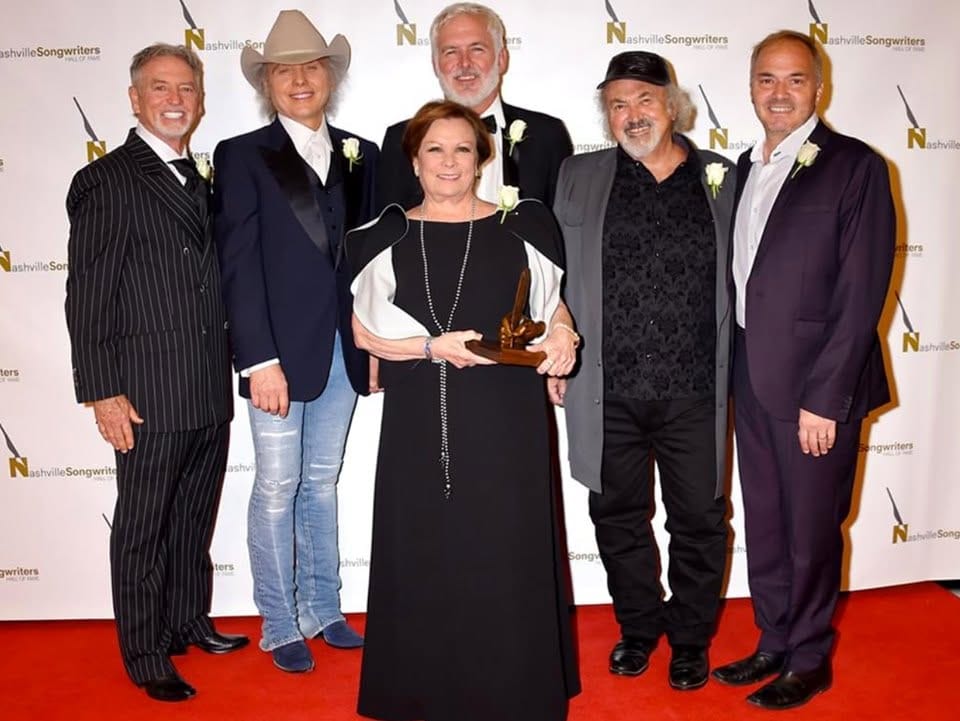
That night he inducted Sharon Vaughn into the Nashville Songwriters Hall of Fame. John Rich and the Isaacs sang the saloon song. Garth Brooks stood with an acoustic guitar and sang “My Heroes Have Always Been Cowboys” back to its writer.
Vaughn says she never had a formal songwriting mentor. In her Hall of Fame speech she named the people who taught her instead: taxi drivers, crooks, cowboys, wanderers, Waffle House waitresses, the lost and the broken. She thanked the women who made room before her and the women coming behind. Then she helped herself to the wisdom of one of her own favorite songs.
“It took a while to get here,” she said, “but I'm right on time.”
Vaughn now serves on the Hall's board, remains on the faculty of London's Songwriting Academy and teaches writers as far afield as Spain. She reckons her lifetime count at more than 4,000 songs and aims to write at least one a day.
Nine of the 16 songs on Exile's 2023 album A Million Miles Later carry her name, from the road-worn title song to the lullaby “Valentine Sky” and the Isaacs-assisted gospel of “Down in Cold Water.” The Swedish years never put her country work out to pasture.
In 2026, she told Generation Country that she had finally begun writing with Paul Worley, a friend since his undergraduate days at Vanderbilt and, improbably, someone with whom she had never worked during all his years producing the Dixie Chicks, Lady A and others. She is also working on scripts and on the memoir Desmond Child keeps hounding her to finish.
At 79, her appetite for a great song is as hearty as ever.
“Great songs are diamonds,” she says. “Good songs just bore me. Great songs thrill me.”
Sources: Sharon Vaughn interview with Generation Country, July 2026; Nashville Songwriters Hall of Fame; Country Music Hall of Fame and Museum's 2017 Poets and Prophets program; Nashville PBS's 2026 episode of The Songwriters; Christopher Lochhead's 2026 Follow Your Different interview; Brendan Murphy's 2026 Please Do Something songwriting interview; Martin Sutton's Hitmakers Exposed interview; Country Aircheck, September 9, 2019; MusicRow, January and August 2000 and October 15, 2019; ASCAP Playback, Fall 2008; Billboard, Cash Box and Record World issues held by World Radio History, 1974–2001; Dave Paulson's “Story Behind the Song” for The Tennessean; The Songwriting Academy; official CMA and Grammy records; Official Charts Company; JASRAC; Sveriges Radio; Orlando Magazine; Paul Brady's official album notes; interviews with Per Gessle and Rodney Clawson; Sharon Vaughn's official biography and songwriting catalog; B Street Theatre; and contemporary theater programs and production materials. Vaughn's interview quotations have been lightly condensed for length and clarity.
RECOMMENDED LISTENING
“Until the End of Time” | Narvel Felts and Sharon Vaughn (1974)
Before the catalog, the voice: Vaughn's Billboard Top 40 country appearance as a recording artist.
“My Heroes Have Always Been Cowboys” | Waylon Jennings (1976)
The song, written in 17 minutes, in its first recorded home, on country's first platinum album.
“Y'all Come Back Saloon” | The Oak Ridge Boys (1977)
A barroom short story written like a hymn, and the doorway to the Oaks' country career.
“I'm Not That Lonely Yet” | Reba McEntire (1982)
A defining Sharon-and-Bill Rice record: conversational, adult and built to let the singer act.
“Soul Searchin'” | Leon Everette (1982)
Top 10 country, with a title that shows how much mileage the Rices could wring from plain language.
“'Til a Tear Becomes a Rose” | Leon Everette (1985)
The first version, five years before Keith Whitley and Lorrie Morgan gave the song its enduring biography.
“Broken Promise Land” | Mark Chesnutt (1991)
Hard-country regret from the Rice catalog, sung by one of the decade's surest traditionalists.
“Lonely Too Long” | Patty Loveless (1996)
Bone-honest country. No sermon, no punchline. Read our Behind the Song feature.
“Along for the Ride” | Matraca Berg (1997)
Two metaphor mavens make a roller coaster out of surrender; Vaughn is also in the background-vocal blend.
“Out of My Bones” | Randy Travis (1998)
Heartbreak as illness and superstition. A No. 1 on the Radio & Records and Canadian RPM country charts.
“Powerful Thing” | Trisha Yearwood (1998)
Vaughn and Al Anderson find get-up-and-go inside infatuation; Yearwood makes the joy sound muscular.
“When a Man Can't Get a Woman Off His Mind” | Craig Morgan (2000)
The Bill Anderson collaboration Vaughn calls perhaps the best country song she has written: three-chord obsession boiled down to one sleepless night.
“Right on Time” | Randy Travis (2004)
One of Vaughn's favorites, later recorded by Al Anderson, Marc Cohn and Gretchen Wilson.
“Trip Around the Sun” | Jimmy Buffett and Martina McBride (2004)
Mortality with a shrug instead of a lecture. The song has gathered stories far larger than its Top 20 peak.
“Release Me” | Agnes (2008)
The international breakthrough: a UK Top 3 hit and an American dance-club No. 1.
“Rising Sun” | EXILE (2011)
A hit by the Japanese group, and JASRAC's top foreign work of 2013.
“Scream” | Sergey Lazarev (2019)
Third place for Russia at Eurovision, with a bridge Vaughn sang by telephone to a waiting Moscow orchestra.