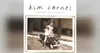
Write! Records · Released September 18, 2026
Produced by Skip Ewing, F. Reid Shippen and Bryan Sutton
Additional production by Alena Moran on “Me & God and a Fishing Pole,” “Play On” and “I Want It All”
Recorded at Blackbird Studio D, Nashville · 10 tracks · 35:19
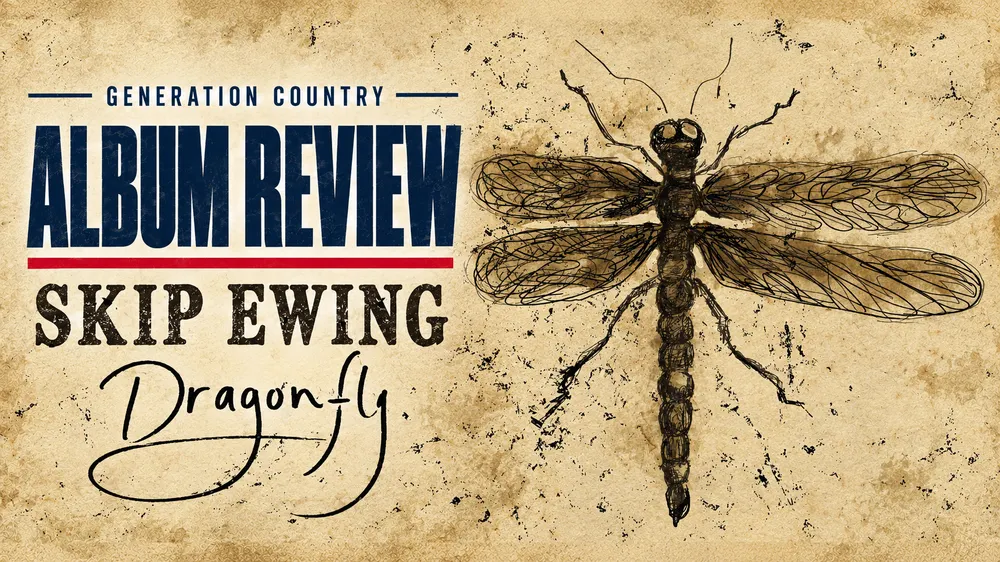
Half of Dragonfly was already in the can when a blue dragonfly flew up beside Skip Ewing on a walk near his home in the Wind River country of northwestern Wyoming and handed him a title.
It had snowed twice already. A grown dragonfly had no business out in that cold, and they're scarce up there to begin with. This one stayed with him anyway, flying escort across the meadow. Ewing, a lifelong philomath, went home and read up on metamorphosis, renewal and the years a nymph can spend underwater before one short season on those shining wings, and recognized the record he was already making.
The title didn't herd the songs anywhere. It found them out in the pasture.
Ewing had returned to album-making with Wyoming in 2020, and Robert K. Oermann greeted it in MusicRow with “Welcome home, son.” Road to California followed in 2024. Six years on, the son has unpacked and moved in for good. Dragonfly takes that independent streak and points it square at country radio, and radio has been answering. “I Want It All” spent 11 straight weeks in Country Aircheck's Top 60, and this year he carried the new songs onto the Grand Ole Opry stage.
Ewing was a Western kid before he was a Nashville one. He was born in Redlands, California, and grew up in an Army family, mostly in Colorado. He first got around horses on an uncle's thoroughbred ranch, and his debut album was called The Coast of Colorado. Years later he sold his Nashville house and everything but his instruments to study horsemanship, and wound up on the road helping his mentor teach clinics. The horses, he found, never cared who had cut his songs. Since 2018 he and his wife, Linda, have lived near Dubois, where bighorn sheep wander up the driveway. For years he brought aspiring songwriters out to a ranch there for a retreat he called Horse and Writer. All those years of waiting on horses show up on this record as patience.
For nearly 40 years, Ewing has kept two mailboxes, one for the singer and one for the songwriter, and Nashville mostly checked the second. His own hits included “Burnin' a Hole in My Heart,” “The Gospel According to Luke” and “It's You Again.” His songs found another life in the voices of Randy Travis, Collin Raye, Bryan White, Kenny Chesney, Diamond Rio and others, accumulating 11 No. 1 songwriting credits along the way. In 2025, ERNEST and Lainey Wilson turned “Would If I Could,” a song Ewing wrote with Dean Dillon in 1996, into a fresh radio hit. It was the only song the two ever wrote together. It sat 29 years on the cellar shelf like a jar of put-up peaches and came out sweeter than the day they sealed it. As early as 1997, Billboard was announcing that Skip Ewing was singing his own lyrics again.
On Dragonfly, he wrote nine of the 10 alone, so for once the voice on the record and the name in the parentheses belong to the same fellow.
Ewing produced the album with F. Reid Shippen and Bryan Sutton in two rounds of sessions at Blackbird Studio D. Read the credits and you find a modern-sounding record staffed by pickers country fans know by name. Sutton, who played lead in Ricky Skaggs' Kentucky Thunder and once got the call to replace an injured Tony Rice on a Béla Fleck tour, moves among guitar, mandolin and bouzouki. Derrek Phillips supplies drums and percussion; Sol Philcox-Littlefield plays guitar; Lex Price plays bass or guitar as the song requires; Dave Cohen and David Dorn handle keyboards and piano; Wes Hightower adds vocals. When the arrangements widen, Josh Matheny brings dobro, Aubrey Haynie fiddle, Mickey Raphael harmonica and Bruce Bouton guitar. Raphael has blown harp behind Willie Nelson since 1973, and Haynie's fiddle is all over Randy Travis' “Out of My Bones,” the record whose story Generation Country told this month. Ewing wrote Travis a No. 1 of his own, “If I Didn't Have You,” and played guitar on the record.
Sutton's acoustic instruments, Matheny's dobro, Haynie's fiddle and Raphael's harmonica keep the record fluent in the country language Ewing has spoken since he picked up a guitar at 4, and the drums and guitars come in big enough to hold their own on today's radio. Alena Moran joins the production team on three tracks. Nobody asks Skip Ewing to dust off 1989. His old tack still fits. It's just been oiled.
“Me & God and a Fishing Pole” opens where Ewing does his best thinking now, out where the loudest thing for miles is a trout changing its mind. The fishing is mostly an alibi. Faith arrives without a church service or an easy answer, carried by Ewing's voice and a compact arrangement that lets a little doubt pull up a stump beside him. He isn't preaching from the bank. He's reading the water.
The stillness lasts one track.
“Play On,” the album's longest song, is the rare music-business song that draws blood without whining. It opens spare and rootsy, with the Martin acoustic introduced as a “Jesus box made in Nazareth” and Hank appearing in a spotlight dream to deliver one hard instruction. The Nazareth line is no stretch. Martin has built guitars in that Pennsylvania town since 1839. And Hank has standing to give orders here. Ewing's first staff-writing deal was at Acuff-Rose, the house that published Hank's songs. Sutton's clean flatpicking, mandolin and bouzouki work alongside Matheny's sliding dobro before Philcox-Littlefield's electric guitar and Phillips' drums pull the track into a heavy Southern-rock groove. Shippen's mix lets it run hot without ever clipping.
The hook starts out as a pep talk and ends up a warning. The devil holds the purse strings in Guitar Town, and his checks keep clearing long after the artist is in the ground. Ewing has earned the right to sing it. He once watched a top producer wave off “Love, Me” for his own record, then stood on the sidelines while Collin Raye rode it to No. 1. His weathered tenor knows where the machinery keeps its grease fittings, and he sings with enough wit to keep the song from curdling.
“Whiskey and You” turns from the business to a house where addiction and heartbreak have grown together like fence wire through a tree. The bottle is an accomplice that keeps taking the rap for the whole job. The real trouble is the love that gives the drinking somewhere to hide. Sutton, who once won a Grammy alongside Doc Watson on a tune called “Whiskey Before Breakfast,” is back on the subject at a later hour. The larger band, with fiddle, dobro, harmonica and piano, keeps the ache human and never lets it play to the balcony. Ewing sings it as a man who understands that naming the problem only gets the halter on.
Two commitment songs follow, and they come at the promise from different rooms.
“Say Yes” is a proposal stripped of performance. The ring has been left behind because the answer matters more than the jewelry, and the singer only wants his dream to come true if it's hers, too. Fiddle and guitars keep it warm without dressing it for church. It is a wedding song for people who have read the fine print.
“I Want It All” sounds larger while asking for less. Its verses try on a country house, a city flat and a double-wide, then find the same abundance in each: chores, weather, neighbors, laughter and somebody present for all of it. By the chorus, “all” has come to mean one person. The band stays lean enough to fit in the double-wide.
Then the telephone rings. “Not Me This Time” gives us only his half of a late call, and it's plenty. You could rebuild every one of her pleas from the dents his answers leave. “Alcohol and a telephone can be a cruel combination,” Ewing has said. He never turns the refusal into revenge, and even the parting good wish comes through intact. Dobro, fiddle, harmonica and piano shade the full-band arrangement, but the performance holds the composure of a man who knows the hardest door to keep shut is the one somebody you love is still knocking on.
Mae Estes joins him for “Stronger Where You're Broken” as an equal voice, and the refrain turns into two people comparing scars. Ewing first took notice of her when she and Matheny posted a cover of a Randy Travis song he wrote. The idea underneath comes from his years in the round pen. Gentling is not breaking, and the song treats a hurt heart the way a good hand treats a spooked colt: slow, close and no sudden moves. Estes sings it like it was her story first.
Then a 6-year-old waits in a car.
The spoken opening of “No (A Self Worth Resurrection)” remembers a child who was told to stay in the car, didn't, and heard a woman face down the man who had spent years grinding her smaller. There's a service revolver in play. The packed car is her way out. The rest of the song is hers, a list of everything she is done taking, and it ends on the smallest complete sentence in the language.
Ewing first heard the whole song in her voice. Then he realized he could walk into it as the kid who saw it all. “I'm the kid,” he explained. “I'm playing the music back through the eyes of a 6-year-old who doesn't really understand what's going on.” He thought about starting it himself and handing it off to a woman partway through, but the deadline beat him to the right singer.
So the hand-off happens inside one throat. He starts out as the kid in the back seat and ends up standing in her shoes. Fiddle, dobro, harmonica and piano pile in behind him, the biggest arrangement on the record for its heaviest scene.
None of that size softens the subject. The song knows abuse works like a slow leak, letting the air out of a person a little at a time until there is hardly anyone left to save. The subtitle calls it a resurrection, and it comes in two letters.
After “No,” the record has earned a rest, and not the quarter-note kind.
“Stop Talking” is flirtation built from musician jokes. The count-off, the pocket and the kick drum all carry second meanings, and the same full band that carried the previous song's weight turns into the house band at a roadhouse. Ewing has called it tongue-in-cheek and groove-first. Coming right after “No,” it lands like the deviled eggs at a funeral dinner. Nobody has forgotten why they came, but somebody is laughing over by the coffee urn.
“Down on the Corner” is the only outside song. Shippen suggested that they cut one, and John Fogerty's old street-corner band gave everybody a reason to play. Fogerty dreamed that band up in 1969 after a newspaper ad for Winnie the Pooh merchandise set his mind wandering, and Pooh came out the other side as Willy and the Poor Boys.
Country has stood on this corner before, and in fine company. Jerry Reed, who could make one guitar sound like three, cut it at FAME in Muscle Shoals for his 1982 album The Bird and took it to No. 13. Kathy Mattea gave it her warm alto and a joyous New Orleans shuffle on 2005's Right Out of Nowhere. She and Ewing broke in the same way, working for the tourists. She led tours through the Country Music Hall of Fame, and he sang in the theme-park shows at Busch Gardens and Opryland. Both know what it means to play for whoever happens by. Sutton and Shippen skip the dutiful cover and fill a room with musicians and singers: Kenzie Nicole Wetz, Marty Slayton, Mica Roberts, Rod Fletcher, Tania Hancheroff, Tony King and Hightower join Ewing on vocals. It sounds like a tip jar with a choir in it.
It is a long way from a fishing bank to a street corner, and Ewing covers it in 35 minutes, done before the coffee in the thermos goes cold.
Ewing has always sung in a soft-edged country tenor that does its best work close to the microphone, and “Not Me This Time” keeps it right there. Dragonfly finds the other end of that voice, too. On “Play On” he growls the Guitar Town hook like a man settling an old account, and on “No” he opens the tenor all the way up until the refusal fills the room. It has grain, weight and an actor's interest in whose mouth each song belongs. He's been bucked off by this business before, and you can hear it.
Nashville filed Skip Ewing under songwriter and misplaced the paperwork for 30 years. On Dragonfly, the singer, the songwriter and the Wyoming horseman in Skip Ewing finally ride for the same brand.
VERDICT: Dragonfly is the record Skip Ewing spent a lifetime earning the right to make. It is present tense from the first cast to the last chorus: nine solo-written songs about faith, commitment, addiction, self-respect and beginning again, played by Nashville's first-call pickers. “No (A Self Worth Resurrection)” is its dramatic center, “Play On” its hard-earned autobiography, and the trip from a solitary fishing bank to the crowd on “Down on the Corner” gives it a shape that would hold even if the dragonfly had stayed home. For decades, Skip Ewing rode drag behind other singers' voices. On Dragonfly, he rides point.
Essential tracks: “No (A Self Worth Resurrection),” “Play On,” “Not Me This Time,” “Me & God and a Fishing Pole,” “I Want It All.”
Skip Ewing · Dragonfly · Write! Records · 2026
Produced by Skip Ewing, F. Reid Shippen and Bryan Sutton