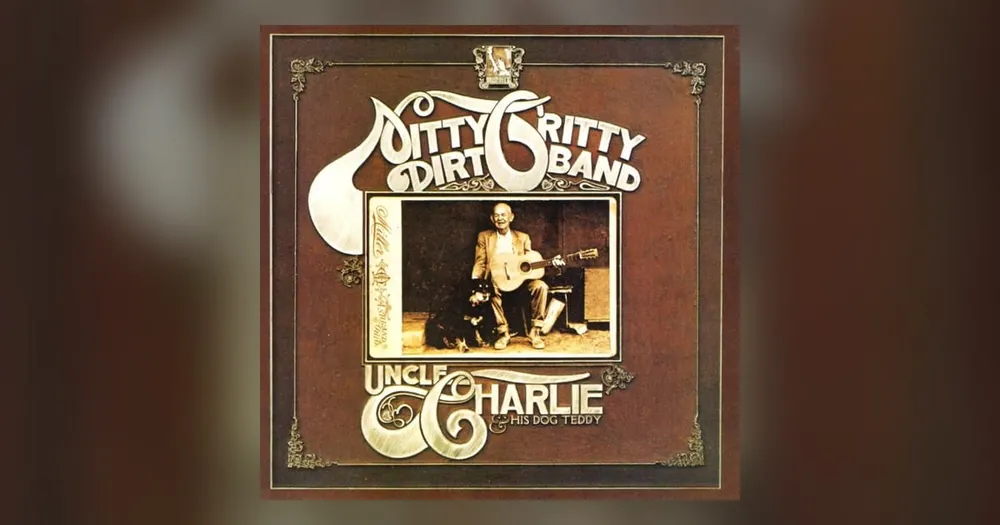
Liberty Records · 1970 · LST-7642
Produced by William E. McEuen · Recorded 1969
Jeff Hanna · Jimmie Fadden · John McEuen · Les Thompson · Jimmy Ibbotson
"It really is our best album." - Jeff Hanna, 1970
The record that would hand the Nitty Gritty Dirt Band its first top-10 single is named after somebody's uncle. Not after the hit riding inside it. Not after the band. After an old man born in Kaufman County, Texas, in 1886, who had been unknown to the wider world his whole life and would have preferred it that way.
Uncle Charlie was real. Bill McEuen taped him at his home in Springville, California, and two of those minutes went straight onto a major-label record exactly as caught: Charlie singing the outlaw ballad "Jesse James" in a 1963 recording, fumbling a few of the words, carrying the tune anyway on nothing but the joy of carrying it. John McEuen explained the choice to the Hartford Courant the next spring without a trace of irony. The album was a tribute, he said, to a kind of person who "really doesn't exist any more. Someone who loves music, but not for the money." That is the whole thesis of the Nitty Gritty Dirt Band, stated once, out loud, on the cover.
It needed stating, because the four albums before this one had buried it. The band had come out of the Long Beach coffeehouses as a jug band, gotten famous fast and sideways, spent three months in the Oregon woods filming Paint Your Wagon, and let a string of producers polish them into something slicker than they were. McEuen's own release-week accounting, delivered to a Kansas City reporter that November, ran "two mediocre albums and two bad albums" — and then Uncle Charlie, "our latest, and we're all proud of it. You can listen to every song on it, which is saying a lot." Jimmie Fadden put the turn more plainly: the earlier records "were a bad representation of what we were… until we got some control over production. 'Uncle Charlie and His Dog Teddy' was a liberating album for us." Backstage in Houston that December, a Houston Post reporter caught Hanna making the same point twice in a breath. "We've been over-produced on occasion, but this one is done just right. We come across as we are." And, closing the folder of reviews his manager was passing around: "It really is our best album." They were not hyping. They were relieved.
Part of that was a new man in the room. Jimmy Ibbotson had joined in 1969 out of Indiana, and he brought rhythm, an accordion, Cajun feel and a rock backbone that deepened everything the others already did. What the five of them made together was less an album than an attic — some twenty tracks pulled from every shelf of American music and shelved side by side without apology. Michael Nesmith, fresh out of the Monkees, supplied two of the best songs on it, "Some of Shelly's Blues" and "Propinquity." Randy Newman contributed the small, devastating "Livin' Without You." Buddy Holly's "Rave On" sat a few grooves from a Muzio Clementi sonatina — "Opus 36," written in 1797, arranged for the band by Walter McEuen — which sat near the fiddle rags "Clinch Mountain Backstep" and "Billy in the Low Ground," which sat near Stephen Foster's "Swanee River" and a home recording of an old man and his dog. Laid end to end it should play like a rummage sale. It plays like a map — every track a different county of American music, cut by a band that had plainly been to all of them.
Name them one by one and they hold. The two Nesmith songs are pop at heart, and the band plays them that way — light on the banjo, easy in the pocket, never straining to be more than they are. "Livin' Without You" is the one most singers sink in their own sympathy; the Dirt Band plays it dry-eyed and half-smiling, and the song is stronger for it. The fiddle romps "Chicken Reel" and "Clinch Mountain Backstep" are pure grin, played hard and left alone. And McEuen's solo-banjo raid on a Clementi sonatina, "Opus 36," is the record's odd little miracle — an eighteenth-century parlor exercise turned five-string. Then there's the fact the cover never tells you: the tape was already an heirloom. Charlie was in his late seventies when Bill McEuen caught "Jesse James" at the house in Springville, seven years before the album shipped — a little history, a song or two, and his dog Teddy howling "The Old Rugged Cross" underneath.
There is a private symmetry in those two cuts. The same autumn the Dirt Band walked back toward the parlor, the man who wrote them was sprinting the other way out of Hollywood — Nesmith's First National Band newly formed, "Joanne" climbing to No. 21 on the Hot 100 on a tide of pedal steel. One ex-Monkee fleeing manufactured pop for the country; a onetime movie act climbing the same chart beside him on a dead man's parlor songs. Two getaways, crossing in the middle. And "Some of Shelly's Blues" reached the band by a back road that ran through Nesmith himself: during the 1968 breakup, Hanna and Chris Darrow had formed a country-rock outfit called the Corvettes with Nesmith producing, and when Linda Ronstadt left the Stone Poneys and needed a band, the Corvettes became hers, the song already in her nightly set. "I got to harmonize on that one with her every night," Hanna recalled to PopMatters. "So when the Nitty Gritty Dirt Band reformed we carried that song into the band; me and Jimmy Ibbotson got to do our Everly Brothers thing on it." A breakup, a Monkee, and a season backing Ronstadt — that detour is how the Dirt Band came home with the two-part harmony that became its signature.
Buried in that scrapbook is one of the great talent-scouting jobs in the band's history. Four of these songs — "Prodigal's Return," "Yukon Railroad," "Santa Rosa," and the one everybody remembers, "House at Pooh Corner" — came from a teenager named Kenny Loggins who had not yet met Jim Messina and had no record deal. The Dirt Band cut a quarter of an unknown's songbook on faith, and their "House at Pooh Corner" — pure electric pop, wah-wah and all, an A.A. Milne bedtime story set loose on the radio — became the first hit version of a song that has never left the American songbook since. Loggins built a career on it. He built it on a chair the Dirt Band pulled out for him before the world knew his name.
The sequencing hides the album's sly masterstroke. Charlie's mangled "Jesse James" and a snatch of interview run straight into "Mr. Bojangles," and the segue is an argument. Jerry Jeff Walker's song is about a broken-down street dancer grieving a dog twenty years gone; the old man who introduces it is a living version of the same tenderness, still singing for nothing in a Texas parlor. The band had picked up the Walker tune almost by accident — Ibbotson had been carrying the single around for months — and cut it half-convinced it was too long and too quiet to matter. The band played the 45 on a warehouse turntable with pennies placed on the disc — there was no amplification — and pulled the lyrics as best they could. They got a few words wrong, and those wrong words are the ones on the record. It went to No. 9 and pulled the band out of the obscurity that years of steady road work had never cured. The too-quiet waltz turned out to be the loudest thing they ever recorded.
The record did its commercial work. The album reached No. 66, the band's best showing yet; "Mr. Bojangles" entered the Hot 100 in November 1970 and kept climbing until it sat at No. 9 for three weeks the following February — nineteen weeks on the chart, No. 10 on the adult-contemporary side, a finish among the year's top fifty singles, the kind of hit the papers were still calling a million-seller a decade later. For one year the band turned up everywhere it had never been — singing "Mr. Bojangles" on The Glen Campbell Goodtime Hour, sitting down for Dick Cavett, sharing a Carnegie Hall bill with Bill Cosby. Four albums in, they had arrived — without changing a thing.
Underneath the song choices sat a real engineering breakthrough. Uncle Charlie is where they solved, one instrument at a time, how a string band built on banjo, mandolin and fiddle could carry a backbeat without going electric-rock and losing its soul — the exact problem an entire genre would spend the next fifty years working out. They were describing the solution to newspaper reporters in 1970 as if it were a plumbing job, which, gloriously, it was. The record swings where the earlier ones only strummed.
The spoken Uncle Charlie interludes are not built for repeat listening, and were never meant to be. They were proof, in a real old man's cracked voice, that the band meant what the polished records had been too slick to say. A year later that same conviction would walk the band into a Nashville studio to make a three-record set with Roy Acuff and Mother Maybelle Carter and Doc Watson, everything cut live, nobody counting the money. The seed of Will the Circle Be Unbroken is right here, on side two, singing "Jesse James" and getting the words wrong.
VERDICT: The record where the Nitty Gritty Dirt Band finally sounded on tape like the band it had always been onstage — framed around a Texas-born old-timer who loved music and not money and was, McEuen said, a vanishing type. It gave them "Mr. Bojangles" and their freedom in the same forty-five minutes, put a teenage Kenny Loggins on the map, and drew the blueprint for the Circle. The band called it their best on the day it came out. Fifty-six years and a farewell tour later, the case has only gotten easier to make. Uncle Charlie's kind of person wasn't supposed to exist anymore; five long-haired kids from Long Beach spent the next six decades being exactly that person.
Essential tracks: "Mr. Bojangles," "House at Pooh Corner," "Some of Shelly's Blues," "Livin' Without You," "Propinquity." Then sit through the "Jesse James" home recording once, and understand why the rest of it exists.
Uncle Charlie & His Dog Teddy · Nitty Gritty Dirt Band · Liberty Records · 1970
Produced by William E. McEuen · Art direction by Dean Torrence