"We make American music." — Jimmie Fadden, 1971
With new reflections from Rosanne Cash, Rodney Dillard of The Dillards, John Cowan of the New Grass Revival, Carl Jackson, Michael Martin Murphey, Mark O'Connor, Duane Allen of The Oak Ridge Boys, Josh Leo, Ray Benson of Asleep at the Wheel, Dave Pomeroy, Gail Davies, Robbie Fulks, J.P. Pennington of Exile, Larry Stewart of Restless Heart, T. Graham Brown, Sawyer Brown, Tim O'Brien, Tim Stafford, Sally Van Meter, Viktor Krauss, Erin Enderlin, Irene Kelley, Bill Lloyd of Foster & Lloyd, Bob Stane, Steve Buckingham, Dan Tyler, Jim Lauderdale, and Michael McCall of the Country Music Hall of Fame and Museum
In August of 1971, in Woodland Studios in East Nashville, the most radical act in American music was a handshake.
On one side of it stood a rock band from Long Beach, California, all of them in their mid-twenties, fresh off a top-10 single and hair that scandalized both of their grandmothers' generations at once. On the other stood the royalty of a music that had every reason to distrust them: Roy Acuff, Mother Maybelle Carter, Earl Scruggs, Doc Watson, Merle Travis, Jimmy Martin. The country was at war with itself that summer, and everybody in that studio knew which side the other one was supposed to be on. The night before Acuff arrived — as Jack Hurst reported in The Tennessean that week — Les Thompson told Jeff Hanna he had "better get a haircut before you see Roy Acuff." The band's manager and producer, Bill McEuen, asked the Nashville papers to stay out of the studio until the King of Country Music and the long-haired kids had gotten used to one another. Bill Monroe declined to come at all. The band understood the stakes in its bones. "The Vietnam War was raging," Hanna admitted years later. "I'd just seen the movie 'Easy Rider' and I wasn't too thrilled about going down South. We were outsiders."
Acuff came, because Wesley Rose of Acuff-Rose asked him to — "he said he thought it might sort of increase the respect between our brand of music and theirs," Acuff explained afterward — and what he found confounded him in the most wonderful way. "Well, you're supposed to know a man by the character of his face," he told Hurst that week, working at being polite. "But if you have got your face all covered up with something, well... I'll just tell you: they are very nice young boys — well, to be honest with you, I couldn't tell whether they were young boys or old men — but they were very interesting, and they certainly knew what they were doing."
Half a century of warm remembrance has sanded that week down into something quaint. It was not quaint. It was a young band spending every dollar of its hit-record capital on its elders, in a town that regarded the band with suspicion and a country that regarded its long hair as a provocation, and it was the elders — to their everlasting credit — who reached back. Hurst's story ran that Sunday under a headline the world would come to know before the album even had a release date: "Music Forms A New 'Circle.'" He wrote that the record "may well be one of the most important recordings done in the 45 years of the Nashville music business." Time has made that sentence look shy.
The Nitty Gritty Dirt Band ended its touring life on June 18, 2026, at the Mission Ballroom in Denver, sixty years and five weeks after their first paid gig. What follows is the story of what happened in between, told wherever possible in the words people said at the time — because this band's history is so improbable that it helps to have the newsprint.
THE HANGERS-ON
The band begins in a guitar shop. McCabe's, on East Anaheim Street in Long Beach, kept a back room where the coffee was free if you didn't ask permission, and in 1965 and '66 a cluster of teenagers kept not asking. "We called them the 'Hangers-On,'" a McCabe's employee named Gary Hart told the Long Beach Press-Telegram in 1967, "because they would hang around, drink our coffee, play their guitars and never buy anything." Jeff Hanna and Bruce Kunkel had met in high school and worked up a folk duo, the New Coast Two, which became the Illegitimate Jug Band — illegitimate, they explained, because they did not own a jug. Ralph Barr and John McEuen taught guitar at the shop. Jimmie Fadden built his own washtub bass out of, per the Associated Press, "an old metal tub, an oak broomstick and a D bass string." Les Thompson played mandolin. The name arrived in a lecture hall: a political science professor at Long Beach City College reached for the phrase "the real nitty gritty," and a band had a christening. "Which was pretty surprising," Barr told the Press-Telegram, "because he didn't usually talk like that." The legitimacy question, at least, was settled in-house: unlike its predecessor, this jug band had a jug man. "We became legitimate, actually," Fadden ruled half a century later, "because I played jug."
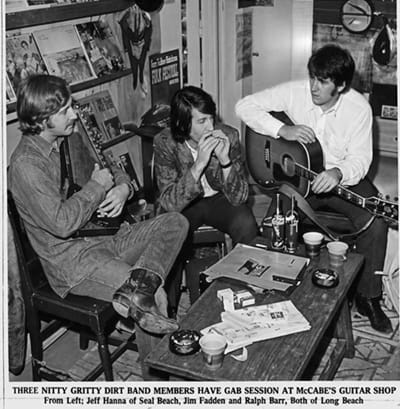
Southern California in those years hid a roots conservatory under the surfboards. The Ash Grove booked the old masters into West Hollywood; the Dillards had carried Missouri bluegrass to Los Angeles and made it fast and funny; the Kentucky Colonels were minting Clarence White into a flatpicking prophet. McCabe's sold the instruments, the Paradox supplied the floorboards, and the Dirt Band absorbed the essential California trick: treat the past as material, not museum glass.
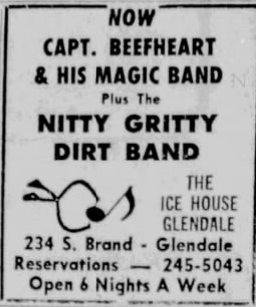
Their first paid engagement came the weekend of May 13, 1966, at the Paradox club in Orange County — a talent-contest prize: a week's paid work and all the pizza they could eat. Memory keeps only fragments of the night itself. "Too much fun," per Fadden. "All I remember is that it was packed, smoky, and I was scared to death because it was the first show we headlined," per Hanna — a man so committed to the enterprise that he'd already skipped a night class at Long Beach City College to play the Jug Band's first-ever concert at the Golden Bear. By the end of June, they were sharing a week at the Glendale Ice House with Captain Beefheart and His Magic Band, six kids in thrift-store pinstripes ("We get them from dead gangsters," Barr quipped) among an instrument collection one paper said "would stock a good sized antique store." The Ice House's owner, Bob Stane, vouched for the booking in the Van Nuys News that week: "It is a completely entertaining package." Sixty years later, asked to remember them for this tribute, Stane wrote: "The Nitty Gritty Dirt Band claimed The Ice House was the first place that they played. Ever. And they got paid!!! Wonderful musicianship and great humor. I wish the music scene still featured them. They traveled the World and the World is better for hosting them." That November, the hometown paper took its first long look and led with a sentence for the ages: "They are out to make Long Beach the Liverpool of America and with a name like the Nitty Gritty Dirt Band they just may do it."
For a moment in 1966, the sixth member was a shy songwriter from Orange County, still in high school, named Jackson Browne. "Getting to play with them was a huge installment in my musical education," Browne said fifty years later, "because I got to sit there and play these really intricate songs. I mean, they were all better players than me, so I learned a lot." He also called them something better than good: "They were kind of musicologists even then, from the very beginning... They found recordings of the Memphis Jug Band and those things were hard to find." When Browne left to become Jackson Browne, the band enlisted John McEuen full time — Hanna spotted the Garden Grove banjo prodigy sitting in with a New York bluegrass band at the Golden Bear and invited him in on the spot. In Hanna's words: "this amazing multi-instrumental secret weapon kind of guy."
The scene's own royalty was watching. Rodney Dillard — whose Dillards had carried that Missouri bluegrass to Los Angeles while these kids were still in high school — takes the measure of it all in a statement for this tribute: "The Dirt Band was one of the first groups to come from the L.A. pop scene into the country music medium. John McEuen's passion for the banjo and bluegrass music was a great influence on their direction. He and his brother Bill were the driving force for the very successful Circle album. The Dirt Band's choice of songs was on target for many successful hits." The crossing, the banjo, the brothers, the songs — sixty years of this story, in four sentences, from the man whose band drew the map.
Michael Martin Murphey was in those rooms too, and he sent his memory of them on video, grinning the whole way through. He was a UCLA student then, "trying to survive as a songwriter in Hollywood and on Sunset Strip, where my company was Screen Gems Music and Sparrow Music," playing the coffee houses — "a big deal back then," he says, the rooms where students went to hear original music. "That's where I ran into a guy named John McEuen and another guy named Jeff Hanna, and they said, 'We're forming a band together someday.'" Before there was a Dirt Band, McEuen backed Murphey and Boomer Castleman's duo, the Texas Twosome, and "taught me a lot about how to play the banjo. And we just got to be fast friends. This is before the Dirt Band." The friendship ran both directions for decades — McEuen played on "Carolina in the Pines," Hanna sang on "Wildfire," and sixty years in, Murphey's "Cosmic Cowboy" was still in the band's set at the anniversary show. "I wish these guys well," Murphey says, "but I want you to know they've been dear, dear friends of mine for a long, long time."
Michael Martin Murphey reflects on the Nitty Gritty Dirt Band for Generation Country
What the stage show looked like survives because a reporter followed them through it in early 1967 and filed the details like a war correspondent. The set opened with Bruce Kunkel crooning "I'm Going to Sit Right Down and Write Myself a Letter" while "practically eating the microphone." The band paused to deliver a six-kazoo salute to a poster of W.C. Fields hanging on the curtain behind them. Ralph Barr blew bubbles mid-song. And under flickering strobes, "Somebody Stole My Gal" turned the sextet jerky and sepia until, she wrote, "it looks like an old-time flick." Cashbox pronounced them "the most visually compelling new group of '67," and the California State Fair billed them that summer under stage names that deserve preservation: Jeff "Spanky Duff" Hanna, Jimmie "Stach Harpo" Fadden, Ralphy "Raucous" Barr, Bruce "Spider Bones" Kunkel, Les "Totally" Thompson, John "King of the Banjo" McEuen.
Success came fast and strange. "Buy for Me the Rain" cracked the national charts in 1967 and put them on Johnny Carson's couch — a bunch of teenagers newly moved up to Hollywood, hearing themselves on the radio, in Hanna's memory, "like every ten minutes." "We were like, 'Top of the world, Ma!'" Dick Van Dyke, emceeing one of their shows, told the crowd that "the worst thing I could do to a friend is to ask him on a program to perform following the Nitty Gritty Dirt Band." Joshua Logan put them in Paint Your Wagon, where they spent three months in the Oregon woods and shared a production number with a dancing Lee Marvin — whose growl from the same picture, "Wand'rin' Star," went to No. 1 in Britain and kept the Beatles' "Let It Be" out of the top spot. And in the lean stretches they were six teenagers in one Sausalito hotel room with two dollars to last until Sunday, hitchhiking across the bridge to play Basin Street West while the road manager bought them food. And the family already had a comedian in the wings: Steve Martin, John McEuen's boyhood friend from Garden Grove, had learned banjo at McEuen's elbow, would take Bill McEuen as his manager, and spent the early '70s opening the band's shows — an apprenticeship that paid off for everybody in 1978, when the band, billed as the Toot Uncommons, played on a little record called "King Tut."
And one night in 1967 tells you everything about where the compass pointed, whatever the costumes said. "I remember one night we were doing a show on a football field in California with The Doors, Jefferson Airplane, Buffalo Springfield, The Byrds and Steppenwolf," Hanna recalled to the Associated Press. "And what did we do? We left as quick as we could, to get to this club that seated 185 people to see Bill Monroe. The other music was fine and there were hip people there. But our feeling was, 'Let's go see Bill Monroe. He's real.'"
The decade turned with a brief fracture — the band dissolved for a stretch after Paint Your Wagon — and even the fracture was generative. Hanna and Chris Darrow spun off a group called the Corvettes; Michael Nesmith produced them; and when Linda Ronstadt left the Stone Poneys — the group Nesmith's "Different Drum" had made famous — the Corvettes became her band. The re-forming took one look: in the summer of 1969, Hanna and John McEuen ran into each other at a Poco show at the Golden Bear — the same club where the band had first found McEuen — and settled it on the spot: "We could do this. We should be doing this. Let's get the band back together." Hanna's chair in Ronstadt's band went to Bernie Leadon, who thanked him years later for the vacancy that forced a banjo man to become a Telecaster player: "That got me the gig with the Burritos, and then of course the Eagles." Hanna carried home a Nesmith song from those nights, "Some of Shelly's Blues," and a friendship with Ronstadt that would keep paying dividends for decades.
Then came the record that changed the weather. Driving home from the Uncle Charlie sessions in 1969, Hanna caught the tail end of a song on the radio — no back-announce, no title. "I pulled the car over to the side of the road, and kind of got a lump in my throat," he remembered, "because it's such a beautiful song. It's so evocative, like a little movie with a gorgeous melody." At rehearsal the next day he started describing it, and Jimmy Ibbotson — the multi-instrumentalist who had come to the band by way of Indiana in 1969 and immediately deepened everything — walked out to his Dodge Dart, popped the trunk, and produced from beneath the spare tire, in a pool of rusty water, a 45 of Jerry Jeff Walker's "Mr. Bojangles." A woman in New Castle, Indiana had pressed it on him when he left for California, telling him he might need it someday. The band cut it and assumed that was that. "We thought the song was too good for radio," Hanna said. "It was a four-minute waltz about an old guy and a dog." A station in Shreveport played it late one night, the phones lit up, and the too-good-for-radio waltz spent nineteen weeks on the national charts and went to No. 9. The band, being this band, spent the windfall on the least commercial idea in America.
PASSED HAND TO HAND
The Circle album did not begin as a concept. It began as a courtesy call. The band had cut Earl Scruggs' "Randy Lynn Rag" on Uncle Charlie, and Scruggs' sons brought the record home — including the son the tune was named for: Earl had written it to celebrate Randy's birth, and the boy it announced would grow up to produce Circle II. "His dad was like, 'Well, that boy can play that five-string,'" Hanna recounted. Scruggs came to see them at Vanderbilt in late 1970 — Gary, then a student there, set up the meeting, and Earl brought Louise and all three boys — and what happened at the door is one of the great hinges in American music. "On the way out the door, Earl turns to us and says, 'If you boys would like to get in the studio and do some recording, I'd sure like that,'" Hanna said. "He closed the door and we looked at each other, like, 'What just happened?'"
They were not the only longhairs headed for Nashville. Dylan had opened that road in 1966, and by the decade's turn the city's session men were backing folk singers, Canadians, ex-Beatles and California rock bands curious about steel and dobro. But the Dirt Band arrived with a different errand entirely — and with no cover. "We were considered freaks," Ibbotson told Mix magazine in 1986, remembering those first Nashville trips into a town where George Jones still wore a crew cut and Willie Nelson had not yet decamped for Texas. They were not asking Nashville to modernize them. They were asking Nashville to remember itself out loud.
At Tulagi in Boulder a few weeks on, John McEuen worked up the nerve to make it formal: would Scruggs record with the Dirt Band? "He said, 'I'd be proud to!'" Doc Watson signed on a week later at the same club. For Hanna, Doc's yes closed a loop older than the band: he had first seen Doc Watson's face in the label advertisements on a Joan Baez liner sleeve his older brother brought home — Vanguard pitching its roster at a California kid who studied record jackets like scripture. The face in the ad was now on the record. Bill McEuen said he'd get Acuff and Merle Travis; John said maybe they could get Jimmy Martin; Scruggs brought Mother Maybelle. Norman Blake, a veteran of Dylan's and Cash's own Nashville bands, carried the dobro. Eight weeks after the question at Tulagi, they were in Woodland Studios — a converted 1924 East Nashville movie house whose studio chief, Glenn Snoddy, happened to be the engineer who invented the fuzz-tone pedal — and United Artists president Mike Stewart had heard the pitch and answered like a gambler: "I don't know how I'm going to sell this, but I'll put up the money." The budget, as the McEuens always told it, was $22,000. Bill McEuen modeled the whole conception on a 1960 blues summit LP, Down South Summit Meetin' — Lightnin' Hopkins, Sonny Terry, Brownie McGhee and Big Joe Williams with the between-songs talk left on the record — and the original plan, as Hurst reported it, was a double album whose second disc carried a tentative title to file away until the end of this story: "All The Good Times Are Past And Gone." The method was radical humility: everything cut live to two-track, first or second takes, no overdubs, a separate tape machine running the whole time to catch the talk between songs. "We tried to be clear that we were sincere about it, and it wasn't some kind of novelty," Hanna said. "This wasn't some kind of side trip for us. This was the music we had cut our teeth on." And: "If we screwed up, we had to start over, so there's a sense of spontaneity throughout the whole thing." The arithmetic stands as the sessions' plaque: more than thirty songs in six days, nearly all of them first or second takes.
What the tape caught was craft passing from hand to hand in real time. Maybelle Carter, whom the band privately regarded the way pilgrims regard a shrine — "all of a sudden we were like these polite little boys going, oh, my gosh, the queen is here!" Hanna remembered — calmed the room like weather. "She was just like, 'Boys, this is no big deal.'" At one point she asked, with total sincerity, whether it would be all right if she played "Wildwood Flower" on the autoharp. "We were like, uh, yeah," Hanna said. "That's like having Robert Johnson say, 'Could I pick a little "Crossroads" for you?'" Jimmie Fadden found himself tuning her autoharp: "That was pretty tall cotton for us, to be sure — we were just kids, in our 20s, and here I was, tuning Mother Maybelle's autoharp, and we're playing with our heroes." The suits never stood a chance anyway. Mid-session, McEuen took a phone call in the control room — a Columbia Records attorney, announcing that the band had been approved to record one song with Maybelle Carter. "And I went, 'OK, thank you very much. I'll let everybody know,' and I hung up," McEuen told Acoustic Guitar's Mark Kemp years later. "We were starting the fourth song... I mean, could you imagine telling Picasso, 'Hey Picasso, only this much blue — no more'? It's a good thing there were some hippies behind the glass." Doc Watson and Merle Travis met each other for the first time in their lives on that studio floor, on tape, Doc explaining he'd named his son Merle after the man in front of him. Vassar Clements tore through "Orange Blossom Special," and when Bill McEuen asked where the two strange little melodies in the middle came from, gave the deadpan of the decade: "Aw, that was just a little bit of 'School Days' and a little bit of 'Dragnet.'" Jimmy Martin surveyed the young band with professional envy — "If you could hire musicians like them around here to go with you on the road, they's no tellin' what you'd be able to do... Take banjo players, for instance. Seems like mine are always asleep." Martin's own son came to watch a rehearsal and filed the review that mattered: "Good Lord, Daddy, they're good." The banjo player in question sat there in one yellow sock and one brown one, legs crossed, and picked.
And then there was Acuff. The King of Country Music arrived wary — "really scared that we were gonna change his sound or ask him to do something distasteful, or that we were going to have Communists around the studio," Ibbotson remembered, "but as it turned out, we were all interested in one thing: crisp, clean recordings of great songs." He sat through five songs of playback without a word, staring straight ahead, while the band silently rehearsed its own obituary. Finally he looked over at Bill McEuen and asked, "What kind of music you boys call that?" The producer began stammering — "Well, I don't know... It's kind of an Appalachian bluegrass... uh kind of country... traditional kind of a..." — and Acuff cut him off with the sentence that ended a cold war: "Why hell! That's nothing but country music. Let's go make a record." He stayed for the Merle Travis playbacks and left the room with a promise: "That ain't nothin' but country. I'll be here tomorrow. Be ready."
The Wednesday evening it all came together made the front page of the next morning's Tennessean — "Getting Down To Nitty Gritty," August 12, 1971 — because Jack Hurst was standing in the room. Mother Maybelle sat teaching "Blue Eyes" to Hanna, Ibbotson and Thompson — three long-haired rock musicians literally at her knee — when Acuff came through the door hollering, "Well, how is this little operation goin' here tonight?" He crossed to the control room, where Doc Watson sat on a couch, listening. "I know you can't see me, Doc, but I just wanted to say hello to you again. This is Roy Acuff." Watson took his hand and would not give it back: "Sit down here a minute. I want to tell you you cut some great stuff yesterday. You must have sounded 20 years younger on 'I Saw The Light.'" Acuff admitted he didn't entirely know what the project even was; Watson explained the plan and vouched for their hosts — "they appreciate the music, there's no doubt about that" — and Acuff laughed: "It ought to either make them or break them." Then Jimmy Martin arrived, and Bill McEuen decided it was time to cut the song they meant to end the album with. Hurst watched the legends file in "laughing and joking with one another," and reported what happened next as plainly as scripture: "they did indeed make a circle." Acuff and Martin standing at a hanging microphone. Maybelle seated, arms crossed over her autoharp. Fadden "blowing softly and tentatively on his harmonica." "The blind Watson, looking dead ahead like a dog smelling the wind." Travis, Oswald Kirby, Earl Scruggs, Vassar Clements, John McEuen, Junior Huskey. And off to the right, around a second microphone, a second circle gathered of everyone else in the building — the wives, Earl's boys Gary and Randy, Martin's son, a writer from Rolling Stone. Maybelle began the opening verse — I was standing by my window, one cold and cloudy day — and the record had its name.
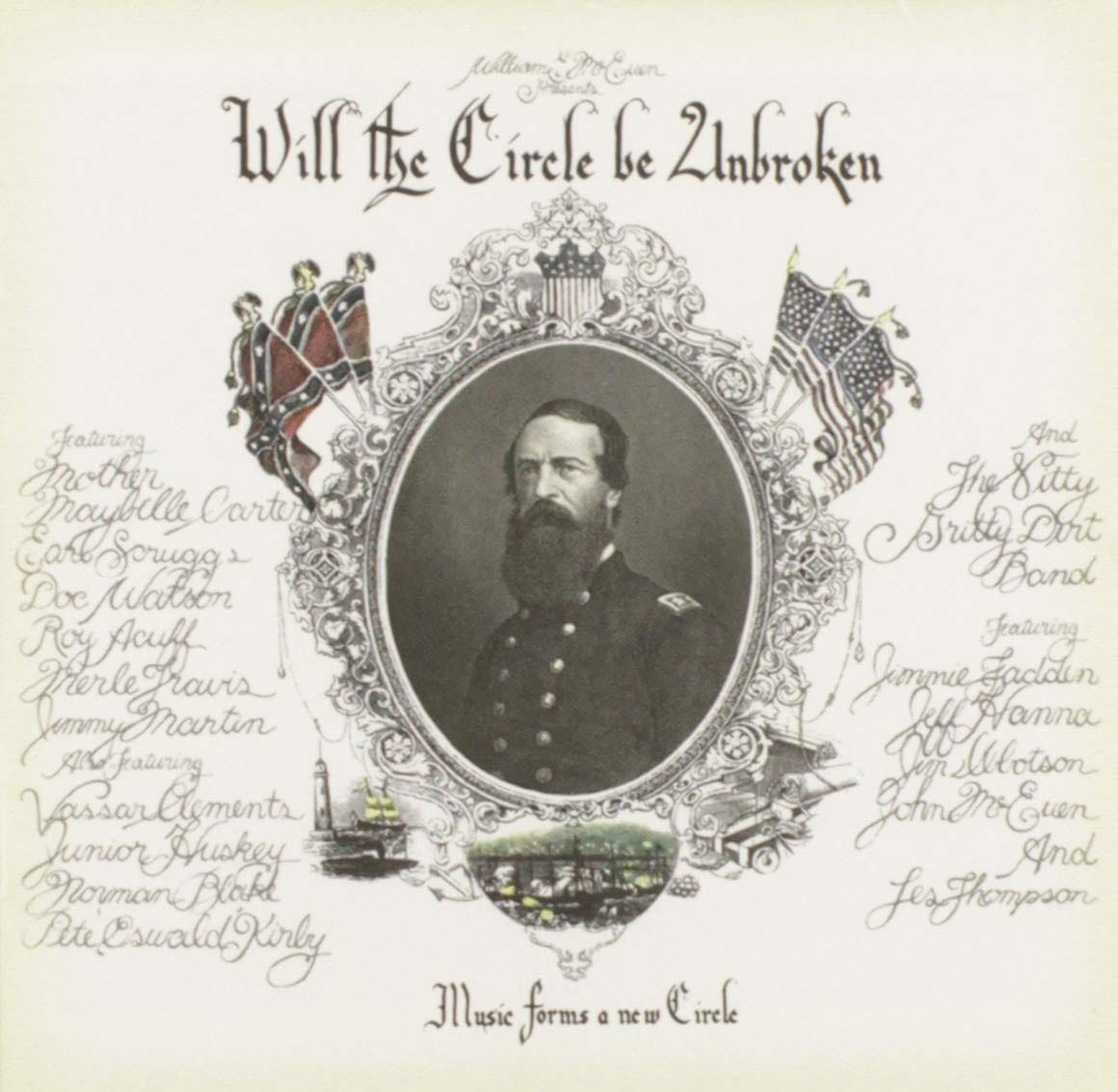
Will the Circle Be Unbroken came out in November 1972 as a triple album, its cover carrying a motto that had first been a Tennessean headline: Music forms a new circle. The package was a family production down to the ink — the Civil War-era portrait on the front is Union Admiral David Dixon Porter, the design came from Bill McEuen and Dean Torrence, lately of Jan & Dean, and the handwriting that spiders across it belongs to Bill's wife, Alice. It went gold within a year and platinum a quarter century later — and it never stopped: decades on, the Bitter Southerner could still report it "selling thousands of copies a year." It entered the Grammy Hall of Fame and the Library of Congress' National Recording Registry. Its title lyric now rings the rotunda of the Country Music Hall of Fame, and Hanna's washboard lives in the museum's collection; in 2022 the museum built the band into Western Edge, its major exhibit on the roots of Los Angeles country-rock, with Jeff and John McEuen both contributing interviews and artifacts. And its deepest sales figures were never counted in units. "We got letters like, 'My father and I never understood each other for thirty years. I bought the "Circle" album because of you guys and I brought him in to listen to it and he was dazzled. From that day forward we've been the best of buddies,'" Hanna has said. "I think it broke down some barriers." The testimonials arrived from every altitude — "When I met Bruce Springsteen he said it was an eye-opener for him," Hanna has noted — but his own shorthand for the collision has never been improved upon: "It was like the Grateful Dead meets the cast of Hee Haw." He has heard the record called "a primer of country music"; he was in the room when it was simply a bet. "My attitude was that, if nobody bought it," he told the San Francisco Chronicle, "at least I had a copy and that was proof that I'd gotten to play with my heroes."
One period skeptic had written — the line survives in Michael Bane's 1986 Country Music magazine profile — that "by every known law of the recording industry such an event should not have taken place, and even if it did, it should have been a disaster of Titanic proportions." Ibbotson's name for the barrier it broke instead beats any historian's: "I think that was when we broke through the barrier — the 'Corn Curtain.'" And McEuen, in the same profile, measured the album's meaning in the only currency that ever mattered to a kid raised on the radio Opry: "The most important thing the Circle album did for me is it allows me to go to Roy Acuff's dressing room anytime I want and say hello to Roy."
The record moved money before it moved genres. Ray Benson met the band in Nashville in 1972, fronting a young western swing outfit called Asleep at the Wheel — and the label that signed them was the one still counting the Circle's returns. "We were signed to United Artists Records largely because their Circle Be Unbroken album was such a success," Benson says. "Their respect for the roots country and bluegrass music was such a great bridge between the baby boom generation and the Roy Acuffs and other artists that made the music so great." Mike Stewart's gamble had become a policy.
Steve Buckingham was one of the listeners it sent hunting. "Like so many others, I was heavily influenced by the 'Will the Circle Be Unbroken' album in 1972," he tells Generation Country. His credits run past 450 albums — the disco smash "I Love the Nightlife" before Nashville ever knew him, the discovery of Ricky Van Shelton, Sweethearts of the Rodeo's whole hit run, a decade of Dolly Parton — with ten years running A&R at Columbia Nashville in the middle of them. In his case the influence went past the songs and into the lumber: when Merle Travis asked Doc Watson, on tape, about the guitar he was playing, and Doc mentioned his Gallagher, Buckingham "tracked down J.W. Gallagher in Wartrace, TN. I ordered a G-70 and had Randy Wood at The Old Time Picking Parlor create a rose & vine inlay on the fingerboard." That's the reach this record had: people didn't just learn its songs — they drove to Wartrace to find the luthier. And the loop closed the way loops in this story always do. Years later, running Vanguard and Sugar Hill — the same Vanguard whose liner ads had introduced a California kid named Jeff Hanna to the face of Doc Watson — Buckingham "was trying my best to sign the group to one of the labels since I loved the album they had made with my old friend, George Massenburg": 2009's Speed of Life. The sign-off on his letter reads like a man still holding that guitar: "Congratulations on 60+ years of pounding it out on the road and creating great art in the studios!"
The influence also traveled to people who never saw the record sleeve. Tim Stafford — co-founder of Blue Highway, a Grammy winner from his early-'90s years in Alison Krauss's Union Station, and three times the IBMA's Songwriter of the Year — came up in the mid-1970s among the pickers of East Tennessee and Southwest Virginia, inside a sound that, he says, "permeated down to the local musicians I adored." He only traced the source later. "The first time I heard Vassar Clements playing 'Lonesome Fiddle Blues,' Merle Travis slaying 'Cannonball Rag' and Doc Watson's unmatched versions of 'Black Mountain Rag' and 'Tennessee Stud' on the radio, I didn't even know they came from the same album, but I had heard this sound before." He had absorbed the record without knowing it existed. The Circle's trick, in his accounting, was that "in a way it brought all these sources together" — for the local heroes he studied, and "for all the young kids who got 'hooked' on this Bluegrass thing way back when and still can't quite get over it."
And the record worked on the elders too — the very generation it was built to honor. J.P. Pennington heard that at home: his mother was Lily May Ledford, founder of the Coon Creek Girls — radio's pioneering all-girl string band; "as far as I know, we were the first," Lily May reckoned late in life — and in 1972 she was in her mid-fifties, still working festivals and theaters on the folk-revival circuit, watching her music's audience gray. "My mother loved seeing these generations merge, as she was always concerned that the old music was slowly dying," Pennington says. "That album proved to her that her style of music could be enjoyed by anyone of any age" — and she watched the proof walk into her own shows, more young faces every season.
Gail Davies — who a few years on would fight the Row's other great fight, as the first woman on Music Row to produce her own records — read the Circle as something close to a peace offering. The band had arrived "hip and cool," she says, opening "the door for a younger audience," and the album put the new generation's intentions in writing: "It brought the generations together, merging the old with the new while still showing respect for the past. It was an assurance that younger people didn't want to destroy country music, only to enhance it."
Robbie Fulks — the Grammy-nominated craftsman of alt-country's sharpest songbook, who came up through bluegrass in Special Consensus before anyone called him alt-anything — was in grade school when the Circle arrived in a house that owned about thirty LPs, where one record could be a whole province of a kid's musical landscape. What this one demonstrated, he says, was "that the country, bluegrass, and old-time music of the previous generation or two was ALIVE, in conversation with younger people, and not least important, cool." Even Roy Acuff could reach him through this band — Roy alone "sounded real old-timey" to eight-year-old ears, and his "Precious Jewel" by itself "wouldn't have communicated to me... But hearing it at all was something. Any song on that record was validated for me, and I can sing and play most of them 55 years later."
TYPICALLY AMERICAN
Colorado had been whispering long before the move. Ramblin' Jack Elliott used to park his blue Land Rover out back and hold court while the band piled in behind him — "Just got back from Colorado, man. The sky is so—" — and on and on, Fadden remembered, "and we'd be like, 'Really? Wow, that sounds great.'" The band left Los Angeles the way you leave a party that has gotten too loud, pulling out in March of 1971. The papers soon had the word out — "the Dirt Band has left the smog of L.A. for the clear mountain air" — and the band scattered into the Colorado mountains, Aspen and Evergreen, a studio in Golden. "When we walk outside of the recording studio, we see the mountains, not rush-hour traffic," John McEuen said then. Hanna's explanation was more Californian: "I have a phobia about earthquakes." Aspen in those years was not yet a billionaires' coat closet; it was a town where Jimmy Buffett or John Denver might sit in on a Tuesday and a young Steve Martin opened shows before anyone knew his name. Bob Carpenter, an Aspen bandleader himself in those days, would remember it flatly as paradise: "People would just go out at night, walk around the clubs and play with each other. It was absolutely Camelot."
The ambassador years began quietly, with two tours of Japan, where the band discovered it was carrying more than its own catalog. "We represent to them all the country-rock music of America," Fadden explained at the time. "Groups like the Eagles, the Byrds, the Burrito Brothers and Poco never tour Japan. So the kids who come out to see us are not only our fans but their fans too."
The mid-'70s brought the band's leanest reshuffle, and they met it the way they met everything, with a joke and a workaround. Ibbotson struck out on his own in 1976 to work with Colorado bands. Two newcomers arrived — guitarist John Cable, and Jackie Clark, lately of the Ike and Tina Turner revue, bringing what one New Jersey paper called "a whole new dimension of heavy guitar music, soul and blues to the formerly folk-rock-country sound of the Dirt Boys." They marked a decade together with the retrospective Dirt, Silver and Gold — and the name itself went on a diet, the billing soon shortened to simply the Dirt Band. "We wanted an abbreviation," Hanna explained in 1976, sipping a diet Dr Pepper backstage at the Westchester Premier Theater. "We referred to ourselves as the 'Dirt Band' from day one anyway." The abbreviation confused as much as it clarified — western fans had always said "the dirt band," easterners said "the nitty gritties" ("Yech," Hanna ruled) — and McEuen later gave the definitive account of the whole affair: "The name was too long. If you put Nitty Gritty Dirt Band on a marquee, it's about this high. Now it's just The Dirt Band, so you can use bigger letters."
Colorado gave the band its second home and, indirectly, its strangest triumph. In March of 1977, a Soviet cultural official named Victor Sakovich flew to Aspen with two dignitaries of what Parade called the Osipov Ballet and sat among some 1,500 fans at a community school benefit, scouting. Moscow had considered the Beach Boys, Chicago and the Doobie Brothers, and passed on all three. The verdict on the Dirt Band, as Parade reported on the eve of the tour: "They are typically American." That May they became the first American rock band ever to tour the Soviet Union — billed, since "rock" was, in Parade's words, "a dirty and degenerate word in the Soviet lexicon," as "a progressive country rock band." The Soviets also wanted a woman on the bill, so the band borrowed singer Jan Garrett from the Colorado group Liberty — "the 'token chick singer,' as she puts it," the Times reported from the tour, who ran nightly "from some bluesy Ella Fitzgerald-like boo-bee-boo-bee-bahs through progressively harder versions of 'Georgia on My Mind.'" A month of sold-out concerts, Moscow to Leningrad to Tbilisi and beyond, plus a Soviet television broadcast whose audience has been estimated as high as 145 million people. "Most of the people that saw us play... hadn't heard our music unless they had heard it over the Voice of America," Hanna reflected. "The audiences, we were told going in, would be pretty reserved but they were just the opposite. They were crazed rock and roll fans, and we loved that about it. But we were happy to get home, too. Seeing what it was like living under the weight of that oppression, we were very grateful to come back to the States."
There was precedent, of a kind, and it flatters the band to name it. For two decades the State Department had sent jazz abroad as the sound of American freedom — Armstrong, Ellington, Goodman, Brubeck — while Willis Conover's Voice of America broadcasts slid through the jamming towers after midnight. By 1977 the export had changed shape: banjo, fiddle, drums, denim and harmony, an America less formal than the jazz ambassadors and maybe more subversive to a hall full of teenagers, because it looked like something they could do themselves.
The proof survives in newsprint, because The New York Times sent David K. Shipler to Yerevan, and his dispatch ran across America under wire-service headlines like "Hammer and Sickle Teenagers Writhe to Nitty Gritty Dirt Band." What Shipler saw in that outdoor bicycle-racing stadium reads like a field report from the exact moment the theory worked. The band from Aspen "was hard into some tough 100-decibel rock, and a lot of the Soviet kids were out of their seats and in the aisles, writhing and grinding and dancing themselves into that special sort of rock-concert frenzy that is Made in the U.S.A." A long-haired kid in a dungaree jacket leaped onstage and danced, oblivious to all pleas, until tour manager Gary Mullen "just picked him up like a baby and put him tenderly into somebody's lap in the first row." Fans who couldn't buy the $2 seats simply took them: they "perched precariously on roofs and chimneys overlooking the stadium... scaled fences, climbed up walls and played cat-and-mouse with policemen." In Tbilisi, a Soviet official came backstage at intermission to ask whether the band could play some harder stuff — "These kids know this music," he explained. "So we've got to give it to them." And one uniformed policeman, standing by the stage and watching the happy crowd, handed the Cold War its finest concert review: "The noisier it is," he said, "the friendlier it is."
Slideshow video documenting Russia from John McEuen's channel.
The band came home with stories no other American act owns. Fans pressed smuggled records on them to autograph — a Temptations album, an Aretha Franklin album, anything American. At a Soviet music school, John McEuen described for the students how Nashville session players work: "I said, 'They play whatever they feel like playing, whatever they want to,' and the talk went around the room. I got a standing ovation. I said, 'What's going on?' to the translator. 'They're astonished they can do what they want.'" McEuen's picture of those crowds, given to Rolling Stone, belongs in the band's permanent gallery: "I'd look out into the audience and everybody would be looking off somewhere watching somebody dance. Then the secret police would come and make them sit down." The band returned to the Soviet Union in 1989 and sold out three more shows. And in Riga, back in '77, they had met Pete Anderson, a Latvian rockabilly pioneer from an underground where young players famously wound electric-guitar pickups from parts scavenged out of public payphones — a man who had paid for loving American music with blacklists and worse. The friendship held for more than three decades, until 2010, when Anderson finally stood beside the Dirt Band on a festival stage in Norway and sang "Will the Circle Be Unbroken."
A jug band that had been paid partly in pizza in 1966 was, by 1977, the United States of America's chosen musical evidence of itself.
The hits of that era kept the lights on and the argument going. "An American Dream," a Rodney Crowell song, reached the pop top 15 in 1980 with Linda Ronstadt's voice wound into it — a harmony secured by the least complicated A&R process in label history. Hanna cold-called her. "She said, 'When do you want to record it?' I said, 'How about tonight?' She said, 'I'll be there in two hours.'" Ronstadt then pointed her friend Nicolette Larson their way for the follow-up, "Make a Little Magic," which climbed the charts behind it. Both crossed onto the country charts too — without a dollar of country promotion behind them, because, as Hanna noted drily, "at that time, our record company did not see fit to really service country radio with our records." A clue was sitting in plain sight; it took one more insult before anybody acted on it.
LONG HARD ROAD
The honest version of the late '70s comes from the band itself, which never bothered to pretty it up. "We went through a real slack period between about '73 and '80, working on the strength of 'Mr. Bojangles' for a while," Hanna has said. They had outlasted a parade of label presidents at United Artists and Liberty — "We thought at some point they were just gonna get a velcro strip for the parking spaces" — and when new manager Chuck Morris sent them to Nashville to make a country record with Norbert Putnam, the Muscle Shoals bass legend who had steered Jimmy Buffett's biggest hits, the producer greeted them with a prophecy: "You guys aren't going to get played on country radio." Period. Putnam cut them another pop album instead — all except one song that, in Ibbotson's telling, "he hated and didn't overproduce." That song was "Dance Little Jean." Released spare and untouched, it went Top 10 on the country chart, and the band drew the only sane conclusion. "So we knew we did have country potential," Ibbotson said, "and we are definitely going after that side of the dial now." The song's reach ran past the charts and onto a birth certificate. Irene Kelley — the Latrobe, Pennsylvania coal miner's granddaughter whose songs would be recorded by Alan Jackson, Loretta Lynn and Trisha Yearwood — heard the waltz and kept it: "We were inspired to name our daughter Sara Jean because of that song's impact and sincerity," she tells Generation Country.
Here is a fact that should embarrass every radio consultant of the era: the Nitty Gritty Dirt Band's music did not change in 1983. The dial finally turned to where they had always been standing. "Our music sounds a lot like it did in 1969, folky lyrics and acoustic and electric blend of instruments," Jimmy Ibbotson told the AP in 1984. "'Mr. Bojangles,' our biggest hit, in 1970, would be a country hit today." Robert K. Oermann — MusicRow's singles critic for decades, co-author with Mary Bufwack of Finding Her Voice, the definitive history of women in country music, and as close to a dean as Nashville music journalism has ever had — sized it up in The Tennessean with the right mixture of welcome and irony: "It's somehow fitting that the title of the Nitty Gritty Dirt Band's first #1 single was last year's 'Long Hard Road,' for it took 18 years of work to turn the group into country stars." Fadden, typically, handed the credit sideways: "Without Alabama's great acceptance in country music, a lot of us still would be outside looking in. Alabama proved the market was ready for some different talent." The turn had architecture beyond the single: Morris brought Jimmy Ibbotson home to the fold — and, in Hanna's accounting of the smart things his manager did, "he changed our name back."
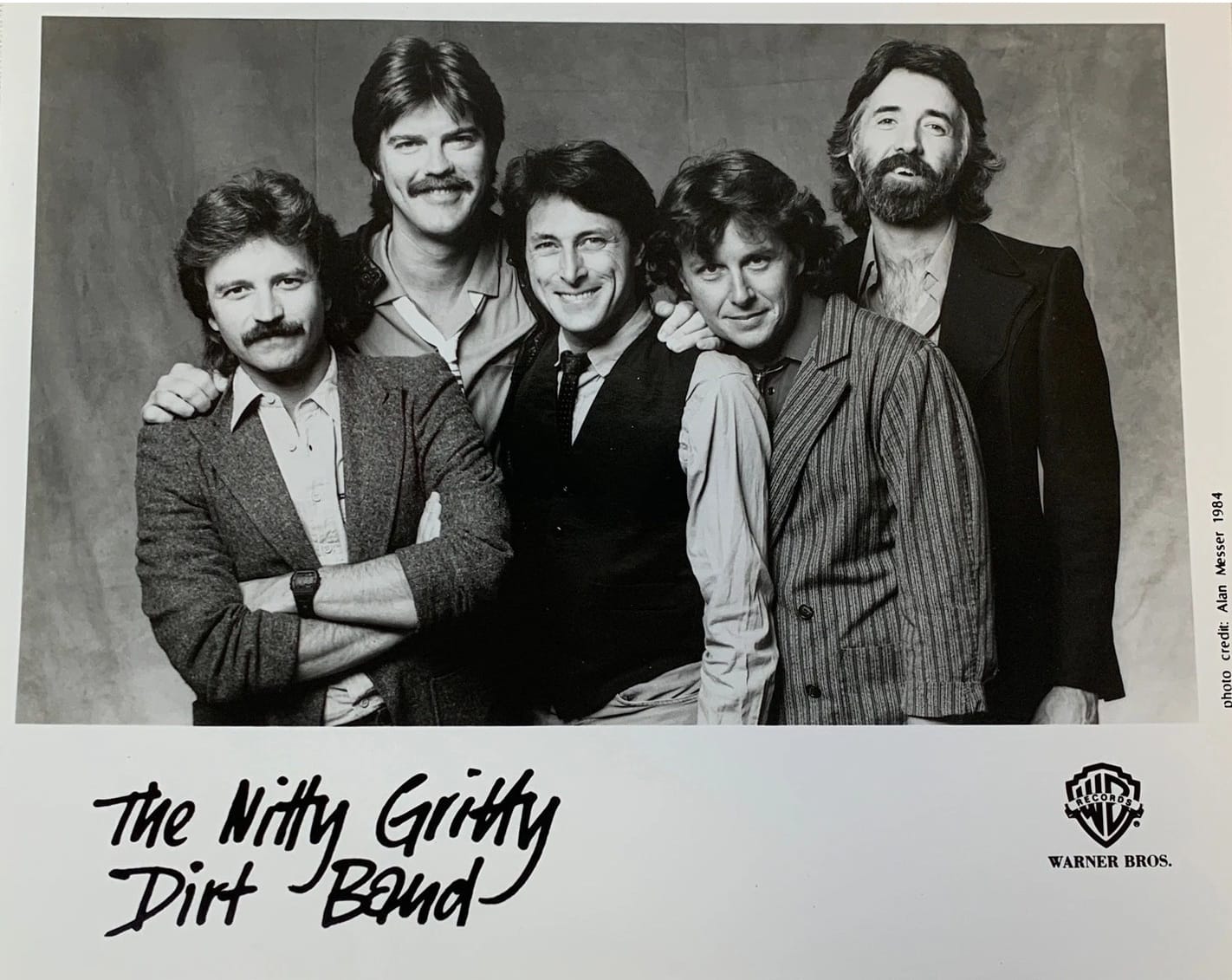
The run that followed belongs in the same breath as the Circle records, and this tribute will not apologize for saying so. Ibbotson's waltz had kicked the door open; "Long Hard Road (The Sharecropper's Dream)" walked through it to No. 1 in 1984, "Modern Day Romance" — a Brooks-Tyler co-write, years before Brooks & Dunn existed — went to No. 1 in 1985. And in 1987 came the demo the band knew on first listen. "When Josh brought us the demo, we were like — that's perfect! That's the perfect Dirt Band song," Hanna said of "Fishin' in the Dark," written by Wendy Waldman and Jim Photoglo. Fadden compressed the same memory to its essence: "Whee! Let's get in the pool!" It became their third No. 1, eventually went platinum, and quietly became the band's password across generations — the song a kid at a bonfire in any decade since can sing without knowing what a washtub bass is. The week it summited, the Tennessean announced the band had landed "a whopper... in the country ocean," and Waldman offered the philosophy of the entire transaction: "It's exciting because music should live beyond its creator." No band in the format's history has honored that philosophy from more directions. By late 1988 Oermann was tallying 15 consecutive top-10 country hits, and Colorado's governor had already proclaimed an official Nitty Gritty Dirt Band Day.
The producer who took the chair for the run's peak had been in the audience half his life. Josh Leo — the Los Angeles guitarist turned Nashville producer — first saw them in Kansas City at seventeen. "I was blown away by how good they were, and how they could all trade instruments between songs — everybody knew how to play everybody else's instrument," he tells Generation Country. "Little did I know that I would have the extreme privilege of working with them years later." The privilege came with a mandate, because Leo inherited a practice he considered exactly backwards: earlier producers had cut Dirt Band records with session players. "Nashville has this way of beating all of the creativity out of you and making you antiseptic by using session players," he says. "I refused to use anybody with them." He made the band play its own record. He played electric and acoustic guitar on the sessions himself — "I kind of became another member of the band... but it was them. They're the ones that did it." His accounting of the trade has never needed revising: "Did they play as good as session players? No. Did it take a little bit longer? Yes. Was it worth it? Absolutely." What the band played instead, he says, "was a lot more inventive... a lot more real." And his ledger closes on the only line that matters between musicians: "They trusted me. I trusted them."
The run scattered careers like seed. In 1984 the band handed a young fiddler named Mark O'Connor the solo on the fade of Ibbotson's "High Horse" — "They were new in Nashville like I was," O'Connor says, "and didn't realize yet that fiddle was no longer popular, so why use one!" When the song hit radio, "my new way of playing the fiddle on a country recording became known to Nashville's Music Row within an instant." What followed: some 450 albums in six years, and a ten-album Warner Bros. deal that made him, by his count, just the third instrumentalist in town with a major contract, "along with none other than Circle I and II heroes Chet Atkins and Earl Scruggs. I will have to credit The Dirt Band for helping me achieve all this." And when Circle II wrapped and the band could carry one extra musician back to the Soviet Union in 1989, they told him job well done and extended the invitation. His thank-you, thirty-seven years later, names the whole classic five: "Thank you Jeff, Jimmie, John, Jimmy and Bob for having me and my fiddle along the way on your great 60-year ride!"
J.P. Pennington watched the door widen from inside another band. Exile — the Kentuckians who topped the pop chart with "Kiss You All Over" in 1978, then remade themselves into one of country's steadiest hit machines — reached the Row just as the old walls came down. "One of the reasons self-contained bands became more acceptable in country music was due to the massive popularity of the band, Alabama," he says. "They made it okay for bands with long hair and big electric guitars and drums to have a place in the format. As a result, Exile and the Dirt Band and many other groups were able to take advantage of the willingness of Country record labels to give us a chance." (Alabama, for its part, had carried two Exile songs — "Take Me Down" and "The Closer You Get" — to No. 1: doors open doors.) The fraternity traveled, too: the two bands once flew to London together for a festival at Wembley Arena — "over the course of a few days we got to know each other better and had a great time. Incidentally, they absolutely slayed that audience." His closing statement is the rarest kind, from a man whose own band lasted: "People should understand the importance of the Dirt Band and know how rare it is that they could be that relevant for that long. There will never be another like them."
Duane Allen ran the same roads from inside the era's other great vocal institution. "I remember the many dates we played with the Dirt Band. We loved being together," the Oak Ridge Boys singer says. "We spent hours, days, weeks, before and after shows, just hanging together." And what the professional in him noticed was the professionalism: "I always appreciated how seriously the Dirt Band were about being a group. They were always on time, on and off the stage, no matter if it was some big fair, festival, or Las Vegas. They always brought their 'A' game."
The boom kept sending its thanks a generation down. Larry Stewart fronted Restless Heart — six No. 1s in the band boom's high years — and now carries the flag in The Frontmen, alongside fellow lead singers from Little Texas and Lonestar; he was a believer long before any of that. "Jeff Hanna and the guys captured my imagination with 'Mr. Bojangles,'" he says. "I always loved their earthy, grassy approach instrumentally and honest vocal approach. The guys represented us all to the highest level, with the highest musical integrity, with self-played and sung recordings — and I want to thank them for that." And his sign-off doubles as a job description for every band that followed: "Hopefully the rest of us groups can continue to carry the torch for the great band music created throughout the decades. Thanks for getting this thing started."
Gail Davies's road into the band's orbit ran through family. Her brother, Ron Davies — the writer whose "It Ain't Easy" David Bowie carried onto Ziggy Stardust — wrote "Dark Eyed Gal" for the band's 1990 album The Rest of the Dream, and it was Ron who first brought his sister into their world — a family tie the Hannas repaid when Jeff and Matraca Berg sang on the tribute album to Ron. The friendship settled into the most Nashville ritual imaginable: once a year, at Suzy Bogguss's birthday party, Davies and Jeff Hanna wind up singing around the piano. "Jeff is an amazingly talented man and a sweetheart of a guy," she says, and her farewell is a working artist's salute: "They will be sorely missed out there on the road. They were, and still are, an incredible band."
The 20th anniversary itself, in June 1986, became the decade's great family reunion. Rain washed the party out of Red Rocks and into Denver's McNichols Arena with less than a day's notice, flight delays ate the rehearsals, and none of it mattered: more than 10,000 fans, nearly 50 songs across four and a half hours, the Dirt Band backing every guest the way The Band had staged The Last Waltz. Ricky Skaggs opened his segment with an order — "Get up on your feet right now. We're going to have a big time tonight" — and the night ran from Doc Watson's "Tennessee Stud" to Emmylou Harris hushing the hall with "To Daddy" to a scorching "Ain't Living Long Like This" with Rodney Crowell flanked by Vince Gill, Marty Stuart and Hanna. Ibbotson introduced "Ripplin' Waters" with a dedication to the whole state: "This song is about a certain stretch of water, but it's also for you." They closed with Steve Goodman's "City of New Orleans," sung for its late author, and then the "Circle," everybody on stage. "How do we follow this?" McEuen asked at night's end. Ibbotson prescribed the cure: "I have to come down from this. What we need is a big dose of reality, like playing some honky-tonk in Des Moines with a disco floor and blinking lights and two shows with nobody listening to us." "It was a memorable evening," Hanna reported. "It took us about three days to recover."
The anniversary interviews caught them in comic mid-season form. "Rock 'n' rollers are like football players. We're more like golfers. Our stroke is getting better with age," McEuen offered. "We may have a stroke," quipped Hanna. Somewhere in those years they also played the first Farm Aid and shared a dressing room with Bob Dylan and John Denver — "We didn't get to share the stage with him," Carpenter said of Dylan, "but it was nice sharing a dressing room." And the future was already leaning over the lip of the stage. Hanna started the story for Bane: "Some girl who's almost 21 comes up, and all the guys are looking. She says, 'You guys are really great...'" Carpenter supplied her next line: "'I listened to "Mr. Bojangles" in kindergarten.'" And Hanna finished it: "'My mother played your records for me when I was growing up.'" It got a round of laughter at the table. It was also a census: the second generation had found them — and by Denver, there would be a third.
T. Graham Brown — the Georgia-born soul shouter who took "Hell and High Water" and "Don't Go to Strangers" to No. 1 — arrived in the format in 1986, the band's 20th-anniversary year, carrying Memphis soul into country the way they'd once carried in the string band, and he'd been a believer since "Mr. Bojangles" first caught him: "To me, they were always a cool band." The bills they shared across the years left him filing the same report as everybody else: "They were always super nice and treated me with respect and kindness. Jeff, Jimmie, and Bob are all great human beings." And his send-off, as the buses park, is pure T. Graham: "Y'all always nailed it! A stellar group! Outstanding! Job well done! Thank you for taking the music to the people in such a fine fashion and good taste!"
Dan Tyler, who wrote "Modern Day Romance" with Kix Brooks, had been carrying the band longer than the band knew. "I was long a fan of the Nitty Gritty Dirt Band," he says. "My first date with my wife of 54 years, at Ole Miss, was a Dirt Band concert!" That was the fall of 1971, in the biggest room on campus — the gymnasium — a pack of folkies onstage about his age, wearing their hair the way he did; Tyler's own background was folk, and the band was a natural fit for him. Fourteen years later came the song. "It was our first co-write and like so many first co-writes, worked beautifully," Tyler says of the session with Brooks. "I had the chorus but was stuck. He took the chorus home and furnished the first and second verses and the 'narrative.'" Brooks then produced the demo himself, singing lead: "The demo, including the signature acoustic guitar lick, was very much the blueprint for the master. I give Kix all the credit for the demo." It nearly went elsewhere — publisher Don Gant loved the song and had it bound for his close pal Jimmy Buffett when Jody Williams — later a longtime BMI executive, and today the head of Jody Williams Songs and Vince Gill's manager — pitched it to the Dirt Band, who jumped. Gant resisted a beat — "but a bird in the hand!" Tyler first heard the band's cut at Gant's office, and was thrilled: "It was very faithful to our demo and it sounded like a hit to me!" It was; on the heels of "Long Hard Road," it went to the top, and Tyler is "happy to report that Modern Day Romance continues to get airplay, over 40 years later." His verdict runs past his own credits: "I think the Dirt Band represents the best in American popular music. It is rare for a band to stay together for six decades and remain creatively relevant... I am a true fan of the band." There was nearly a third: Hanna told Tyler the band wanted to cut his and Fred Knobloch's "Baby's Got a New Baby" — "but there were too many chords!" The song went to No. 1 anyway, for Schuyler, Knobloch and Overstreet. The band's ear, as usual, had been right about the song.
The craft argument was simple, and Hanna made it every time anyone asked. "We're playing the same music; it's nice that people are buying it now," he said in 1986. "If they want to call it country, that's fine by me." What radio was finally buying is easy to name and hard to copy: the blood harmony, as the band's own tour biography calls it — Hanna's warm lead with the family-style stack around it, banjo and fiddle and mandolin doing the melody work other bands hand to electric guitars. "It was the harmonies and fiddles and banjos," Hanna said, asked what made them distinctive. "We were rooted more in the mountainy stuff like bluegrass and less in the steel guitar honky tonk stuff." The bio strained for adjectives — "crisp as an Autumn apple and rich as a royal flush" — and four bars of "Fishin' in the Dark" settle the matter faster than either one. Membership shifted with the decades, as it does in any band that lasts long enough to raise families. When John McEuen decided to step away as 1986 turned to 1987, to tend to his life and his own music, the invitation that followed says everything about the company this band kept: Carl Jackson — Glen Campbell's longtime musical partner, later a Grammy-winning producer — was approached about joining. "I do know I was offered the job on a salary basis," he recalls, holding the memory gently: he no longer remembers just who reached out, and allows that Jeff and the others may remember the details differently. What he remembers exactly is his answer, and why. "After traveling on the road since the age of 14, I had vowed not to take any full-time road gigs unless it was for myself" — a vow that in those same years also turned aside invitations from Emmylou Harris, Dolly Parton, Roy Clark and more, and not one of those artists, he says, ever came down on him for the decision. "Believe me, I labored over all of them because of the respect I had for each as artists and the honor that they would ask." Of the Dirt Band's offer, his account runs honor to honor: "I was honored to be asked but respectfully declined... Bottom line, it was a true honor to be considered for a position with a band I truly respect." When Emmylou came calling for the Nash Ramblers, Jackson suggested a gifted young picker named Randy Stewart in his stead — the world knows him now as Jon Randall, who would one day co-produce the band's Speed of Life. "Emmy made me an official 'Nash Rambler' anyway," he says. He still has the tour jacket, and treasures it. The Dirt Band's chair went, for a stretch, to Bernie Leadon, late of the Eagles, who lent his even temper and his multi-instrumental fluency — but the center held: Hanna and Fadden, together since the McCabe's back room, now joined for good by Bob Carpenter, the Aspen keyboard man who had been sitting in since the mid-'70s and became a member in 1979.
And then, at the exact peak of the hit run, they did the least commercial thing available to them all over again.
"We really fought the idea of doing a sequel to 'Circle,' for a very long time," Fadden said in 1989. "The first one is so special... just take a look at all the terrible follow-ups. We didn't want to go in and create another Jaws II." What broke the resistance was family, in the literal sense: June Carter Cash had told the band the Carter Family would be honored to take part if there ever were a second volume. "That meant a lot to us," Hanna said. "To have the Carter Family's blessing." Johnny Cash opened the album because, as Carpenter explained, "in Europe a couple of years ago he said if we ever did another 'Will the Circle Be Unbroken,' he'd be happy to appear on it." Bruce Hornsby was recruited off a magazine quote naming Circle I as a desert-island record. Roger McGuinn and Chris Hillman remade "You Ain't Goin' Nowhere" and sent it to No. 6 on the country chart — the same Byrds song Nashville had frozen out in 1968, welcomed home at last through the Dirt Band's front door. The Rosanne Cash–John Hiatt duet on "One Step Over the Line" was hatched in the room, Randy Scruggs' idea; "And I think it was really brilliant," Hanna said. John Denver, asked before a take whether this was practice, gave the sessions their motto: "They're all practice." Even the gospel arrived by providence: "Little Mountain Church House" — now a standard of the bluegrass gospel repertoire — was written by Carl Jackson and Jim Rushing at Ricky Skaggs' request, for a Dolly Parton album Skaggs was producing. Skaggs loved the song too much to give it away, and carried it into the Circle sessions himself. Jackson wasn't in the room and only heard about the cut after the fact: "They did such a wonderful job on the song. It's truly an honor to be part of that record." Tyler had a song inside the Circle too. "Turn of the Century," written with Fred Knobloch, reached the project through Screen Gems' Charlie Feldman — and the two writers were invited to drop in at the Berry Hill studio while vocals were being cut, a courtesy Tyler notes is rare in that business, "for good reason." They stayed less than an hour, and inside it got a memory for life: Bob Carpenter, about to sing his verse, walked over with a request — could one line change from "no more fighting for your country" to "no more fighting for a country"? No problem. One small word, cleared with the authors face to face — the whole project's manners in a single syllable. Levon Helm sang, which for this band was the closing of a private circle: "The Band is the only band that we all paid tickets to see together," Hanna said. "Levon is just the greatest."
"The Nitty Gritty Dirt Band have been as essential to roots music as Thomas Jefferson was to the Declaration of Independence." — Rosanne Cash, to Generation Country
Somewhere in those sessions, June Carter stood in the booth singing "Life's Railway to Heaven" and stopped. "I could swear I hear Mama's guitar," she said. One of her sisters had brought Maybelle's guitar to the studio; June knew the sound without turning around. It was June, too, who delivered the review this band treasured above every award, reporting her mother's private statement from the first sessions: "She said, 'I like them dirty boys. They're good boys.'" Four generations of the Carter-Cash family span the two Circle albums, down to Rosanne Cash's five-week-old daughter, Carrie Crowell, who slept in her mother's arms while Rosanne recorded. And in the bass chair sat Roy Huskey Jr., holding the seat his father had held on Circle I. And Emmylou Harris, on the record itself, gave the whole enterprise its epitaph in advance: "We've lost the living room. The living room has gone out of the music, but today I feel like we got it back."
Thirty-seven years on, the woman who recorded with her five-week-old daughter sleeping in her arms delivers the edition's grandest claim, and stands behind it. "The Nitty Gritty Dirt Band have been as essential to roots music as Thomas Jefferson was to the Declaration of Independence," Rosanne Cash tells Generation Country. "If they had done nothing else, the spotlight they put on Mother Maybelle Carter, Doc Watson, and more of the old guard in the first Will the Circle Be Unbroken album would have been more than enough. A whole new audience was introduced to the essential bedrock artists of the genre." Her own seat at the second Circle "was a massive honor." And her closing accounting reads like the thesis of everything above it: "The Dirt Band have been archivists and curators, to the benefit of the American music songbook, and they have been a great band with a vision and purpose. We owe them a tremendous debt of gratitude."
The living room was engineering, not accident. Circle II was cut live and acoustic at Randy Scruggs' studio — Mark O'Connor, the decade's most-recorded fiddler, among the players in the room — under a band commandment Hanna explained to the San Francisco Chronicle: "We have a phrase — 'Let's put away the microscope,' because you can get so hung up on the details, you lose sight of the emotion, which is the key element." O'Connor — seated in Vassar Clements' old chair, on every song but the closing guitar solo — testifies to what the commandment felt like from inside it: "Everything that I played live in the circle formation setup in the studio was kept. I remember being both nervous by that idea, and feeling so incredibly free at the same time... I sometimes improvised more outlandishly than I ever thought I could get away with on a song in a recording studio, as I knew there would be no way to replace it later! My sound was bleeding through all the mics, but I was taking chances anyway and they had to keep it all!" His summary, all these years later: "The album became my very favorite Nashville recording session I ever did." And when Vassar himself was invited back to fiddle one song, O'Connor slid over to his second instrument, the mandolin, and kept playing. Asked to locate the band on anybody's dial, Hanna drew the line that explains all sixty years in one stroke: "To me, rock and roll is more Buddy Holly and less Bon Jovi."
Will the Circle Be Unbroken: Volume Two won the CMA's Album of the Year and a pair of Grammys, and Roy Acuff — who had arrived at the first sessions unable to find their faces — came back for the second and told them the truth of the matter: making the new record was more fun than the first time around.
The '90s asked less of them at radio and more of them everywhere else, and the band answered with the road. They cut a live album with T-Bone Burnett producing, taped in a 600-seat theater in Red Deer, Alberta, because Alberta, Hanna explained, was "a real hardcore Dirt Band area." Mostly, they toured — up to a hundred nights a year, decade after decade, the working life Carpenter later described with a lifer's precision: "There are hotels where windows won't open. You eat when you can, and not always the best food... Anything but playing on stage sometimes is a pain. Once you get on stage, everything disappears. All the problems back at home, all the stuff you went through during the day, it's gone. It's cathartic." They played a cave in Tennessee to 1,200 people, played lakes and ocean shores and a mountaintop in Colorado. That was the job, and it stayed the job for thirty more years — which is the fact that gives the word "farewell" its weight.
BEFORE THE WORD EXISTED
There is a word now for music that blends bluegrass, country, folk and rock without apologizing to any of them, and an industry association to go with it, and festival stages and Grammy categories. The word did not exist in 1966, or 1972, or 1987. The thing itself existed. It was playing four sets a night in a pinstriped suit. Hanna said it plainest back in 1986: "It was called country-rock in the '70s, and now it's mainstream country."
"Early on, we took a lot of our influences — Flatt & Scruggs, Buddy Holly, the Everly Brothers, the blues, all the things we liked in country and rock — and combined them," Fadden said in 2010, asked whether the band really belonged among the pioneers. "But, yeah, when I hear some of the alternative-country artists and bands of the last decade or so, I do hear a lot of what we were doing back in the '60s." He declined, with characteristic understatement, to beat his own drum, and then allowed: "I would say that that's an accurate assessment."
The confusion was physical before it was ever critical. In 1972, Hanna remembered, "Nitty Gritty Dirt Band records would all be racked in rock and roll." Then the band handed retail a three-record set of American roots music and watched the stores hold it at arm's length: "Where do we put it?" "It's in country." "No, it's not exactly country." The solution was surrender: "Well, let's just put it in the Dirt Band thing, you know, it'll work." The bins were more honest than the critics: there was no word yet for what they were. T. Graham Brown — a man who knows something about refusing a bin — files the width verdict: "They were great at any style. They were never confined to any one genre; they could do it all, and they did it all!"
Trace the mechanics and the claim stops being sentimental. In November 1970 — before "newgrass" existed as a word, a quarter century before anyone said "Americana" — McEuen walked a Kansas City reporter through the band's engineering problem like a patient professor: "If you put a mike in front of a mandolin, it changes the sound. And you can't get it to play loud enough to carry over the other instruments... So the mandolin was the first to go electrical. Then we added electric guitars on some songs. And electric bass on a couple of songs. And then we added drums. And then the fiddle." That is the central puzzle of an entire genre-to-come — where does the backbeat live when your lead instruments are banjo, mandolin and fiddle? — being solved out loud, one instrument at a time, in a newspaper interview. The question underneath was technical and philosophical at once — how much electricity can a wooden instrument absorb before it stops telling the truth? — and every band in this story's family tree has been answering it since. The Dirt Band dug at that tunnel from the folk-rock shore. Within two years, a crew of long-haired players out of Kentucky bluegrass was digging from the mountain side: New Grass Revival, Sam Bush's outfit, stretching Monroe's forms toward rock repertoire and jam-length improvisation. Two bands, same tunnel, opposite ends. They met, inevitably, in the middle of the 1970s — New Grass opening the Dirt Band's midwestern arena shows, both bands orbiting Leon Russell, who is right there in the Symphonion Dream credits — and by 1989, New Grass Revival stood inside Will the Circle Be Unbroken: Volume Two. Which closed a circle with a gentleness history rarely manages: Bill Monroe had declined the first Circle, and by the second, his own musical descendants had climbed into it. Nobody ever pressed the point. "We've done concerts with Bill in the last few years," Hanna said in 1989. "It wasn't personal animosity, I guess. I'm glad it wasn't." Monroe himself eventually gave Jack Hurst his reasoning, and it deserves printing whole, because it is an originator's pride, not spite: "This music of mine, I originated it, and I couldn't play under another man, because my public wouldn't have liked it... I ain't got nothin' against it, but it's not bluegrass. All the way through, I've had to be careful how I done my music, and who I worked for."
What the meeting felt like from the other end is best told by the man who lived it. John Cowan — New Grass Revival's bassist, one of the great voices in American music — set it down in a letter for this tribute, and it deserves room. In 1972 he was nineteen, freshly flunked out of college — "where I proceeded to confuse GPA with THC" — washing cars in Louisville by day and chasing the young musician's dream at night, when a friend came by with "a beautiful and curious looking record." He put it on. "As per usual I poured over the elegant record sleeve and credits. Strangely enough, though I'd grown up in Kentucky I didn't know any of the guest artists. Man, what a great surprise we were in for. My first real exposure to country/folk artists lay at my feet. Yes, I loved Poco and The Flying Burrito Brothers but this was, from what I could gather, 'The Source.'" Two years later he auditioned for New Grass Revival. Two years after that, his band was opening those arenas. "To say we were treated with kid gloves doesn't even cover how kind & respectful we were treated by these guys who were literally our heroes. From that moment to NGR's inclusion in 'Circle 2' to this very day my friendship and love for these men will go with me to my grave. Their place in music and the indelible mark they made on music lovers and musicians will never fade away." He signed it from Boston, 2026. There is no better one-paragraph history of what this band actually did: a Kentucky kid had to hear California hippies to find the music buried in his own home state — and when he came looking for the source, the men who guarded it treated him like family.
Tim O'Brien — Hot Rize's co-founder, steeped his whole life in every music the Circle gathered — says it without a hedge: "With their Will the Circle Be Unbroken release, the Dirt Band invented what we now call Americana music. They brought a brand new audience to Country and Bluegrass and redefined it in the process."
Murphey, who watched them from the coffee houses on, seconds it on camera: "They went for the old-time music. They went for the classic music. They went for the soul that was in American music. If you could ever say there was an Americana band — if you could ever say anybody was part of the founding of the Americana movement — you got to admit that Nitty Gritty Dirt Band is it." And he names the admission standard the whole enterprise ran on: "Nobody ever did anything to unify all kinds of country music people together in one place — and the unification was: does the song have soul? If it has soul, it's going to be a part of the Nitty Gritty Dirt Band's music. I don't look at a song as, does it tell a great story, is it going to be a hit, is it a love song — and I don't think any of the Dirt Band guys ever did that either. They pick songs that work for the artist that's really had a deep old soul."
Fadden accepted the word on behalf of everyone it shelters. He remembered the young FM radio of their California days playing "an amazing, eclectic show of people" — Earl Scruggs into Jimi Hendrix, Jackson Browne into the Dead — before the format men decided audiences wanted things "packaged up a little more." Standing in the middle of AmericanaFest in 2022, he gave the word its best definition yet: "What Americana has done in retrospect, it's gone back to this thing that says, 'You belong here, and here is a very big place.'"
Fulks, from the far side of a career built inside that big place, describes what the band actually handed down — not a sound but a method. "Entering country music with an idea of it not just as an industry but as a lineage, a communication tool, a community craft, a behavior, you can branch out into the world and start connecting; you can sit down and make music with total strangers, or play songs you've never heard by knowing the grammar and likely paths." He watches rock musicians wander into backyard picking parties and marvel "at how things work this way, with people just seeming automatically familiar with whatever song is called" — a world of "people off stage and on the same level, passing impulses and little inspirations back and forth between them, on a field of play that was established when everyone was little." The Dirt Band, he says, "beautified the world by leading pickers and aspiring musicians into those opportunities" — and "one of the fundamental entry points for me into this magical place was the Circle record." His farewell to the band runs five words: "Thank you for your service!"
If the word needed a face, for most of two decades it had Jim Lauderdale's: host of the Americana Honors & Awards year after year, two Grammys of his own, the writer behind George Strait's "The King of Broken Hearts." When the Circle album reached him, he was none of that yet — he was a kid with a banjo. "For me, a teenage beginning banjo player this was a joyful, meaningful education that opened my mind and heart and helped set me on a concentrated path for music," he tells Generation Country. What strikes him now is what the record did in both directions at once — renewing the elder guests and putting them in front of millions, while it worked on the kids: "For my generation, which was already listening to rock, soul, blues, and the dynamic music happening in the sixties and early seventies, we were also exposed to more country, bluegrass, and acoustic music. This record was an unexpected welcomed beautiful gift." And then the man whose job it became to hand Americana its trophies renders the judgment: "If this was all the Nitty Gritty Dirt Band had ever done for the rest of their careers they would still be heroes to me. However, they have continued, evolved and music still drives each member past and present and I am forever grateful to them."
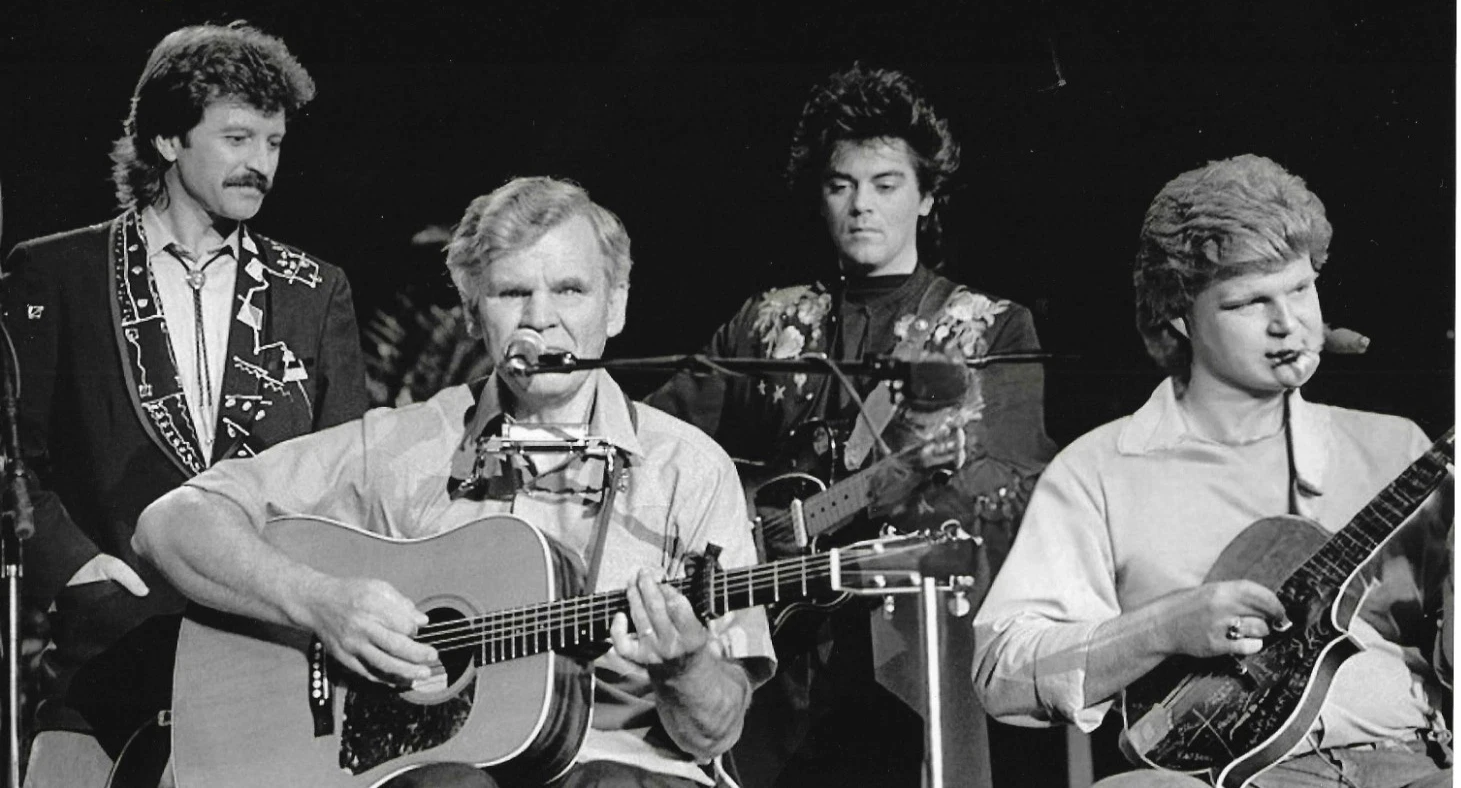
The roll of witnesses runs long. Marty Stuart has told the Broken Record podcast about finding the Circle album in a North Nashville used bin in 1973 — $2.99, and he still owns the copy, wrapper and all — while he was playing in Lester Flatt's band at the Opry: "It was the first time that I'd ever heard rock and roll and country and honky tonk and folk and bluegrass and gospel music collide kind of successfully in the group of one record." He fell in love with Vassar Clements, he says, "by way of that Nitty Gritty Dirt Band record." Béla Fleck has pointed to the album as the discovery that followed Earl Scruggs and "Dueling Banjos" in making him a banjo player — and like Bush, he ended up inside Circle II. Trey Hensley grew up on his father's copy and puts it plainly: "It just blew me away." Carl Jackson's conversion came one album earlier, with Uncle Charlie & His Dog Teddy: the cassette "rarely left the player" of his old yellow Ford Gran Torino — and 56 years on, says the man who went from Glen Campbell's banjo chair to a shelf of Grammys of his own, "it still rates as one of the most listenable albums from start to finish of all time." Jerry Douglas, who bought the first Circle record the week it appeared and stood on the Ryman stage at the band's 50th anniversary, confessed what was happening under the professional calm: "I'm such a fan of all of those guys... I'm just going nuts inside." Hanna once tallied the returns for Country Music magazine with typical understatement: "a lot of people like Ricky Skaggs, Jerry Douglas, Mark O'Connor or the guys in Newgrass Revival have told us that [the album] inspired them." O'Connor can now file it firsthand. He was eleven, a Seattle prodigy just finding bluegrass, when his mother brought home the triple album. "I loved that triple album set so much, and I went to sleep with the album cover at night," he says. The men on it "became instantaneous musical heroes to me as well as the Dirt Band themselves. I got to play music and work professionally with all of them within a few short years of that young boy going to sleep with the album cover by his head. More than a few of them soon became mentors. Roy Acuff actually put me on the Opry the very next year when I was 12." The accounting has never closed — No Depression's 50th-anniversary roll ran from Tony Trischka and Rhonda Vincent to Alison Brown, Stuart Duncan and Billy Strings, the biggest bluegrass star of the current century, who sends "Will the Circle Be Unbroken" out over festival crowds the size of the towns the song came from.
Sally Van Meter heard it at nineteen too — Cowan's age, the other edge of the country. She was digging into bluegrass with the local players around the San Francisco Bay, in a crowd that took its orthodoxy seriously — Monroe, Jimmy Martin, Flatt & Scruggs — when somebody brought the record home. "We all sat around for hours just listening with our hearts wide open to something that felt so new but absolutely genuine," she writes in a statement for this tribute. "It was life-changing for me." And what won over the traditionalists in the room wasn't the novelty. It was the manners. "The respect shown to the legendary players by Nitty Gritty on this recording was right up front. This to me was not a vanity project, it was real music played by great players who loved playing Bluegrass. It opened me to so much possibility in Folk and Bluegrass interpretation — all while playing the real stuff in the right way." Keep playing is her own word for the debt — "I am forever thankful to have been inspired by Will the Circle Be Unbroken to keep playing. It made me believe in the power that this music holds" — and she kept playing all the way into the front rank of dobro players, nearly twenty years with the Bay Area's Good Ol' Persons, a seat at the David Grisman–Jerry Garcia session for the Jimmie Rodgers tribute Bob Dylan produced. Then the Circle did what the Circle does. In 1994 she cut The Great Dobro Sessions — ten resophonic masters, produced by Jerry Douglas and Tut Taylor — with Vassar Clements fiddling in the band and Bashful Brother Oswald, Roy Acuff's dobro man from the 1971 sessions, seated among the ten. The nineteen-year-old who listened to those elders with her heart wide open grew up to share a Grammy with them.
And the hits run a parallel ministry. "Fishin' in the Dark" became the format's shared campfire: Garth Brooks — who scored front-row tickets to see the band back in college — has recorded it twice and chosen it on national television over his own catalog, and what he told Billboard Country Update in 2014 outgrew the song entirely: "The Dirt Band goes way beyond genre. Their influence has reached the greatest bands and artists in music history. Their legacy is over 40 years old and will live forever." Kenny Chesney, by Fadden's telling, once turned up at Hanna's birthday party for the sole purpose of singing it around the fire; Carrie Underwood carried it out on an arena tour; and Luke Bryan told Hanna about his early-career insurance policy outright: "If the show starts going south, all I do is sing 'Fishin' in the Dark.'" Erin Enderlin — the songwriter whose work has gone out in the voices of Alan Jackson, Reba McEntire, Lee Ann Womack and Terri Clark — cut her own "Fishin' in the Dark" with Jeff Hanna himself playing on it — "I'm so grateful," she says — and offers the band a one-line valentine: "I just loved their interpretations and musicality and the way they wove the old with the new." And Raul Malo — the Mavericks' founder, gone too soon, the closest thing his generation had to an Orbison voice, and family to this band in every sense, down to the years Jaime Hanna spent touring in his ranks — once said, as Hanna told it, that the reason he moved to Nashville at all was to play "that kind of music." Sixty years of evidence say the influence never trickled; it poured.
As early as 1989, the trade press could find only two American bands with a comparable unbroken run: the Beach Boys and the Grateful Dead.
The genealogy runs everywhere once you look. If Harry Smith's Anthology had made America's old music feel like a secret map, the Circle albums made the map breathe — not ghosts in shellac but elders in a room, choosing keys and teasing one another on tape. It was the past talking back. So when the O Brother, Where Art Thou? soundtrack remade the market for roots music at the century's turn, Capitol's own executive reached for the obvious ancestor: "'Circle' was the original 'O Brother' in some ways." The band answered the moment the way it always had, with a third volume — and Johnny Cash, near the end of his life, wrote "Tears in the Holston River" specifically for it, a tribute to Maybelle and Sara Carter for the band whose trade press had long since named Maybelle "the patron saint of all three Circle projects." Willie Nelson came, and Emmylou, and Alison Krauss, and Matraca Berg singing "Oh Cumberland," and a next generation already in the credits: a young harmony singer named Jaime Hanna. Even the between-takes commentary stayed in the family register — McEuen, on Iris DeMent's "Mama's Opry": "She sounds like she just took her husband his lunch at the coal mine." Hanna's summary of all three volumes needs no improving: "These are big yardsticks in our lives." John McEuen, back in the fold after his years away, put the mission the same way he had in 1972: "I always looked at that album as a way to give credit where credit was due." The Circle III project spilled over into a PBS concert, Farther Along, and out of it came a rendition of "Earl's Breakdown" — Earl and Randy Scruggs, Vassar Clements, Jerry Douglas — that won the band its third Grammy in 2005: Earl Scruggs collecting a trophy, in the new century, for a tune he'd written fifteen years before the Dirt Band existed. Craft, passed hand to hand, both directions, for as long as anybody kept a hand out.
THE MAN WITH THE WASHBOARD
Jeff Hanna was born in Detroit on July 11, 1947, learned California by way of Phoenix and Denver, and has spent sixty years declining every opportunity to make this band about himself. Start with the instrument he donated to the Country Music Hall of Fame: not a guitar. The washboard. The thing a teenager scrubs rhythm out of when the band can't afford a drum kit, carried all the way from the Paradox to the museum's collection. Even Earl Scruggs marveled — "I don't think I've ever done a session with a washboard" — and Hanna repeats that story with more pride than he tells any story about himself. The instrument never retired, either. "The band always makes me play washboard on at least one song on each record," he reported in 1998 — a man sentenced for life to his own origin story, and serving it happily. The stewardship extends to other people's instruments. Bill Lloyd once brought his 1966 Rickenbacker 12-string to a rodeo date they shared in Oklahoma: "Jeff was mortified I had taken the vintage instrument out for a gig like that. I took his advice, too. It stayed home after that."
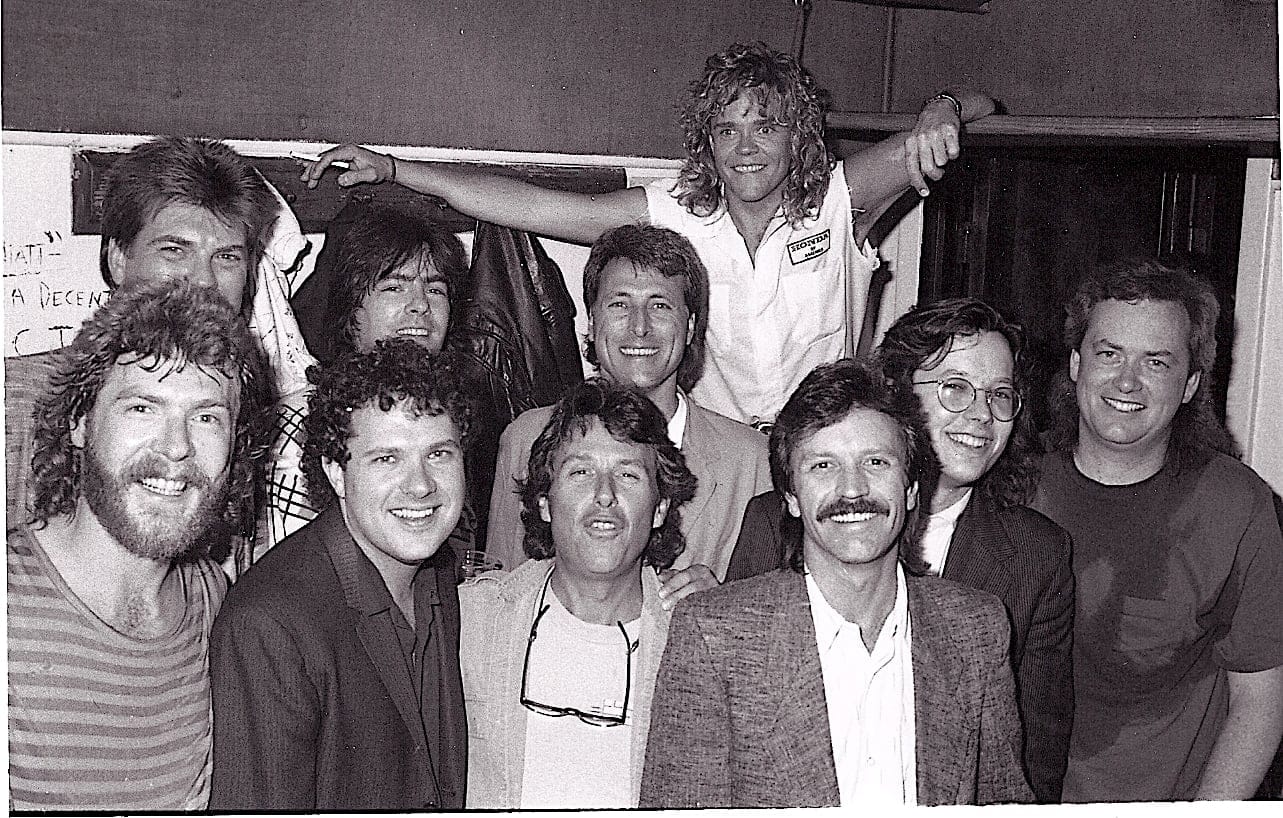
The modesty conceals a resume most front men would kill for. He is one of the finest harmony singers and rhythm players of his generation, the voice that stitched together sixty years of shifting lineups into one recognizable sound. He is a hit songwriter — "Partners, Brothers and Friends" with Ibbotson, "Baby's Got a Hold on Me" with Carpenter and Josh Leo, and, in 1994, a ballad written with Marcus Hummon and Bobby Boyd called "Bless the Broken Road," which the Dirt Band recorded first and Rascal Flatts carried to five weeks at No. 1 and a Grammy for Best Country Song a decade later. Leo adds the co-writer's report on both: "They're both very quick and very creative. Jeff's a lot of fun to write with, and so is Bob." And he is that rarest of things, a bandleader nobody ever had to vote for. As far back as 1967, Ralph Barr described the arrangement to the Press-Telegram: "Jeff is the spokesman on stage and John is interested in the business side. But, it's kind of a friendly anarchy." Sixty years of friendly anarchy, and the spokesman never once mistook himself for a boss.
The studio ran on the same constitution. "We used to say — why worry, let Jeff!" Leo remembers; Hanna helps arrange every song. And the famous blend is an architecture Hanna conducts rather than crowns: Carpenter always rides the top, Ibbotson and Hanna trading the middle and the floor beneath, in whatever permutation the song wants. "It always works," Leo says.
You can hear the band before you can name what you're hearing. Hanna's harmony tucks in tight against the lead, bright and a little grained, so close that a chorus widens the room instead of raising the volume. Then Fadden's harmonica answers the vocal instead of decorating it, a bent, crying line phrased by a man who'd rather sing than play and found a way to do both. The same man keeps the backbeat, so the band's pulse and its lonesome come off one pair of hands. Nothing fights. Everything stays legible — the record parked in the narrow seam between a porch pick and a single cut for radio. A Dirt Band record sounds less produced than overheard.
Hanna's own account of the whole enterprise, from a 1989 interview, is as close as he has come to a philosophy: "Music, to me, is a community effort... Sometimes it's a community among musicians, sometimes between a band and the audience. Music is not totally a personal experience. It's more fun to share it." And when the end was finally in sight, he summed up the whole accident of a life: "This has been my life's work, but it wasn't my intention... It has been a great ride. We're humbled and grateful that we get to do this, and that we have made some music that has had a positive impact on people. That's a big deal, because I know how I feel about the music that touches me."
The philosophy survives in other people's memories. Vince Gill, from the Ryman stage at the band's 50th anniversary, traced his own beginnings to being a banjo-playing Oklahoma kid asked to play "Mr. Bojangles" when the song was everywhere: "It was one of the coolest things that ever happened to me, because I was accepted." Sam Bush still tells of the nights New Grass Revival opened those arena shows and the Dirt Band called them out for the title hymn, Hanna leaning over mid-song with an instruction no headliner is required to give: "Walk to the front of the stage with me, and we'll play our electric guitars together." Duane Allen gives the blend its field test: "The vocals of the Dirt Band members are identifiable, waking from a dead sleep." And one voice in particular: "Jeff's voice is one I have always loved. I cannot describe how it made me feel when I heard the voice of Jeff Hanna singing 'Leaving Louisiana in the Broad Daylight.' He helped induct the Oak Ridge Boys into the Country Music Hall of Fame, singing that song. That experience is embedded in my memory bank." A harmony singer, in the end, is a man whose instrument only works when it makes someone else sound better. Hanna has spent sixty years playing it.
PARTNERS, BROTHERS AND FRIENDS
"We broke up five times the first week," Hanna joked at the 20th anniversary, which is the truest thing anyone has said about keeping a band together. His companion diagnosis, from 1994, completes it: "We've been going through mid-life crisis since we were 17, 18 years old." And when a magazine writer asked the whole table for the most important thing they'd learned in 20 years on the road, the band answered as one organism. Food, said Hanna. Food, agreed Carpenter. Eat, said Fadden. "It's true," chimed Ibbotson. "We all like to eat!" Then came the scripture: 18 food stops between Chicago and Emporia, Kansas. "They once had 18 meals in 200 miles!" McEuen testified, arriving late to the table and knowing without asking exactly what they'd been discussing. The self-scouting stayed merciless to the end. "When we started, we didn't know how — we really didn't," Hanna told Jack Hurst in 1988. "We were sort of folk. But bad folk; I don't want to defame folk music." Fadden offered the defense: "In those days, the Grateful Dead didn't sound that good, either."
The band's policy on comings and goings was set down in 1986, backstage at the 20th-anniversary show, by Fadden — talking to a young Palm Beach Post critic named Holly Gleason: "This band was born out of friendship and we continue out of friendship. Even those who leave do so out of a spirit of friendship." Sixty years of highways make an honest ledger: people came, gave the band something permanent, and went on to the rest of their lives, and the Dirt Band's history honors every name in it. Bruce Kunkel, who co-founded the whole adventure in a high school hallway. Ralph Barr, the guitar player-bubble blower. Les Thompson, who told a Kansas City reporter in 1970, quite simply and truthfully, "We're like brothers." Chris Darrow, of the Kaleidoscope, who fiddled through the Paint Your Wagon years. Bernie Leadon, who stepped in with an Eagle's pedigree and a gentleman's temperament — "Getting Bernie in sort of got us off on the good foot again," Hanna said, "but the road just wasn't a good place for him. Bernie had been off the road for 10 years."
And two names above all. Jimmy Ibbotson — the man who kept "Mr. Bojangles" under his spare tire, wrote "Dance Little Jean" and "High Horse," sang "Fishin' in the Dark," and wrote the closing verse the whole company sang on Circle II's finale — gave the band its rowdy heart across two long tenures. He narrated his own mid-'70s walkabout gleefully and at his own expense: "I thought my writing was more important than anything else... I just went out and fell flat on my face without 'em." The reunion, in his telling, was pure Dirt Band — Hanna and McEuen kept dropping by his Aspen gigs, one at a time, to sit down and harmonize, "and we remembered that we enjoyed that a lot." With hindsight, everyone agreed the years apart had been good for all parties — "They learned how to play in tune," Ibbotson ruled; "And he learned how to write again," McEuen added. For years afterward, Hanna and Ibbotson played a little Aspen bar between tours, "just for fun and pin money." Jeff's scouting report on him is the one to frame: "Ibby is the energy source for the band... It's nice to have a wild card. Ibby's a wild card." His producer concurs: "His insanity was what made him special," Josh Leo says. "He had lots of energy and it was infectious." John McEuen — the string wizard, as Hanna still calls him — asked Earl Scruggs the question that made the Circle possible, and his banjo and fiddle are woven through the band's greatest records across five decades and two chapters of membership. When an interviewer observed in 1998 that McEuen's first departure had been for creative reasons rather than bad feelings, Hanna answered simply: "Yeah, that's how it was." And McEuen's own summary, on leaving the second time to pursue his solo work, was exactly right: "It has been a great privilege to work alongside the others; together, we made history." They did. And McEuen took the history with him — his solo stages still carry the Circle's songbook from town to town, which means the mission never lost a man. It gained a second road, and the home team cheered it on: "We're all super happy, including John," Hanna said of the String Wizards years. "All the guys in his band are friends of mine." Bands this long-lived are not a single unbroken lineup; they are a relay, and every runner carried it well. Not every handoff was painless — sixty years of vans, buses, business and brotherhood collect real costs, and nobody in this band has ever pretended otherwise — but the baton never touched the ground.
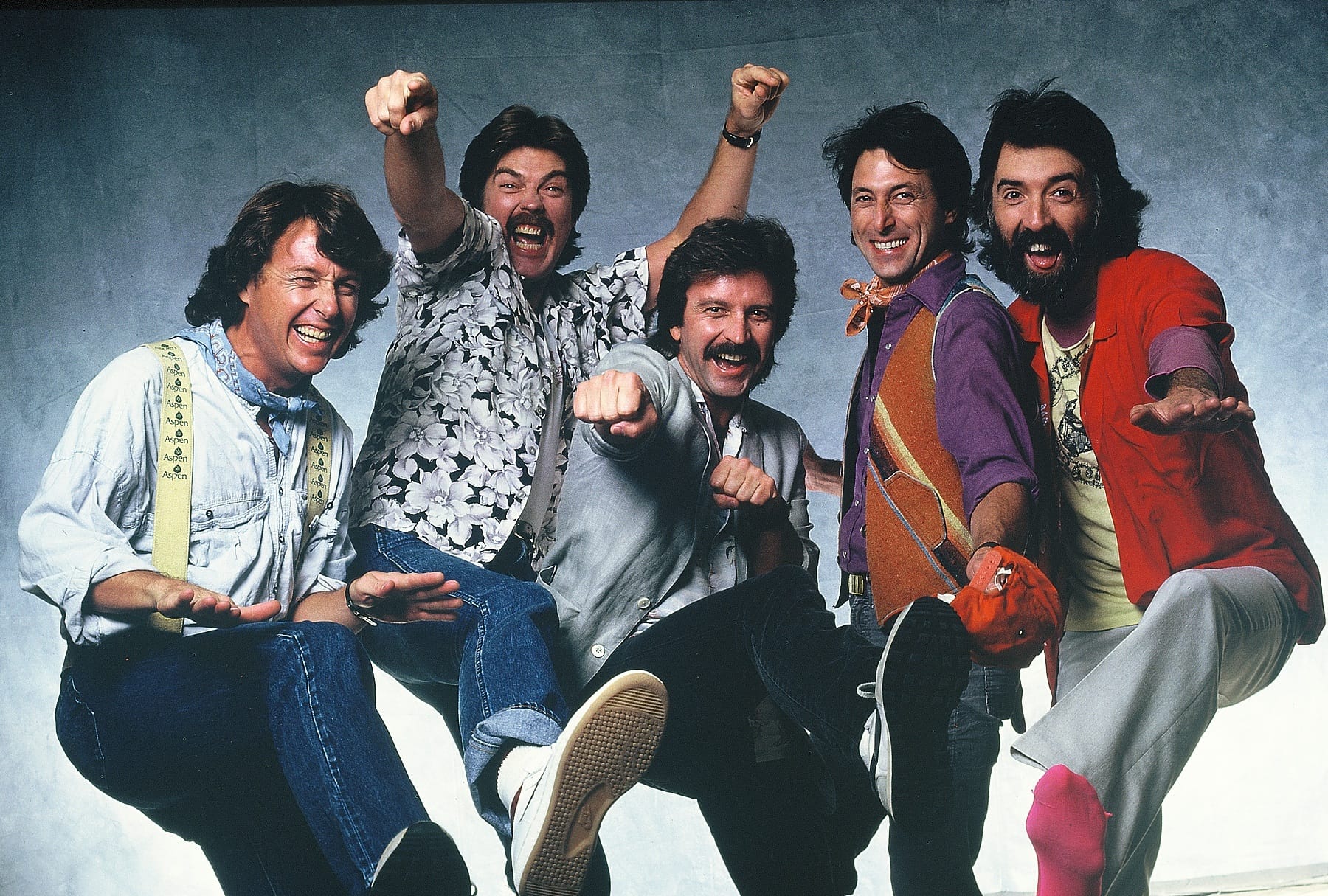
The ones who carried it longest tell you why it worked. "We realized, a long time ago, that we really enjoy doing this, and we think we make pretty good music together," Fadden said in 2010, "so we've sucked it up and carried on even when there might have been some disagreements... we've created something together that we can't do separately." Jimmie Fadden: sixty years on drums and harmonica, the only man besides Hanna present for all of it, whose harmonica — as Peter Cooper wrote in the band's own biography — "is to the Dirt Band what Mickey Raphael's is to Willie Nelson: It is instantly recognizable, and instantly satisfying." The steadiness travels: when a drummer couldn't make a Freedom Sings road date in Iowa, it was Fadden who sat in. Asked once why they'd formed a band in the first place, Fadden gave the complete answer: "We wanted to avoid working." Hanna's version of the origin, offered half a century in, rhymes exactly: "It started out as a way to avoid getting a real job, and we ended up touring the world." The drummer's unjoked version arrived in 2022: "Essentially, that's the driving force. It's gratitude, you know. You get up every day and you go, 'I got a job that I love.'"
Duane Allen, decades deep in his own four-man marriage, endorses the arithmetic and adds the covenant: "Each person must love the music, and hopefully, each other... It is important to listen to the ideas of all members. The best ideas always work the best. And fourth, it is important to learn how to say 'I'm sorry,' and mean it."
Bob Carpenter — the accordion-playing, high-school-choir kid who never imagined this lifestyle, four and a half decades at the keys — was asked in 2014 whether he ever got tired of playing "Fishin' in the Dark" and "Mr. Bojangles" every night. His answer deserves framing: "Never tired of singing or playing them. Never. Never. Never. Never. Never." Hanna's answer to the same question splits the difference with a grin: "Do I need to play 'Mr. Bojangles' another thousand times? Not in my living room, I don't. But on stage is great. It's great having people sing along."
Pressed once for adjectives about his bandmates, Hanna protested — "That's really unfair" — and then delivered a set of portraits nobody could improve. Carpenter: "the rock at the center of all this... a steadying influence." Fadden: "Mr. Steady... He's the soul man." Ibby: the wild card. And himself? "I show up," he said, laughing. "I'm a list-maker as a person... I see the list at the end of the day and see I haven't done any of it." The list may go unfinished; the life was never in doubt. "We've never had a plan B," Hanna said at 75. "This, you're looking at it. I mean, it's plan A."
The clearest X-ray of the band's soul is a round-robin a Kansas City reporter transcribed in 1970, the five of them finishing one another's ambitions: "We're trying to play good." "And be happy." "And make other people happy." "And work nice places." "Places where people listen." "Not swank places where people are too busy drinking to listen." "Or places where people are too hip to be happy." Sixty years later, that remains the complete mission statement, unamended.
The song that names this section was an Ibbotson-Hanna co-write, and its birth certificate belongs in the American songbook's registry of miracles. Ibbotson started it, he confessed, "as a joke," in a basketball arena in St. Joseph, Missouri, with 40 people in the seats, singing it to Fadden in the dressing room "as just something to pass the time, to keep our mind off the fact that we were bombing." Give St. Joseph its due in this story. It is the old jumping-off town — the Pony Express first rode west from there, Jesse James finally fell there — and country music circled back to it: a decade past that empty night, Sawyer Brown, the Dirt Band's running mates in the band boom, both outfits putting singles at No. 1 in 1985, came to St. Joseph to film "The Boys and Me" — a Mac McAnally co-write, and at bottom the same song "Partners" is: the boys, staying the boys. Decades later, asked to look back, the band put it plainly: "The Nitty Gritty Dirt Band were and are heroes of ours. When we first started our band, we looked to those guys as folks who blazed their own musical trail — they were a band whose creativity and originality never stopped." And the miles turned it personal: "over the years, we traveled thousands of miles with them, and we're so thankful to be able to say that our heroes became our friends." Out of the emptiest room of the lean years came the fullest line the band ever wrote, the one Hanna calls their whole autobiography: "It's great to be a part of something so good that's lasted so long." He allows that they're puffing out their chests on that one. Sixty years in, they've earned the puff.
THE CIRCLE COMES HOME
The long last lap opened at the Ryman on September 14, 2015: a sold-out 50th-anniversary night with Jackson Browne, Vince Gill, John Prine, Sam Bush, Jerry Jeff Walker, Alison Krauss, Rodney Crowell and Jerry Douglas crowding the stage — a lineup Bush christened "The Nitty Gritty E Street Band." Jerry Jeff sang "Mr. Bojangles" playing Hanna's own Gibson; Hanna's private highlight was singing "Paradise" with Prine. "We'd worked so hard that we were somewhat tired when we hit the stage," he said afterward, "but the energy from that crowd had us levitating!" The night became a PBS special, the special won a regional Emmy, and the band declined to treat any of it as a finish line.
By then, every elder from the 1971 sessions was gone — Acuff, Maybelle, Earl, Doc, Merle Travis, Jimmy Martin, Vassar — and in 2020 Prine and Jerry Jeff would follow them. The young men who needed haircuts had become the last custodians of the tape.
The band on the farewell run was a family photograph. Jaime Hanna — "the absurdly talented singer and guitarist Jaime Hanna," in Peter Cooper's words — had been circling the family business his whole life: harmonies on Circle III as a young man — and when a chair went empty in 2004 and booked dates loomed with nobody to play them, Bob Carpenter's solution was already obvious: "Let's just call Jaime." Carpenter knew how this band absorbs people, because it had absorbed him: his band Starwood toured with the Dirt Band in the late '70s, and soon he was singing and playing keys on The Dirt Band album — the start of a run that has kept him "the new guy" for nearly fifty years, with a voice that's warm, husky, and somewhere in the neighborhood between Michael McDonald and Bob Seger. Ten shows on the family bus, then years on the road with Raul Malo's Mavericks and with Gary Allan, and Hanna-McEuen, the 2005 duo record he made with Jonathan McEuen — two sons of the band, blood harmony inherited intact, a second generation closing a circle of its own. He joined his father's band in 2018 and greeted the job with clear eyes: "It's been fun. It's been a challenge on lots of different levels... There are amazing parts about it, and there are equal opposites. It's been great." His father's accounting of the same eight years is simpler. "He grew up on this music... I'm very proud of him and happy to have been alongside him," Jeff says — and on that run, when Jaime introduced him mid-set each night, the pride ran downhill: "when somebody starts getting choked up, then it's contagious. Everybody does." Ross Holmes brought the fiddle by way of Mumford & Sons' touring ranks and Bruce Hornsby's Noisemakers — meaning the man sawing beside Fadden every night apprenticed under a Circle II guest — and by way of the driveway: he was Jaime's neighbor, recruited after a family get-together at Jaime's house dissolved into picking, singing, and, per Hanna, a few hoisted glasses. And on bass stood Jim Photoglo — the same Jim Photoglo who co-wrote "Fishin' in the Dark" and joined the band three decades after it hit No. 1, a man who spent the farewell run playing, every night, the song Josh Leo had first heard at an apartment party and carried straight to the band. Even his hiring was neighborly: Bill Lloyd of Foster & Lloyd remembers the breakfast club Photoglo kept for a while with Jeff, Lloyd and guitarist George Marinelli — "It was at one of those catch-ups that Jeff asked Jim to go on the road with the band." Somewhere the circle metaphor filed for overtime. Hanna's survey of the six-man band needs no decoding: "We have such a great time playing together. I love the band. I love this lineup. This is the most fun we've had playing in decades."
And the family photograph extends past the stage. Jeff married Matraca Berg in 1993, a courtship he has recounted with unusual candor: a producer told him he ought to write songs with her, "So I called her up, and well, you know, I had ulterior motives. The writing really knocked me out." When the band cut "It's About Time" with her in 1998, he counted it among the perks of the whole career: "That's Matraca Berg. They finally let me sing with my wife. I was really happy about that." His marriage philosophy, offered to the CMA's own magazine, is road-tested and plain: "You gotta listen. You gotta talk. And you gotta allow people a little room." And the road stays outside: "You can't bring that home. You gotta check that stuff at the door." That same season, in one of Nashville's crueler coincidences, Rising Tide Records collapsed beneath them both — her months-old album died mid-single, and the band's finished one was stranded unreleased until DreamWorks finally put it out — labelmates in marriage and in shipwreck. The household absorbed the hit the way this band has absorbed everything, and kept writing.
They kept making things right through the last tour, which almost nobody does. Every veteran act knows the joke Hanna attributes to either John Mellencamp or Tom Petty — announce a new song from the stage and "well, here's your opportunity to go get a beer" — and this band kept writing anyway. Dirt Does Dylan in 2022, produced by Hanna and Ray Kennedy — and mark the debt it settled. Dylan was the man whose Nashville records had opened the road every longhair traveled in 1971, the Dirt Band included. Half a century on, they repaid the toll with an entire album, passing "The Times They Are a-Changin'" around the room to Rosanne Cash, Steve Earle, Jason Isbell and The War and Treaty, the way everything they ever loved got passed around a room. They had walked in with 80 Dylan songs and kept the handful that passed Hanna's test: "It sounds like Dylan, we're honoring the material, and yet it sounds like us." And in October 2025 — inside the farewell tour itself — the Night After Night EP, produced by Jerry Douglas, the dobro master whose whole career stands on ground the Circle records cleared. Its centerpiece, "Nashville Skyline," was written by Jaime Hanna, Jeff Hanna and Matraca Berg. "'Nashville Skyline' is a lament about change," Jeff said. "A yearning love letter to what was." Carpenter put the same fact his own way: "Who do you know that does a farewell tour and does a brand-new song? Nobody. That's us because we do stuff that nobody else does. It makes no sense." Viktor Krauss, on bass at those sessions — a Champaign, Illinois kid who had the band on his radar from childhood — heard it from the outside: "It was certainly really special to work within a group of people that have had so much history together."
The decision itself traced to the year the pandemic parked every bus in America. "It was weird to sort of disappear," Carpenter said, "so we want to take this opportunity to give folks in all the places we're playing one last chance to see the band live and say thank you for all the years of support."
Sawyer Brown took them up on it. "Last summer, we lucked into having a night off on the road in the right place at the right time, and we got to see them in Boise, Idaho. And they were great — as always!" Their sign-off was three words: "We love y'all."
"60 years! Incredible! So, here's to our road brothers and friends The Dirt Band, whose music will always live on and continue to bring joy to everyone who hears it."
— Sawyer Brown
Josh Leo had a message for the three men he cut the hits with. "It was an extreme pleasure working with you guys and making music business history together," he says, to Jimmie, Jeff and Bob. "It's fun when you do that. It's even better when you do it with your closest buddies, which we are."
Irene Kelley has loved the band since the '70s and credits the descending line in Jerry Jeff Walker's "Mr. Bojangles" with rewiring her own writing — "it's largely the reason I've incorporated that figure into so many of my own songs." Her send-off retires only the buses, the way everyone in this story is careful to: "Wishing them all the best in their road retirement... Thanks for being an immortal soundtrack to my life."
Then Nashville itself spoke. Dave Pomeroy spent fourteen years holding down the low end for Don Williams and has played bass on more than five hundred records — Trisha Yearwood, Willie Nelson, Elton John, Emmylou Harris. Since 2008 he has led the Nashville Musicians Association, the town's own union; since 2023 he is also International Vice President of the American Federation of Musicians. His letter carries both the player's life and the office. "As a teenager, I listened to their records at a time when genres were rarely mixed, and they broke the rules in a completely unpretentious way. They made me feel that all things seemed possible, but I had no idea I would someday meet and become friends with these incredible musicians." Then, with the weight of the office: "On behalf of the Nashville creative community, thank you and congratulations to everyone involved with the Nitty Gritty Dirt Band's amazing career. We love and respect you and know that your music will live on forever."
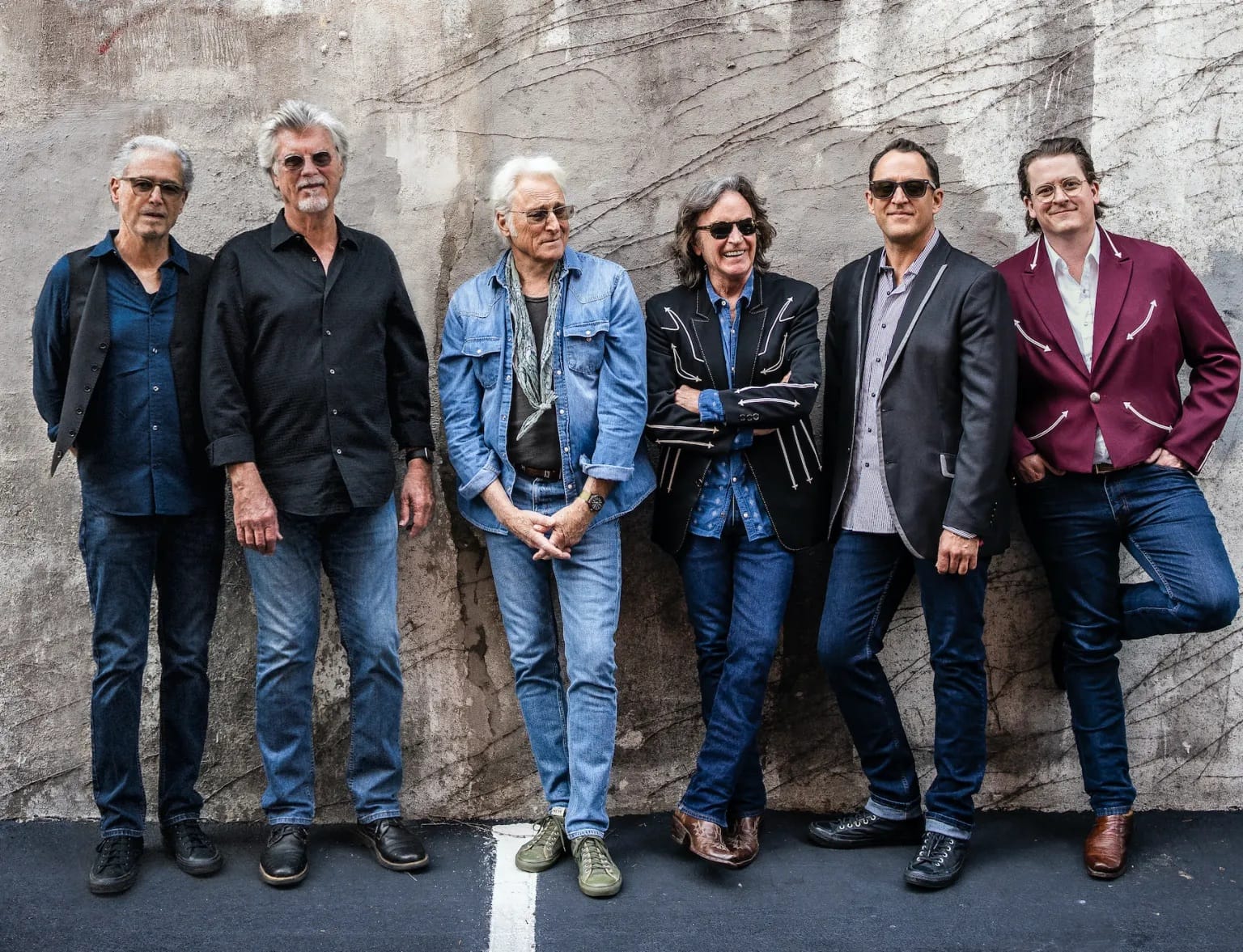
The keeper of the history spoke as well. Michael McCall is Associate Director of Editorial at the Country Music Hall of Fame and Museum and co-curator of Western Edge: The Roots and Reverberations of Los Angeles Country-Rock — the exhibit that wrote the band into that story at the highest institutional level, built with Jeff and John McEuen's own interviews and artifacts. He opens his reflection like a citation being read aloud: "Any band that survives sixty years in the music business deserves a distinguished service medal," McCall tells Generation Country. "Fortunately, the Nitty Gritty Dirt Band early on learned the value of perseverance." His accounting runs the whole arc, from the "Mr. Bojangles" breakthrough that "helped push country-rock to national prominence at the start of the 1970s" to the Circle album "anchoring the Dirt Band as a group that bridged the past with the future" — and closes on the judgment a museum exists to render: the chart run that followed proved the band's broad appeal "while providing a blueprint on how a band can evolve and adapt while always pledging allegiance to the roots music that had inspired them from the start."
The farewell was announced in January 2024 with a statement that read like the band sounds: "'All the Good Times' perfectly describes our career... The most important part of that has been the connection to our audience — that beautiful communal give and take is like nothing else." And here the file opened in 1971 closes. When Jack Hurst sat in Woodland Studios that August and sketched the Circle's plans for Tennessean readers, the set's second disc carried a tentative title borrowed from an old mountain song: "All The Good Times Are Past And Gone." The Circle grew into a triple album instead, and the title slid onto the album the band released that very winter, months before the Circle itself appeared — and then lay in wait, five decades, to name the farewell tour. All the good times: past, and gone, and somehow neither.
Hanna called it "the final chapter of the barnstorming era of our career," and refused all melodrama: "We're still in good shape, but the tires have less tread. We want to end this while we can still go out there feeling good and playing great." Carpenter's version, as ever, came with a grin: "We're making jokes now about how this is the last time we're going to be delayed and this the last free piece of cheesecake backstage." And Hanna, asked what kept the whole thing alive for sixty years, reached for a sports metaphor that is really a creed: "As they say in basketball, it's the sixth man. It's the audience, you know?" Once the buses were parked, he described for NPR what that audience looked like from the stage at the end: "goosebumps... looking out over that crowd and seeing kind of three generations of fans. We call them dirt heads... folks that came to our shows, and then they brought their kids to our shows, and their kids brought their kids. So the legacy part of it really kind of hit us a lot in the last couple of years — and we never imagined." Michael Bane, who once drove the Smoky Mountains at dawn with "Ripplin' Waters" pouring out of the dashboard, closed his profile of the band with the finding that the best music "touches us in a place where we're always alone, to remind us that we're not." That was always this band's product line.
On May 13, 2026 — sixty years to the day after the Paradox gig that paid, in Hanna's accounting, "in dollars rather than pizza" — they played the Grand Ole Opry House with Jerry Douglas, Alison Brown, Kathleen Edwards and Suzy Bogguss as guests. Jaime surveyed the stage and cracked, "No hard drives up here... And that's the way we like it." Robert K. Oermann, reviewing the night for MusicRow — a piece he shared with Generation Country — certified the claim: "The evening's music was utterly refreshing, since we experienced a real band, playing and singing without pre-recorded sounds, click tracks, synth effects, video walls or pitch adjusters." Some 2,500 were in the seats, and many in the "sweetly enthusiastic audience," he noted, "looked like they shared the band's vintage." The encore folded "Will the Circle Be Unbroken" into The Band's "The Weight," which is the band's whole story in a single medley. Jeff told the room: "It's not lost on us how lucky we are to have been doing this with you guys all these years. You are beautiful. Thank you so much."
Five weeks later, Denver. The Mission Ballroom, June 18, 2026 — Colorado, because, as Carpenter said, "We call it our ancestral home. In our hearts, Colorado is our home." He'd told a reporter that spring what the hits were for: "When we play like 'Fishin' in the Dark' and '(Mr.) Bojangles,' I mean people just light up, it's great. That's what they come to hear and it's great to sort of be able to hit those home runs for them when they come to the ballpark." Hanna's version of the same fact is a nightly physics report: "hearing those folks applaud when I sing the first three or four words of the tune, and singing it back to us — lifts us up."
The last ballpark got everything. They opened with "You Ain't Goin' Nowhere," the Dylan song they'd once used to welcome the Byrds home to country music, and put "Partners, Brothers and Friends" second — the autobiography, right up front. The night ran like a last walk through the house: "Girl From the North Country." Prine's "Grandpa Was a Carpenter," sung for a friend six years gone. Molly Tuttle stepping up for "I'm Sittin' on Top of the World." "Ripplin' Waters." "Bless the Broken Road." "Fishin' in the Dark." And "Nashville Skyline" — the brand-new song, performed at the very last show, which is the entire band in a single programming decision. Grateful Web's reviewer in the room reported that "every note was resonant, crisp, and clear," judged Carpenter's voice better than ever, and watched the crowd file out on "misty-eyed, heartfelt smiles." Alison Brown, Tuttle and Tommy Emmanuel — three more borrowers from the lending library this band ran for sixty years — helped play them out. Then, for the encore, everyone came back to the stage, and "Will the Circle Be Unbroken" was stretched wide — verses handed around, instrumental interludes blooming between them — until it poured into "The Weight," borrowed from the only group all of them ever bought tickets to see together, whose drummer had stepped inside Circle II. The question they built the whole edifice on, answered by everyone in the room, one last time.
And then the buses parked.
Nobody who has read this far believes that's an ending, and neither, it turns out, does the band. What ended in Denver was the job, not the appetite. "Not that we hate it," Hanna told Bill Graham of American Blues Scene as the last leg began. "We love our tour buses and we love touring. But we've gotten to the point where we really need some time with our families. And we want to sort of enjoy some of what's left ahead of us." "We're gonna try to create opportunities that you'll still be able to see the band," he says. "Maybe doing a residency here or there, or the odd festival or one off this and that. But just not the full-time job part of what it has been." Then, with the timing he's had since the Ice House: "Maybe when we all turn 90, we'll try to come back."
Michael Martin Murphey on the Nitty Gritty Dirt Band's legacy
Michael Martin Murphey, on camera, backs that up with sixty years of source credibility: "I've been hearing them say that for thirty years, by the way. So I'm hoping that it really won't be true — that they really get tired of retirement and they'll come back again. But if they don't, there will never be anything like the Nitty Gritty Dirt Band ever, ever again. You're one of a kind."
Duane Allen sent the band a request instead of a farewell: "I am still trying to retire but I find that retiring is not so easy. Please give me pointers on how to retire gracefully." Then the toast: "We may not have 'knocked our audiences dead' — but we badly bruised a lot of them! I will always love the Dirt Band and each of you."
And what Hanna will miss isn't the roar. He told NPR's All Things Considered that it's the long mornings in the next town, the bus in by eleven and nothing to do but walk: "I love downtown, downtown America... There's a lot to see. I'm going to miss that."
They spent sixty years asking one question with the whole of American music gathered around the microphone — fathers and sons, Nashville and Long Beach, Moscow and the Opry House, a washboard and a five-string, them dirty boys and the queen herself. Every generation that sang it with them already knew the answer. The road ends. The circle was never in danger.
Carl Jackson — who was once honored just to be asked to join them — gets the last word: "God bless the Nitty Gritty Dirt Band."
The Nitty Gritty Dirt Band's first sixty years: Jeff Hanna, Jimmie Fadden, Bob Carpenter, Jaime Hanna, Ross Holmes, Jim Photoglo — and Bruce Kunkel, Ralph Barr, Les Thompson, Jackson Browne, John McEuen, Chris Darrow, Jimmy Ibbotson, John Cable, Jackie Clark, Al Garth, Richard Hathaway, Merel Bregante, Michael Gardner, Vic Mastrianni, Bernie Leadon, and all who carried it.
Sources: Jack Hurst's reporting from the Circle sessions, The Tennessean, August 12, 1971, and after; the Long Beach Press-Telegram, 1967; The Kansas City Star, November 22, 1970; Cashbox, 1967; the Associated Press, 1967–1984; Parade, May 1977; David K. Shipler's dispatches, The New York Times, May 1977; Mix, March 1986; Michael Bane's profile, Country Music, September–October 1986; Holly Gleason, the Palm Beach Post, 1986; Robert K. Oermann, The Tennessean, November 20, 1988, and MusicRow, May 2026, shared with Generation Country; the San Francisco Chronicle, September 24, 1989; and other period newspapers held in the Generation Country archive. Contemporary and retrospective: Acoustic Guitar; Billboard Country Update, August 2014, by Phyllis Stark; the Bitter Southerner; NPR; American Blues Scene, by Bill Graham; Grateful Web, June 2026, by Debra Lambert; and the band's own histories. New reflections and statements were given directly to Generation Country in June and July 2026 by the contributors named throughout.