
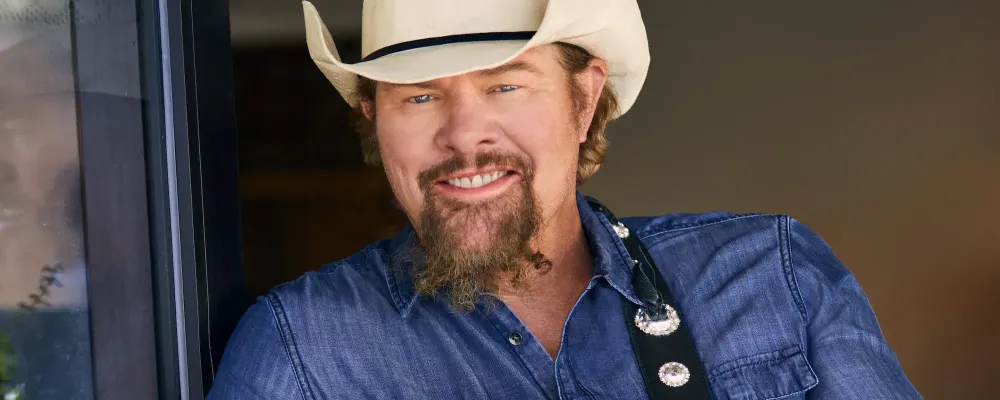
He was one of the biggest artists his format ever produced — the baritone, the swagger, the stadium command, twenty No. 1s and a decade spent at the top of country music. He was also the man who wrote almost all of it himself, and of everything he won, that was the recognition he wanted most.
In June of 2015, in a ballroom in Manhattan, the brashest man in country music finally got the one award that meant anything to him, and Stephen Colbert handed it over by singing "As Good As I Once Was." Toby Keith already owned a wall of the others — Entertainer of the Year, Male Vocalist, Album of the Year, a stadium's worth of platinum — and he waved all of it off from the podium. "I don't know if people know that I wrote all that stuff," he said, "but I outworked everybody. I put an album out every year, I wrote 99 percent of it, and this is the reward you get. And this is the only award I ever wanted." He had been saying it for years, in quieter rooms. "It's the one thing I do a little bit of every day. I just happened to become an artist, but I was a songwriter first and foremost."
He meant it, and he could afford to, because the stardom was never in question. The country audience got a genuine giant — the six-foot-four presence, the baritone that turned from a conversational drawl to full theatrical muscle inside a single line, a run of hits that made him one of the defining entertainers of his era. He was a cowboy poet built like a defensive end who sang like he owned the room.
THE OILFIELD AND THE BANDSTAND
Toby Keith Covel was born July 8, 1961, in Clinton, Oklahoma, and raised mostly in Moore, a suburb south of Oklahoma City, the son of Hubert K. Covel Jr. The music came from his grandmother, who owned Billie Garner's Supper Club up in Fort Smith, Arkansas. Keith spent boyhood summers there doing odd jobs, watching the band, and eventually climbing onto the bandstand himself; he had a guitar in his hands at eight. "That blessing that God gave me reared its head," he said of those nights, "and here we are today." The 2011 album Clancy's Tavern is named for a version of that room.
He did not chase it, though, not for a long time. He followed his father into the Oklahoma oil fields, worked as a derrick hand, and made supervisor. When he was twenty he and some friends started the Easy Money Band and worked the roadhouses at night — Keith sometimes walking off a gig mid-set because his pager called him back to the rig. Then the bottom fell out. The state's oil industry collapsed in 1982 and left him unemployed, and he did the only other thing a big Oklahoma kid knew to do with himself: he tried out for the USFL's Oklahoma Outlaws. He didn't make it. He played defensive end for a semi-pro farm club, the Oklahoma City Drillers, until the band pulled him back for good.
What followed was nine years of honky-tonks across Oklahoma and Texas and no return calls from Nashville, where he'd busked Music Row to nothing. The break, when it came, came sideways, the way his fame always would: a flight attendant who was a fan carried his demo tape to Mercury producer Harold Shedd, Shedd flew out to watch him play, and the deal was done. He was thirty-one when his first record came out, and he had already written a decade of songs to get there. He married Tricia Lucus in 1984 and never moved to Nashville at all. He stayed in Oklahoma and made the town come to him.
CLOSING THE GAP
Ask him how a person learns to do this and he'd give you arithmetic, not mystique. "When I first started writing, I didn't know what I was doing — you write 100 songs and they're not very good," he said. "Then all of a sudden you'll write a decent one. You're at 100 songs, then you write a decent one, then 90 songs and another good one, then 50 and another good one, so you just start closing that gap over the years. By the time I was 22 or 23, I was writing a good song every 10 songs." The first one arrived when he was fourteen or fifteen — "If You're Handing Out a Heartache," structured right and not much good, he admitted, and by his own reckoning near the end of his life that was "5,000 songs ago."
The method under the arithmetic was discipline, and he preached it plainly. "Most of my catalog was written at a time when I was writing at least four or five days a week," he said. "You got to have volume, you got to have practice, you got to keep your chops up, and you got to stay in the middle of the game." He built songs from the chorus out. "The chorus to me is the gist of the song; that's where the idea is delivered," he said. "If I don't ever get the chorus right, it's no use in me writing the song." And he was ruthless about the part most beginners skip: "Finishing a song is just as important as having a great idea. If you start 100 songs and finish one of two, you never learn to finish a song out."
He believed the writing was the thing that made a singer real. "When someone writes their own things, they release their character in their music, and that character shines through in all their songs," he said. "If you hear me sing one of my songs on the radio, people who know me say, 'that is so you' — well, it should be, because I wrote it." He liked to keep eight or ten songs a year to himself and chase the rest across the country with a short list of collaborators. The volume never let up. It was the whole point.
THE SIDE OF A MOTEL TUB
The song that started it was written in about twenty minutes on the edge of a bathtub. Keith was finishing his debut album and out on a hunting trip, and in a steakhouse bar in Dodge City, Kansas, he watched a hunter get shot down by a cowgirl while a friend needled him — you should've been a cowboy. "So I thought, I'm going to write that," Keith said. "I took my guitar, sat on the side of the motel tub, and shut the door so no one could hear me." "Should've Been a Cowboy" went to No. 1 in June of 1993, the first single he ever released, and it kept going long after: it became the most-played country song of the entire 1990s, more than three million radio spins deep by the end of the next decade.
The early run made the case that he was more than a good-time hook. "Who's That Man," his second No. 1, started as the old bar joke about what you get when you play a country song backwards — the dog, the truck, the wife, all of it coming home — and Keith turned it inside out into the story of a divorced father driving past his old house watching another man live his life. He wrote it alone. "Wish I Didn't Know Now" and "Me Too" followed, and so did a stretch of label mergers that moved him from Mercury to Polydor to A&M and back without ever quite knowing what to do with him. An early AllMusic verdict caught the mismatch: the records were "a bit too big, clean, glossy" for his own good, the production reaching for early-'90s radio while the talent underneath strained against the sheen. The songs were already stronger than the rooms they were cut in. He just needed a label that would get out of the way.
HOW DO YOU LIKE ME NOW
He got it by force. Mercury had turned down a song he'd written with Chuck Cannon — "You should have seen the disgusted looks I got when I submitted that song," he said — and when he jumped to DreamWorks in 1999 and his first single there stalled, he demanded the label pull it and put out the reject instead. "How Do You Like Me Now?!" spent five weeks at No. 1, finished as the top country song of 2000, and crossed him onto the pop chart for the first time.
The song is about exactly what his career was about — for anybody, he said, who was ever told they wouldn't make it: an old flame, a boss, a teacher. He and Cannon had gotten stuck after the first verse and set it down for six months before they came back and finished it. A man the business had spent a decade not knowing how to handle aimed the song straight at the town that passed on him, and made them play it into the ground. After that there was no arguing with him.
A DECADE NOBODY COULD TOUCH
For the stretch that followed, Toby Keith was the center of gravity in country music. He put twenty songs at No. 1 and forty-five of his own compositions into the Top 20; he sold more than forty million records and stayed a fixture on country radio for two full decades. The CMA named him Male Vocalist of the Year in 2001; the ACM handed him Entertainer of the Year in 2002 and again in 2003. When Billboard tallied the century's first ten years, it ranked him the top country artist of the decade, with more Hot Country Songs No. 1s across those years — sixteen — than anyone else in the format. He filled arenas on the strength of a voice you knew inside four notes and a presence that reached the back row without a screen. The records were loud and funny and built for a crowd on its feet, and the craft underneath was the reason they held up after the crowd went home.
THE MAN ON THE OTHER SIDE OF THE BUS
Backstage at the 1997 CMA Awards, Keith met a young Florida writer named Scotty Emerick, and the partnership that followed became the engine of his best decade. "For the next 10 years we wrote like 53 songs that he did," Emerick said. Their arrangement was the road itself: "Toby and I'd do shows — I'd do my show, he'd do his, then we'd get back on the bus, and we'd be back at it, just making up songs." It was the same relationship Dean Dillon had with George Strait, the writer-foil who rides along and keeps the well from going dry, and Emerick knew the lineage — Dillon and Red Lane were his own mentors.
What they made together is a catalog of standards that never announced how well built they were. "I Love This Bar" spent five weeks at No. 1 and turned into a beer-joint jukebox fixture for good. "Whiskey Girl" went to the top the next summer. "As Good As I Once Was" — six weeks at No. 1 and BMI's Country Song of the Year — came out of a Burt Reynolds line that Keith's own father used to quote: not as good as I once was, but as good once as I ever was. Keith built three verses on it, the man in each one a little older and a little slyer, and made it a promise instead of a lament. "Don't sell me short," is how he read the last verse, "because I'll surprise you."
The one they'll play forever started with a title Keith had carried around for years and a melody lick Emerick tossed off one day. "Beer for My Horses" — the phrase lifted from a line of Old West justice in the 1975 film Bite the Bullet — was written before anything about it could be political, "about the law of the Old West," Keith said. When it was done he floated the idea nobody else would have dared. "He said, 'Man, you know who'd be perfect to do a duet with? Willie Nelson,'" Emerick remembered. "I said, 'Man, don't even say that, that'd be way too cool.' And then Toby got it done." They pitched it on Willie's bus. It spent six weeks at No. 1 and made Nelson, at seventy, the oldest artist ever to top the country chart — his twenty-third No. 1, his first in fourteen years, and, as it turned out, his last. The kid from the Oklahoma oil patch had just handed a legend one more trip to the summit, and stood next to him while it happened.
THE ONES HE DIDN'T WRITE
He wrote most of it, and he was honest about the rest, which is its own kind of songwriter's confidence. He didn't touch "I Wanna Talk About Me," the spoken-word country-rap that gave him a five-week No. 1 — that was Bobby Braddock, one of the deepest wells in Nashville history. "My List," another five-week chart-topper, came from Tim James and Rand Bishop. And the one that outsold nearly everything, "Red Solo Cup," was written by the Beavers and Warren brothers, not him; Keith's own verdict was the most clear-eyed sentence anyone ever offered about it. "It's the stupidest song I ever heard in my life," he said, "but it's so stupid it's good." The man knew exactly what he was singing, and sang it anyway.
The strangest cut in the drawer belongs here too. In 1997 he recorded a duet on a song off Sting's Mercury Falling — "I'm So Happy I Can't Stop Crying" — with Sting himself singing harmony and playing bass, and the two of them stood on the CMA stage together and delivered it. It went Top 5 country and remains, to this day, the only time Sting ever appeared on a country chart. Keith didn't write a word of it. He just heard where his baritone could live inside it.
HIS OWN HOUSE
By 2005 he had stopped waiting on anyone. He founded Show Dog Nashville to put out his own records on his own terms, and he'd already helped Scott Borchetta start Big Machine, the label that would launch Taylor Swift a year later. His publishing ran through his own company, Tokeco Tunes. He filled the Show Dog roster with people he believed in — Trace Adkins, Mac McAnally, Trailer Choir, and Mica Roberts, a fellow Oklahoman who'd sung in his Easy Money band before he ever had a deal to offer her. Forbes eventually put him on the cover as country music's five-hundred-million-dollar man. He acted, too — top-billed in Broken Bridges opposite Burt Reynolds and Kelly Preston, then in the movie Beer for My Horses, which he wrote himself into. He built an empire and kept writing four days a week inside it.
Kyle Young, who runs the Country Music Hall of Fame, found the right words for the whole approach: Keith "didn't play the Nashville game, but chose to roll the dice and face the consequences." And he pointed the leverage somewhere it counted. When his first guitar player's daughter, a little girl named Ally, was dying of cancer just shy of her third birthday, Keith named a charity for her, then built the Toby Keith Foundation and OK Kids Korral, a cost-free home in Oklahoma City where families of children with cancer could stay through the fight. He called it the best thing he ever did. He had no way of knowing the disease would come for him too.
DON'T LET THE OLD MAN IN
In 2018 Keith was riding shotgun in a golf cart at Clint Eastwood's charity tournament in Carmel. Eastwood was about to turn eighty-eight and about to direct and star in The Mule, and Keith asked him how he kept doing it. "He said, 'I just get up every morning and go out. And I don't let the old man in,'" Keith recounted. "And I thought, I'm writing that." He couldn't put it down. "I was short on phone calls, I didn't hear any conversation, I could not quit working on it," he said. He wrote the whole thing alone in about a day and a half. "The second I wrote it, it was just like I jumped 500 feet in the air." He was sick the day he cut the demo — "a real raspy, sleepy, tired, sick vocal" — and Eastwood loved that worn quality so much he put the demo straight into the film.
He folded a real woman into it, too: the grandmother of a friend of his, a woman who had never had a birth certificate and genuinely didn't know her own age — and she became the many-moons line in the chorus, the one Willie Nelson singled out as among the best he'd ever heard. Buddy Cannon called it the best song Keith ever wrote. It was a song about refusing to let mortality through the door, written by a man who had no reason yet to think about the door at all.
At the end of 2021 he was diagnosed with stomach cancer. He stepped off the road to fight it, and in September of 2023, frail and cheered to his feet, he walked back onto a stage to accept the first Country Icon Award and sang "Don't Let the Old Man In" to a standing ovation — his first public performance since the diagnosis. He played one last full show in Las Vegas that December, worked "As Good As I Once Was" into the set, and went home. He died February 5, 2024, at sixty-two. The Country Music Hall of Fame's ballot had already closed; the results reached the Hall the day after he died. The vote had made him a member while he was still alive, and nobody got the chance to tell him.
At the induction that October, Post Malone sang "I'm Just Talkin' About Tonight" and Eric Church sang the old man song, and Church said the truest thing about the man's craft anyone found: "As a songwriter, I've never heard him write about anything that he wasn't living at that time." Tricia Covel stood up for her husband and repeated the line he'd lived by since the oil patch — there may be better singers, there may be better songwriters, but they'll never outwork me. He'd been telling everyone for years which trophy he actually wanted, and he collected all three houses in the end: the national Songwriters Hall of Fame in 2015, the Nashville one in 2021, the Country Music Hall of Fame the year he died. But the last word wasn't a plaque. It was a song he wrote by himself, sick, alone behind a shut door the way the first one was — a man staring down the one thing that wins, and refusing, right to the end, to let it in.
SELECTED SONGS
"Should've Been a Cowboy" — Toby Keith (1993)
Twenty minutes on the edge of a motel tub, and the most-played country song of its entire decade. Solo write, first single, instant standard.
"Who's That Man" — Toby Keith (1994)
A backwards-country-song bar joke rebuilt into a divorced father's drive past his old life. Wrote it alone, and it's where the depth showed.
"Me Too" — Toby Keith (1997)
His third No. 1 and proof the early run wasn't a fluke.
"How Do You Like Me Now?!" — Toby Keith (1999)
Written with Chuck Cannon, rejected by one label, forced onto radio by another. The anthem of everyone ever told no, by a man they told no.
"You Shouldn't Kiss Me Like This" — Toby Keith (2001)
His own line for it: "a three-and-a-half minute song about a five-second kiss." Solo write, the last single off the DreamWorks debut, No. 1 by March 2001 — and Tricia's all over it.
"I Wanna Talk About Me" — Toby Keith (2001)
He didn't write a word — that's Bobby Braddock — and he knew a rocket when he heard one. Five weeks at No. 1.
"My List" — Toby Keith (2002)
Tim James and Rand Bishop wrote it; Keith rode it five weeks at No. 1. A great writer's ear for someone else's great song.
"Beer for My Horses" (with Willie Nelson) — Toby Keith (2003)
Emerick's melody, Keith's old title, Keith's audacious idea to call Willie. Made a seventy-year-old legend the oldest man ever to top the country chart.
"I Love This Bar" — Toby Keith (2003)
Co-written with Scotty Emerick. Five weeks at No. 1 and a jukebox fixture in every beer joint that's opened since.
"Whiskey Girl" — Toby Keith (2004)
Emerick again, top of the chart again. The road partnership at full gallop.
"As Good As I Once Was" — Toby Keith (2005)
A Burt Reynolds line his father loved, built into three verses of aging gracefully and daring you to underestimate him. BMI's Country Song of the Year.
"God Love Her" — Toby Keith (2008)
Co-written with Vicky McGehee after the two of them tied for a BMI songwriter award and someone said they ought to write together. His eighteenth No. 1.
"Red Solo Cup" — Toby Keith (2011)
Not his — the Beavers and the Warrens wrote it. His review stands as the last word: "the stupidest song I ever heard in my life, but it's so stupid it's good."
"Don't Let the Old Man In" — Toby Keith (2018)
Seven words from Clint Eastwood, a day and a half alone, a sick demo Eastwood refused to re-cut. The song he wrote about the thing that was coming, and the one he'll be remembered by.