In the early 1980s, at a club across from the Opryland complex called the Nashville Palace, the kitchen employed a young cook out of North Carolina who could fry catfish and work a dish pit with the best of them. A few nights a week, when the dinner rush thinned, he would take off the apron, walk out past the tables, and sing a set with the house band under the name Randy Ray — a baritone so deep and so sure that first-timers put their forks down. Then he would go back to the kitchen and put on the apron. The people eating the catfish had no idea they were getting the best country voice of his generation for the price of the plate.
A few years later, that cook had the No. 1 country album in America, and Nashville was spending money it did not know it had on singers it had sworn did not exist.
Storms of Life came out on June 2, 1986 — forty years ago this summer — and the story it has worn ever since is destiny: the once-in-a-generation voice, the inevitable coronation, the record that "saved country music." Four decades of retelling have made it tidy. It was not tidy. Every label on Music Row passed on that voice, some of them twice, and Warner Bros. was one of the labels that had already said no. The debut single died at No. 67 and was written off. The producer's stated ambition for the album was to sell enough copies that the company might let them make another one. Even the name on the cover wasn't the singer's. It was the third one he'd worn, arrived at because executives thought the second one sounded, in their word, podunk. The record that turned an entire format around was, at four separate points, one polite phone call from never existing.
THE KID FROM MARSHVILLE
Randy Bruce Traywick was born May 4, 1959, in Marshville, North Carolina, the second of six, to a construction man who farmed turkeys and horses and loved traditional country enough to push guitar lessons on his boys, and a mother who worked in the textile mills. The records in that house were Hank Williams and Lefty Frizzell and Ernest Tubb, Gene Autry and Tex Ritter, and they took. When Randy was nine and his brother Ricky ten, Harold and Bobbie Traywick built a twenty-by-forty-foot music room behind the Marshville house, and the boys who practiced in it could recite the country Top 10 like box scores. They played square dances and private parties and Moose halls as the Traywick Brothers, and Harold hauled Randy to fiddlers' conventions across the Carolinas for the better part of a decade, watching the back seat fill up with prizes. "I've seen him win awards since he was 8 or 9 years old," the elder Traywick told the Knight-News-Tribune wire in the spring of 1986, sounding like a man whose only surprise was how long the rest of the world took. By fourteen the boy was singing in clubs.
The turn came at a talent contest at Country City USA, a nightclub in Charlotte. His dad drove him there to enter it. It had started as a brother act, but circumstances left Randy to compete alone, and, as he walked Jack Hurst through it that April for Tribune Media Service, he sang Gary Stewart's "Your Place or Mine" and Mickey Gilley's "The Girls All Get Prettier at Closing Time," and he won. The club's operator was Elizabeth "Lib" Hatcher, a Kernersville, North Carolina native, and she gave the definitive account of the moment to her hometown-state paper, the Winston-Salem Journal, in 1987: the talent that night was thin, she was busy, she wasn't really listening, and then the Traywick kid started to sing, and the papers in her hands hit the floor. "Wait a minute — this is something special," she remembered thinking. She asked him afterward if he wanted to make country music his career; he said yes; a contract was drawn up. "Sometimes I feel like it was just destined to be that way," she told the Journal. "It was a real bad time in his life, and he needed somebody to help him." She heard that baritone come out of a teenager and made a decision on the spot that everything since has vindicated: she gave him a full-time job singing at the club, became his manager, and threw the whole of her considerable will behind him at an age when he badly needed someone to. Travis has never hidden that his teenage years were stormy — his memoir carries the word right in its subtitle — and he has always named Hatcher's belief in him as the thing that turned it. She believed completely, and she worked the problem from every angle. Weekends he sang on her stage in Charlotte, and on weekdays she sent him to Nashville to learn songwriting and meet the people who mattered. For a stretch the two of them ran that commute in both directions, seven or eight hours each way, because, as she put it plainly, "We couldn't afford to fly." She kept believing through a false start most managers would have quit on, too: singer Joe Stampley took an interest and produced a pair of singles on Paula Records out of Shreveport, and neither went anywhere. Eventually Hatcher sold her Charlotte property outright and pointed the car at Nashville for good, toward the town that would decline that voice more than once before it learned better.
THE PALACE
The Palace job came through the family business, such as it was. Lib Hatcher took the manager's post at the Nashville Palace, and when a kitchen job opened up, her singer got it — dishwasher first, then up to the cook's station, learning short-order plates on the fly. He didn't oversell the cuisine when Hurst asked. "The fanciest thing I had to fix was the stuffing for the flounder," he said. The stage was a few steps from the fryer, and the path ran the way these things run at a working club: open-microphone nights first, then filling in when a booked act canceled late, and then, by rights, the Palace's primary act, with a nightly audience of tourists and Opry regulars who kept discovering him one table at a time. The apron-to-microphone routine that opened this story ran for years, and the club has never stopped being proud of it. Nor did the hits end it right away. By Hatcher's affectionate testimony, even after "1982" broke through, he was "still mopping floors and cooking when he had to." He didn't mind, she said.
He was not idle out there. Hatcher and the Palace's owner, John Hobbs, backed an independent album, Randy Ray Live at the Nashville Palace, cut on the club's own stage with a young writer-producer named Keith Stegall at the board, heavy on Randy's own songs, and pressed in part to sell to the tourists at the club. Two of those originals — "Send My Body," a condemned man's last request set to an almost cheerful gait, and "Reasons I Cheat," a ballad with no self-pity in it anywhere — would live to fight again. The album's other job was as a calling card, and the calling card failed everywhere it was presented. The answer came back the same from every office: too country. In the years after Urban Cowboy, with the format chasing pop crossover and the audience quietly leaving, "too country" was Music Row's way of saying too much like the real thing.
Martha Sharp heard it differently. The Warner Bros. A&R executive had sat through an industry seminar in late 1984 where the prescription for the format's malaise was young, good-looking artists with a traditional sound, advice the town applauded and then largely ignored, even as the successes of John Anderson, Ricky Skaggs, George Strait and Reba McEntire were proving, as Hurst framed it at the time, that young traditionalists could sell. Word of the singer at the Palace reached Sharp, and she went and listened to the cook. "I loved his voice," she told the Los Angeles Times, knowing exactly what she was walking into: the prevailing opinion, at her own label as much as anywhere, was that he was hopelessly country. "Still, my gut told me to go ahead." She started with a cautious four-song deal. The executives got one concession. "Randy Ray," they ruled, sounded podunk. Sharp came up with Travis, and the singer took the rechristening the way he took most things: "It's closer to Traywick than Ray was." He signed with Warner Bros. Nashville on February 14, 1985 — Valentine's Day.
The first session, with Kyle Lehning producing and Stegall alongside, cut four sides in a day: "Prairie Rose," which went off to a movie soundtrack; "Carrying Fire" and "Reasons I Cheat"; and a Paul Overstreet–Don Schlitz ballad called "On the Other Hand." Lehning was a pop and country craftsman best known then for Dan Seals, and the demo had actually come to him with Seals in mind. He heard it, and he gave it to the cook instead.
THE ACCIDENTAL COMEBACK
"On the Other Hand" went to radio on July 29, 1985, and died. No. 67. A debut that stalls in the sixties usually ends the conversation, and the customary next step is a quiet exit from the roster. Keith Whitley had cut the same song for his own album that year, so the writers were in no danger. The singer was.
What saved him was a phone call to 1982. The follow-up single was a Buddy Blackmon–Vip Vipperman song about a man dialing back through the years to the woman he let go, and it carried a wrinkle in its title: the writers had set it in 1962, and Travis balked. He'd have been three years old, and he was not going to stand at a microphone and lie about it. He and Lehning moved the heartbreak twenty years forward, and "1982" climbed to No. 6 in the spring of 1986. Suddenly Warner Bros. had reason to look at him again.
What that spring actually looked like from inside survives, because Jack Hurst caught him mid-grind for Tribune Media Service that April, days after the ACM named him Best New Male Vocalist, and filed a portrait of an emerging star who could not yet afford his own emergence. A big Milwaukee show opening for Barbara Mandrell meant twelve hours up by car, three hours of sleep, soundcheck, rehearsal, the show, and twelve hours straight back, luggage sharing the back seat. "Sleeping in the backseat of that car don't get it," Travis reported, and admitted the week had sent him to the chiropractor. The first standing ovation of his life had just arrived, opening for T.G. Sheppard at a theater in Meridian, Mississippi. By fall he'd tell the Waco Tribune-Herald he was averaging five shows a week and still getting used to travel itself. And Hurst, surveying it all, called him the possessor of the scene's purest young country voice since Merle Haggard's.
Buried in that same April story is the piece's real treasure: the re-release, announced by the singer himself, while it was still a gamble. Warner Bros. was about to do the thing that labels, as a matter of doctrine, do not do, and send a dead single back out. Re-servicing a failed record to radio was close to unheard of. Programmers had already voted, and no promotion department volunteers for a second beating. But Nick Hunter, who worked Warner's singles to country radio, could see what the chart hadn't captured — the song was selling and listeners kept asking for it — and Travis laid out the label's logic to Hurst in one sentence, plainspoken as a man ordering lunch: it only got to No. 67 the first time around, and "we think it's such a great song that it should get a chance to do better." That is the entire corporate rationale for one of the great chart reversals in country history, delivered in advance, on the record, by the cook.
This time the phones answered differently. "On the Other Hand," on its second life, went to No. 1 in the United States and Canada in the summer of 1986, and by fall it was the CMA's Song of the Year. The album arrived that June carrying both hits, moved better than a hundred thousand copies in its first week, hit the top of Billboard's country albums chart by August, held No. 1 for eight nonconsecutive weeks, and kept selling so long that the industry had to invent new language for what it was watching. It was the first of five straight Travis albums to reach the top.
Lehning's own expectations deserve to be entered into the record. His hope, he admitted later, was almost comically modest: "I thought if we sold 40,000 copies they might let us make a second record." The figure history settled on was three million certified, with the label's own accounting running closer to four. Plenty of country albums had gone platinum before. What no debuting country artist had ever done, per the Country Music Hall of Fame's own precise wording, was go platinum with a first album and then multi-platinum after that. The cook did both.
THE RECORD
Ten songs, about thirty-two minutes, and not a wasted bar on it. The band was Nashville's first string — Mark O'Connor's fiddle and mandolin, Jerry Douglas's dobro, Doyle Grisham's steel, Eddie Bayers and Larrie Londin splitting the drum chair, Baillie & the Boys and Paul Overstreet himself stacking the harmonies — and Lehning's production made a decision that sounds simple and was actually the whole argument: get out of the way. The voice sits up front, dry and easy, a baritone with Lefty Frizzell's bent notes living inside it and George Jones's patience underneath, and everything else in the arrangement stays behind it.
"On the Other Hand" opens, and its own birth story is a writers'-room parable. Overstreet and Schlitz were stuck on a song called "Greedy Heart" and going nowhere when Schlitz offered up a list of spare titles. Overstreet grabbed the phrase and answered it in the same breath with the golden band on the other hand: temptation and the wedding ring, in one volley. The title track, from Troy Seals and Max D. Barnes, gives the album its name and its weather, a man taking honest inventory of his own wreckage, no excuses filed. "Diggin' Up Bones," written by Overstreet with Nat Stuckey and Al Gore, a Nashville songwriter doomed to spend eternity being confused with a vice president, was built on Thanksgiving Day 1983 at Gore's house, the two men trading lines off Overstreet's title, and Mel Tillis actually cut it first. Travis's version went out in August 1986 and became his second No. 1, a man alone at night exhuming a marriage one drawer at a time, and it earned him his first Grammy nomination. Josh Turner has said it was the first song he ever performed in public.
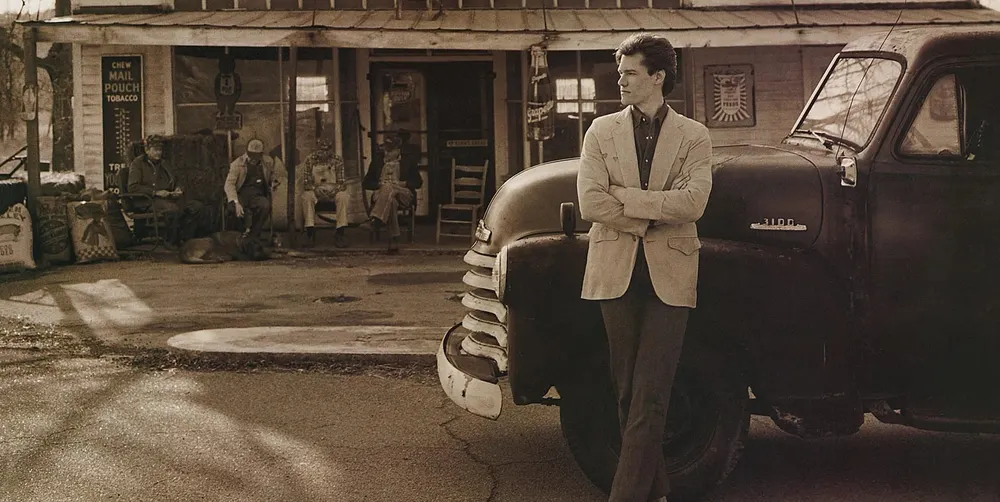
"No Place Like Home," Overstreet writing alone this time, took the fourth-single slot to No. 2 and would have topped the chart in any season that didn't already owe the man two favors. The back half belongs to the Palace: "Send My Body" and "Reasons I Cheat," the two originals off the live album, re-cut and standing without apology next to the professional songwriting around them, the second of them spare enough and sad enough to serve as the album's conscience. "My Heart Cracked (But It Did Not Break)" and "Messin' With My Mind" keep the tempo honest, "1982" holds down the hit ledger, and "There'll Always Be a Honky Tonk Somewhere" closes the record with a mission statement disguised as a barroom shrug. The cover shot — denim, fence rail, a face out of a hundred years of North Carolina — was made by Robin Hood, a Pulitzer-winning Tennessee photojournalist, and inside the sleeve Travis's dedication thanks "a Special Lady," Martha Sharp, for giving him a chance. The A&R woman got her name on the record, and she had earned the ink.
THE STIR
The reviews read like a town remembering a language it had pretended to forget. Rolling Stone's critic surveyed the crop of new traditionalists and picked a winner outright: "expect Randy Travis to last the longest." The Washington Post heard the album as hard country in its most concentrated form, little barstool confessions delivered without varnish. Robert Christgau, no friend of Nashville sentimentality, filed a B+ and a line that has aged into a compliment sharper than he may have intended: "an unspoiled John Anderson singing the material of a lucky George Strait." The awards arrived in a column: the ACM's Album of the Year, its Single of the Year, its Top New Male Vocalist; the CMA's Horizon Award and Song of the Year; and when Ricky Skaggs had to withdraw from hosting the 1986 CMA telecast, the network handed the job to the newcomer, a cook eighteen months removed from the kitchen, emceeing the format's biggest night. That December he was made the newest member of the Grand Ole Opry, nine months after Little Jimmy Dickens had introduced his Opry debut.
The doubters had spent years insisting that this exact record could not sell, and the best thing about the record's answer is how completely the town embraced being wrong. It sold, and then it kept selling, and Music Row, to its credit, and with real speed, went looking for more voices like it. The audience had been there the whole time, waiting for somebody to trust it.
The fall 1986 papers catch the new life mid-arrival. By November he was sharing a bill with George Jones himself at the Knoxville Civic Coliseum — a kid who'd studied Jones off his daddy's turntable, now on the same marquee — and telling the Waco Tribune-Herald the comparisons to Jones and Strait didn't bother him one bit: "quite a compliment." He'd done Joan Rivers and Donahue. He had a Christmas single out, "White Christmas Makes Me Blue." Fans kept marveling that the husky bass came out of such a young face, and he had a shrug ready for that too: "Even when I was a kid, it was always lower than anybody's." And parked in the Waco piece, easy to miss, is a seed of the future: among the songs he'd been writing between road dates was one called "I Told You So," placed on a Jeanne Pruett album, the same song that, two years later, he would take to No. 1 himself. Asked by the Knoxville News-Sentinel's Wayne Bledsoe whether all of it would change him, he gave the answer forty years have since backed up: "I just don't see why anybody would." What mattered most, he told Bledsoe, was that everything was finally happening and he was still standing next to the same people he'd started with. Somebody you can get along with, somebody you can trust.
One year later, the album's aftermath was measurable from a folding chair in a Nashville film studio. In August 1987, Floyd Rogers of the Winston-Salem Journal, the big paper from back home, watched Travis tape a radio spot for a Phoenix station, flubbing his lines, laughing about it, nobody on the set minding in the least, while the director marveled at his looks and Hatcher noted, accurately, that the crowds at his concerts confirmed the assessment. Rogers also recorded a wardrobe negotiation for posterity: the director wanted him in a checked shirt from the studio rack; Hatcher said Randy didn't wear checked shirts, that he liked his black one and looked good in it; the director agreed at once that the black shirt would be great. "Mrs. Hatcher," Rogers reported, "is not one of your wimpy kind of women." And the reason a hometown reporter was in the room at all had been announced that very morning: the CMA had just handed Travis five nominations, Entertainer of the Year among them, more than anyone else that season, the paper noted, more than Skaggs or Strait or Reba McEntire, more than his idol George Jones. Time and Newsweek had come calling. The New York Times had pronounced the voice "a once-in-a-generation country twang." The Wall Street Journal heard in it, as in Merle Haggard's, a "vulnerability not very far beneath the surface grit." And the man at the center of the national fuss confessed to Rogers that exactly one stage on earth still rattled him, the one he'd just been made a member of. On the Opry, he admitted, he'd been "nervous to the point of shaking." The kid raised on the Opry's radio signal never did get comfortable standing inside it.
WHAT IT PROVED
Nineteen eighty-six is remembered now as the hinge year — Ricky Skaggs and George Strait already holding the traditionalist line, Dwight Yoakam and Keith Whitley pressing the same case — but Storms of Life was the one that moved the needle on the sales chart the suits actually read, and its aftershocks have names. Alan Jackson has said flatly that Travis opened the door for everyone who wanted to sing real country music. Garth Brooks has gone further than anyone. Inducting Travis into the Hall of Fame in 2016, he issued the challenge from the podium: "Tell me some other artist... who's taken a format, turned it around back to where it was coming from, and made it bigger than it was. It's never happened." And he filed himself in the debt column outright, telling the room he would not be standing there without Randy Travis. The entire Class of '89 — Brooks, Jackson, Clint Black, Travis Tritt — walked through a door with this album's hinges on it. In 2022, Rolling Stone ranked it ninth among the greatest country albums ever made. It is routinely called the greatest debut in the genre's history, and the case against that claim gets thinner every year.
The Country Music Hall of Fame made it official on October 16, 2016, and the induction became something no one in the room will outlive. Travis had suffered a catastrophic stroke in 2013 — viral cardiomyopathy, a clot, months in the hospital, his speech and his singing taken nearly whole. Brooks inducted him at Travis's own request; Jackson sang "On the Other Hand" back to the man who made it. And then Randy Travis rose, with his wife Mary beside him, and sang "Amazing Grace," his first public singing since the stroke, in a voice reduced and absolutely unmistakable. Mary Travis told the room her husband had stared death in the face, "but death blinked."
The Country Music Hall of Fame made it official on October 16, 2016, and the induction became something no one in the room will outlive. Travis had suffered a catastrophic stroke in 2013 — viral cardiomyopathy, a clot, months in the hospital, his speech and his singing taken nearly whole. Brooks inducted him at Travis's own request; Jackson sang "On the Other Hand" back to the man who made it. And then Randy Travis rose, with his wife Mary beside him, and sang "Amazing Grace" — his first public singing since the stroke — in a voice reduced and absolutely unmistakable. Mary Travis told the room her husband had stared death in the face, "but death blinked."
FORTY YEARS LATER
The vault had one more session in it. A 35th-anniversary deluxe edition in September 2021 remastered the ten originals and turned up three finished, unheard 1985 recordings — "Carryin' Fire," from that very first four-song day, alongside "Ain't No Use" and "The Wall" — Lehning comparing the find to stumbling over an old photo album in the basement. Bernie Taupin, Elton John's lyricist, wrote the liner notes and called the record "an anomaly in any genre of music." The 2019 memoir took its subtitle from the album, braving the storms of life, and a biopic, Forever and Ever, Amen, is in the works, with Clay Walker playing Travis in his prime and the performance scenes built on Travis's actual recordings.
And the voice itself refused to stay archived. In 2024, Kyle Lehning, forty years on from the first session and still the keeper of the sound, used a pair of AI models trained on decades of Travis's isolated vocals to build "Where That Came From," the first new Randy Travis recording since the stroke, assembled note by note over a session singer's guide vocal with Travis and Mary approving every phrase. The producer who captured the voice in 1985 spent 2024 giving it back.
The fortieth arrives with one chair empty. Don Schlitz died on April 16, 2026, at 73, in a Nashville hospital, the co-writer of "On the Other Hand" and, a year after it, "Forever and Ever, Amen," the man Kenny Rogers said "doesn't just write songs. He writes careers."
On June 3, 2026, the day after the fortieth anniversary, Randy Travis cut a ribbon at the Nashville Palace — the club lives on about a hundred yards from its original site — with Mary beside him and a room full of his own band members, old friends, and young singers working through his catalog all night. Drake Milligan took "Storms of Life." Walker Montgomery took "There'll Always Be a Honky Tonk Somewhere." And James Dupré, the singer whose guide vocal carried the AI single home in 2024, stood up and sang "Diggin' Up Bones" and "1982" with the man himself in the room. The night closed with everybody onstage for "Forever and Ever, Amen," and the front room of the Palace now carries a permanent name, announced by owner Barrett Hobbs in the only words available: forever and ever, The Randy Travis Room. The walls hold photographs from the whole career. It is the room where the cook used to set down the apron and pick up the microphone, back when only the regulars knew.
Randy Travis · Storms of Life · Warner Bros. Records · 1986
Produced by Kyle Lehning · "On the Other Hand" and "Reasons I Cheat" co-produced by Keith Stegall · Recorded at Emerald Sound Studio, Sound Stage Studios, and Ground Star Laboratory, Nashville · Overdubs and mixing at Morningstar Studio · Mastered by Mike Reese at The Mastering Lab
Sources: Jack Hurst, Tribune Media Service, via the Macon Telegraph and News, April 18, 1986; Wayne Bledsoe, The Knoxville News-Sentinel, November 21, 1986; Carl Hoover, Waco Tribune-Herald, November 7, 1986; Knight-News-Tribune, via The Telegram (Bridgeport), May 21, 1986; Floyd Rogers, Winston-Salem Journal, August 30, 1987; The Tennessean and Los Angeles Times, 1985–86 (Martha Sharp interviews); Billboard chart archives; Robert Christgau, Consumer Guide; Rolling Stone, 1986 (Davitt Sigerson) and August 2022; The Washington Post, 1986; RIAA certification database; Country Music Hall of Fame and Museum; Kyle Lehning interviews (Songstuff; Mix; CBS Sunday Morning); Randy Travis with Ken Abraham, Forever and Ever, Amen (2019); Warner Music Nashville, 35th Anniversary Deluxe Edition materials, 2021; Bernie Taupin, 35th Anniversary liner notes; ASCAP Country Music Awards, 2019; MusicRow and Variety, April 2026 (Don Schlitz); The Tennessean, MusicRow, Pollstar, and Country Now, June 2026 (Randy Travis Room dedication).