The twenty finest songs from the catalog of country's last great traditionalist, counted down to number one.
For three decades Alan Jackson has written and recorded songs that stuck. He wrote a good many of these himself, and had the ear to take the rest from the best writers around. Every one earned its place. Here are the twenty that matter most, counted down to the very top.
20. "The Talkin' Song Repair Blues" (Dennis Linde; from What I Do, 2004)
Dennis Linde, who gave the genre "Goodbye Earl" and "Bubba Shot the Jukebox," hands Jackson a running gag and trusts him to carry it: a songwriter hauls a broken tune into a repair shop and gets the full mechanic's runaround, estimate padded, part on back order, labor climbing by the minute. The joke could give out at any line and instead keeps finding another gear. Jackson plays it bone-dry and lets Linde's wit do the driving. Released as the album's third single, it climbed to No. 18 on the country chart. A comic song with the construction of a serious one.
19. "Love's Got a Hold on You" (Keith Stegall, Carson Chamberlain; from Don't Rock the Jukebox, 1991)
One of four No. 1 singles off the Don't Rock the Jukebox album, and a reminder of how easy Jackson could make romance sound. The melody hooks you on the first line and holds on. Stegall and Chamberlain wrote it lean and sure, the lone single on the album Jackson didn't have a hand in writing, and he sings it like he means every word. Proof that a love song doesn't need a twist when the feeling is this plain and this true.
18. "Summertime Blues" (Eddie Cochran, Jerry Capehart; from Who I Am, 1994)
Eddie Cochran's 1958 teenage complaint, pulled onto a honky-tonk floor and set loose. Jackson treats the rockabilly bones with real affection and rides them to No. 1, three weeks running, grinning the whole way. You can hear a star who came up loving this stuff and never lost the kick of cutting loose. Some songs just want to get you on the dance floor and keep you there. This is one.
17. "Tall, Tall Trees" (Roger Miller, George Jones; from The Greatest Hits Collection, 1995)
A song handed down and held with care. George Jones cut it first in 1957, with Roger Miller's wordplay threaded through every verse: a man with empty pockets promising his love the moon and the tall, tall trees. The record flopped for Jones. Jackson revived it nearly four decades later, took it to No. 1, and you can hear how much he loves singing it.
16. "Mercury Blues" (K.C. Douglas, Robert Geddins; from A Lot About Livin', 1993)
The liveliest cover in the catalog, and few singers ever made wanting something sound this much fun. A jump-blues number from the 1940s about a man and the car he covets: the guitar struts, the rhythm section swaggers, and Jackson sells it with a wink in his voice. It hit No. 2, with a young, long-haired Keith Urban picking guitar in the video.
15. "Little Bitty" (Tom T. Hall; from Everything I Love, 1996)
Tom T. Hall's two-minute philosophy of contentment, every line landing on the same easy warmth. The Storyteller had mostly stepped back from writing by then; Jackson found the joy in its smallness and rode it straight to No. 1. It loosens your shoulders and leaves you half-convinced a little bitty life lived right is plenty. He sells every word.
14. "She's Got the Rhythm (And I Got the Blues)" (Alan Jackson, Randy Travis; from A Lot About Livin', 1992)
Co-written with Randy Travis on the road, and the partnership shows in how hard the thing swings; the two nearly pitched it to B.B. King before Jackson kept it for himself. A heartbreak set to a dance beat, the contradiction country pulls off when it trusts the groove. Jackson keeps it brisk and bright, the kind of misery you can two-step to. In and out in under three minutes, every one of them earned.
13. "Dallas" (Alan Jackson, Keith Stegall; from Don't Rock the Jukebox, 1991)
The sharpest of Jackson's early wordplay singles, hung on a pun he commits to fully: he wishes Dallas sat in Tennessee, so the woman named for the city might never have gone home to Texas without him. Jackson's fourth straight No. 1, and there's real hurt running under the cleverness. It makes you smile at the pun, then gets you with the heartbreak when you're not looking.
12. "Monday Morning Church" (Brent Baxter, Erin Enderlin; from What I Do, 2004)
One of the bravest song choices of Jackson's later career, and a flat-out devastating one. Erin Enderlin was still in college when she and Brent Baxter wrote it; Jackson took it to No. 5, Patty Loveless shading the harmony. A widower keeps talking to a God he can no longer locate, certain his wife reached heaven and lost without her here. It's long been counted among the saddest songs country has made. Enderlin knew she had something the night she played it in a rowdy Nashville bar and two men stopped throwing punches to sit down and listen.
11. "Livin' on Love" (Alan Jackson; from Who I Am, 1994)
A young couple with nothing, then an old one with little more, both getting by on the one thing they can't run out of. Jackson wrote it alone and let it stay simple, watching the decades pass without ever reaching for a lesson. It went to No. 1, and it remains one of his warmest, truest pieces of writing. It knows exactly what a marriage is worth, and so does he.
10. "Chasin' That Neon Rainbow" (Alan Jackson, Jim McBride; from Here in the Real World, 1990)
His origin story, set to a honky-tonk shuffle. A boy raised on his daddy's records grows into a man chasing the next stage down another late-night highway. Co-written with Jim McBride, the partner behind so much of his finest early work, it climbed to No. 2 and plays like autobiography, all hope and hustle. McBride remembered the lean days underneath it: Jackson driving an old Dodge van down to Florida, playing five or six sets a night, clearing nothing once he'd paid the band and filled the tank. He told his own myth before he'd fully lived it, and the song has only grown truer since.
9. "Murder on Music Row" (Larry Cordle, Larry Shell; recorded with George Strait, 2000)
Some of the finest writing Jackson ever lent his voice to, and a record with a backbone. Larry Cordle wrote it as a bluegrass lament, and Jackson and George Strait turned it into a stand: two of the genre's most devoted traditionalists at a microphone, mourning the music that made them, naming no one and indicting a whole town. They debuted it as a protest at the 1999 CMA Awards, the industry it scolded sitting right in the front rows. Never issued as a proper single, it still drew enough airplay to reach No. 38, won CMA Vocal Event of the Year in 2000, then came back to take Song of the Year in 2001.
8. "Remember When" (Alan Jackson; from Greatest Hits Volume II, 2003)
His signature ballad, and a deserved one. Jackson wrote it for his wife, Denise, folding a whole marriage into one long backward glance. He never raises his voice the whole way through, and it hits harder for that. Released in 2003, it reached No. 1 early the next year and became the song people reach for at weddings and at funerals both.
7. "It's Five O'Clock Somewhere" (Jim "Moose" Brown, Don Rollins; with Jimmy Buffett, 2003)
Brown and Rollins handed Jackson a getaway in the middle of a workday, and teaming with Jimmy Buffett turned a daydream into a phenomenon. Eight non-consecutive weeks at No. 1 and the biggest pop crossover of Jackson's career. It won the Grammy for Best Country Song, the CMA's Vocal Event of the Year, and two ACM Awards, and it handed Jimmy Buffett the first major trophy of his long career. One listen and the whole week slides off you. A perfect summer record, and one of the most beloved duets country has ever produced.
6. "Don't Rock the Jukebox" (Alan Jackson, Roger Murrah, Keith Stegall; from Don't Rock the Jukebox, 1991)
The cornerstone of everything Jackson believed about this music, and few singers ever stated their purpose so plainly. The story has him leaning on a jukebox with a busted leg at Geraldine's, a truck-stop lounge in Doswell, Virginia; it wobbled, someone hollered the warning, and a hit fell out of the moment. Leave the rock and roll be, the song pleads, because a broken heart needs George Jones and nothing else will do. It became his second straight No. 1.
5. "Drive (For Daddy Gene)" (Alan Jackson; from Drive, 2002)
The warmest thing in the catalog, a love letter to a father that never goes mushy. A son remembers being put behind the wheel of a homemade plywood boat and a hand-me-down Ford truck, then finds himself the one doing the teaching now. Jackson wrote it for Joseph Eugene Jackson and took it to No. 1, plain and specific, every detail true.
4. "Gone Country" (Bob McDill; from Who I Am, 1994)
Bob McDill's masterstroke, sharper now than the day it was cut. A washed-up lounge act reinvents himself as a cowboy; the Village folkie and the Hollywood striver aren't far behind, every one of them country the second the money heads south. McDill meant it as satire and time turned it into prophecy. "I wish that I'd written it," Jackson said when he first heard it, "'cause it says a lot of things that I'd like to say." He delivers each punchline straight-faced, and the song only keeps winning.
3. "Midnight in Montgomery" (Alan Jackson, Don Sampson; from Don't Rock the Jukebox, 1992)
The most ambitious record Jackson ever made. Bound for a New Year's Eve show, the narrator stops at Hank Williams' grave and meets the man himself, a rhinestoned ghost who thanks him for remembering and then is gone. Set in a minor key and filmed in black and white in a moonlit cemetery, it reached No. 3 and won the CMA's Video of the Year, the first CMA Award of Jackson's career. Atmosphere this rich is rare anywhere, and almost unheard of on a mainstream country single.
2. "Chattahoochee" (Alan Jackson, Jim McBride; from A Lot About Livin', 1993)
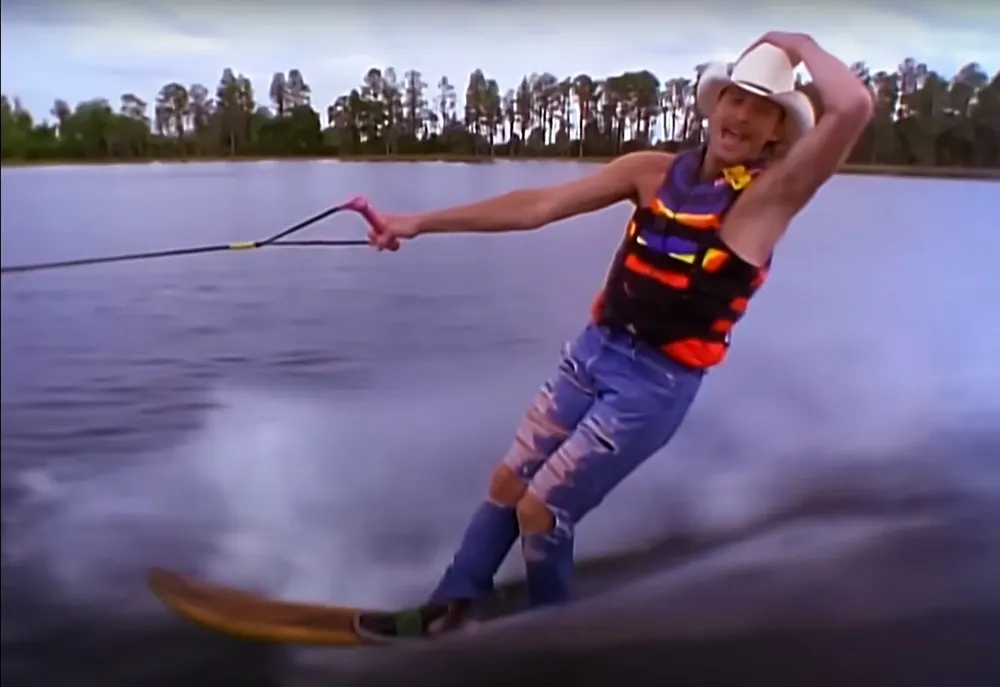
The perfect uptempo country record. Jackson and McBride packed a whole adolescence into it, first love and hard lessons down by the water, and never let the tempo flag for a second. McBride lifted the title from Sidney Lanier's poem "Song of the Chattahoochee," half-remembered from a school textbook. It swept the CMA's Single and Song of the Year, spent four weeks atop the country chart, drove the album to No. 1, and gave the world a country star water-skiing in red boots. Nostalgia with a full tank of gas, and not a wasted note in it.
1. "Where Were You (When the World Stopped Turning)" (Alan Jackson; from Drive, 2002)
The most important thing he ever recorded, and the years haven't dulled it. Jackson wrote it in the weeks right after September 11, caught the melody on a tape recorder in the middle of the night, and unveiled it cold on the 2001 CMA Awards, skipping politics for the small private ways grief moved through ordinary homes. It swept Song and Single of the Year at both the CMA and ACM Awards, won the Grammy for Best Country Song, and had its lyrics entered into the Congressional Record. Where a lesser writer would have grandstanded, he asked a plain question and let ordinary people answer it. A career's worth of restraint, spent all at once.