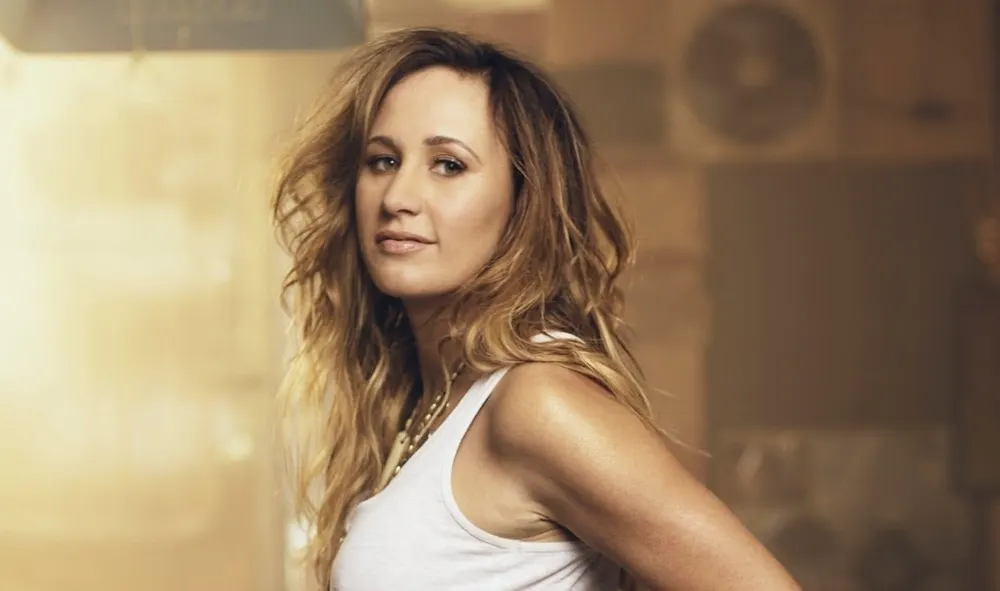
Page 5E of the Sunday Tennessean, March 19, 2000. The Business Peopl column, where the accounting firms announce their new senior managers and the hospitals introduce their vice presidents. Under the subheading ENTERTAINMENT, wedged into the agate, sits a single item: "Jessi Alexander has been signed to Warner Chappell. She has sung backup for Neal McCoy, and has written songs with Famous Music's Austin Cunningham, Sonya Isaacs (Lyric Street), Glen Worf, Jim Lauderdale and Gary Nicholson." One postage-stamp headshot, captioned ALEXANDER. That was the town's full notice of her arrival.
Twenty-six years later, on April 20, 2026, Warner Chappell Music Nashville announced a new global publishing deal with the same writer, this time in partnership with Perfect Game Creative, whose publishing division exists because she agreed to be its flagship signing. The president of the company put it plainly: "Jessi Alexander is undoubtedly one of the all-time greats in country music." Between the brief and the press release lie eleven No. 1 country hits. A pop smash sung on every continent lives in there too, along with the most decorated country song of its decade and back-to-back Female Songwriter of the Year awards. So does a record deal that failed. That last one turns out to be the load-bearing wall.
THE YEAR OF THE OUTLAWS
Jessica Leigh Alexander was born in Jackson, Tennessee on November 18, 1976, the same year "Wanted! The Outlaws" became country music's first platinum album. Her father, a painter and musician, loved that record's singer so much he named his daughter after Jessi Colter. Country music was stamped on her birth certificate before she could object, and the first records she ever owned included the Outlaws album she was named for, along with Patsy Cline's greatest hits and Janis Joplin's "Pearl."
Her parents divorced when she was 3, and her childhood split along the map. At her mother's house in Georgia the records ran from Led Zeppelin to bluegrass, from the Eagles to Motown. Summers belonged to her father in Memphis, a man whose stack of vinyl started at Ralph Stanley and Bill Monroe and ended somewhere past Little Feat, and mostly to Beale Street, where she watched B.B. King, Albert King and Buddy Guy work and where her father's musician friends figured out the kid was good for business. "They tell stories about setting me up on an amp with a tip jar," she told the Charleston Gazette. "They could always make more money with a cute little blonde."
What she wanted was a bass; she'd heard one growl on a B.B. King record and asked her father for "that low thing." "I, like, had this total love affair with the bass," she said. "It has such a low-down sound." One Christmas a long box appeared under the tree and she tore into it. Not a bass. "He couldn't afford it," she said. "So, he got me an acoustic guitar." She ignored the consolation prize for a good while on principle. In the meantime she taught herself "Love Me Tender" on the piano by ear around age 9, and by 11 she was taking songs apart to see how they worked, studying the small print on things like "Crazy" and discovering that the names in the credits, Willie Nelson, Harlan Howard, were not the names on the record sleeve. Somebody wrote these things. Years later her own website would carry a Harlan Howard line as her favorite quote: "He writes the song, I hold the pen." At 13, a Beale Street slide player named Rick Harvey started getting her up to sing with working bands, and by her early teens she was deep into Hank Williams, Harlan Howard and Bonnie Raitt, an education split evenly between the writing and the wailing.
She enrolled at Middle Tennessee State University to study social work and found, in the words of a CMA profile from 2004, that she thought about music more than her studies. She drifted into the music business program instead, and after three years her professors urged her to skip the diploma and move to Nashville. "I'm so glad I listened!" The social work degree never happened. In a sense the career that followed absorbed it: her catalog would eventually do its most famous work sitting with other people's grief.
A 2004 questionnaire caught the rest of her in amber. Asked what era she'd visit, she copped to being the "hippie chic" people had called her all her life and picked the 1960s, revolutionary times, electric music, "and of course, we can't forget about the clothes." The phrase she caught herself saying constantly was "When are we going to eat next?" Her lucky charm was a 1976 Guild guitar named Guilda, born the same year she was and bought at a guitar show because she "looked like she seen a million honkytonks, smelled like cigarettes, and seemed to be scratched and scarred with tears." "She's been there when I couldn't find a friend, and given me many songs." And the moment of her life she would relive, she said, was the one that hangs over everything that comes later: "The last Mother's Day I spent with my mom."
BEST UNSIGNED
She moved to Nashville in 1999 and auditioned, on her first day in town, to sing backup for Reba McEntire. She didn't get it. Singer Matt King hired her instead, and the years that followed ran on the standard new-in-town fuel: road gigs, a Subway counter, a factory bench repairing power tools, a car auction, a stretch caring for elderly Alzheimer's patients, writers' nights at the Bluebird and 12th & Porter. Then came the staff deal behind that 2000 business brief. "I got my dream job when Warner Chappell wanted to hire me to write songs.... and get paid!" She settled into the apprenticeship.
In 2001, without telling her, a friend submitted a tape of hers to a talent contest run by the Recording Academy's Nashville chapter, a showcase created, as local Academy chief Nancy Shapiro told The Tennessean, "to showcase the great talent out there that kind of flies just beneath the radar of the industry." The first Alexander heard of any of it was a call telling her she'd made the second round of a contest she had never entered. Then she won the whole thing, Best Unsigned Artist. The prize package included studio time, a photo session, image consulting and a professionally written bio, but the real prize was the small print of the premise: the contest existed to get people signed, and with her it worked. By November 2002 The Tennessean was reporting that "last year's Nashville Grammy Showcase winner Jessi Alexander is in the midst of recording her debut album for MCA. And that's exactly how it was supposed to work."
The deal that stuck wore a different logo. In October 2003 the paper's business page announced that Sony Music Nashville had signed her, age 26, to Columbia Records; her own label bio would later compress the hop from MCA into one veteran's shrug: "Mergers and regime changes are the norm." Label president John Grady called her "the future of country music," a quote the publicity machine would ride for the next two years. The same item noted she'd contributed a cover of "So Wrong" to a well-received Patsy Cline tribute, and listed the influences the label was selling: Hank Williams, The Band, Jackson Browne, Emmylou Harris, Loretta Lynn and Rosanne Cash. That is not a country-radio list. It is a record collection, the Georgia house and the Memphis summers filed side by side, and it should have told everyone how the next part would go.
"THE FUTURE OF COUNTRY MUSIC"
She made the album her way, which meant Memphis. "Honeysuckle Sweet" was cut at Ardent Studios with Gary Nicholson producing, Alexander co-producing her own debut, and Mark Wright as executive producer. She wrote or co-wrote everything on it, and she made it under a weight the press releases never mentioned: her mother was dying of ovarian cancer, and Alexander was her main caregiver through the sessions. "I was trying to make 'Honeysuckle Sweet' and trying to be her main caregiver," she said. Hospice workers made it possible for her to be there at the end and still finish the record. "They were our angels." Her mother did not live to hear the album released. The two causes she has kept as her charities ever since: hospice care and ovarian cancer research.
Then the machine sat on it. Label delays and internal squabbles kept the finished record in limbo for more than two years before it finally arrived on March 1, 2005. The title track reached No. 52 on the country singles chart. The follow-up, "Make Me Stay or Make Me Go," written with Al Anderson, stalled at No. 57. Two more singles didn't chart at all, and in 2006 Columbia let her go. The future of country music, as pronounced by the president of Sony Music Nashville, was out of a record deal at 29.
But 2006 subtracted and added in the same breath: the year she lost the deal is the year she married Jon Randall, the songwriter and Emmylou Harris alumnus she'd met at the Telluride Bluegrass Festival in 2000. Peter Cooper, The Tennessean's music writer, would later offer the definitive scouting report on him in a single parenthesis: "Good dude: He was a member of Emmylou Harris' Nash Ramblers band, co-wrote 'Whiskey Lullaby,' plays great guitar and is an excellent singer. Otherwise, no real talents." Nashville's songwriting rooms are full of marriages, but few households have ever carried this much catalog: his side would come to hold "Whiskey Lullaby" and "Tin Man," hers was about to fill up with things nobody saw coming.
Because the artist career was over, said the town. She was a songwriter now, said the town. She believed it enough to keep going and not quite enough to mean it, and out of that crack in her confidence came the biggest copyright of her life.
"GOD, PLEASE SEND ME AN IDEA"
The morning it happened, she had nothing. Driving to a writing appointment with Jon Mabe, she refused to turn on the radio, refused every distraction, and bargained out loud: "I need an idea. God, please send me an idea." What arrived, somewhere on the drive, was a climbing chorus melody so classic-sounding it worried her. "Am I (re-writing) something?" she remembered thinking. "Is this '(Love Lift Us) Up Where We Belong?' What is this song?" Her only plan was to get through Mabe's door and onto a guitar before it evaporated. Mabe's memory of the moment is simpler: "She was on a mission when she came through that door."
What they wrote that day, she has said, was less a session than "a weird therapy session." She'd been in town roughly a decade by then, one deal dead, the doubt compounding. "For me, the lyrics came from a place of, 'Gosh, I've been in Nashville for 10 years, and I still haven't found real success,'" she told Cooper. The song came out in third person, with Mabe singing the demo, "a lot more spiritual and a little more adult," under the title "It's the Climb." It was a song about their own stalled careers, and several artists passed on it.
Then a film director named Peter Chelsom asked her to put some songs on a CD. He was making a movie around a Disney television star, and Alexander and her song-plugger, Lisa Ramsey, went down the list and paused on the trippy, poppy one, the one that sounded like it could be cinematic. Days later Chelsom called with a sentence songwriters do not get to hear: "If you'll rewrite this, I'm going to re-write the script around it." Alexander's inner monologue, by her own delighted confession, was pure Nashville scar tissue: "Aw, you're cute. You're not from around here. You don't realize that there's going to be a bigger songwriter that's going to sweep in and get this slot."
No one swept in. Rewritten into first person, "The Climb" went to the star of "Hannah Montana: The Movie," a girl Alexander helped learn the song on guitar. "I would never in a million years have guessed that a 15-year-old called Miley Cyrus would record it," she said later. Released in March 2009, it went No. 4 on the Hot 100, sat at No. 1 on Adult Contemporary for 15 consecutive weeks, charted country, Christian and everywhere between, and took the MTV Movie Award for best song from a movie. John Mayer tweeted that he liked it because "it represents a nearly dead species of a pop song that I can actually have an emotional reaction to." A Grammy nomination for Best Song Written for a Motion Picture materialized and was then withdrawn on a technicality, since the song hadn't been written for the film, which was, of course, the whole point of the song. By December an X Factor winner had carried it to No. 1 in the UK. The certifications have kept climbing ever since, platinum many times over.
Two more items from that season belong in the ledger. Her daughter Shyla was born on January 22, 2009, just as the single was reaching radio; "It looks now like she's going to get to go to college," Alexander deadpanned to Cooper that summer. And the same column noted that she and Randall had formed a swampy, bluegrassy combo with no name yet, taking suggestions, booked into the Station Inn. It became 18 South. The artist the town had written off kept right on playing.
The award that mattered most arrived years later, at a preschool. "The coolest thing of all was hearing my six-year-old daughter sing it at her graduation from preschool," she said. "That was my Grammy."
THE TRUCK
On Memorial Day weekend in 2011, songwriter Connie Harrington heard a radio interview with Paul Monti, a Massachusetts father whose son, Army Sgt. 1st Class Jared Monti, had been killed in Afghanistan in June 2006 and posthumously awarded the Medal of Honor. Monti told the interviewer he drove his late son's truck to feel close to him. Harrington carried that into a writing room with Alexander and Jimmy Yeary.
Alexander wrote it thinking about her own dead. Her mother and her grandfather were both in the room with her, and the song's most quietly brutal couplet, the mother asking whether the narrator has been by the grave, and the answer that the flag and stone aren't where the feeling lives, came from Alexander's own life and her mother's grave, the one she could never bring herself to visit, because the flag and stone were never where the feeling lived. Everyone in that writing room had somebody riding in the truck.
Lee Brice released "I Drive Your Truck" at the end of 2012, and by April 2013 it was No. 1. Then it started collecting: Song of the Year from the NSAI, Song of the Year from the CMA, Song of the Year from the ACM, plus Grammy nominations, the most decorated country song of its stretch of the decade. But the verdict Alexander actually sweated was a jury of one. "I really hoped that the father would like it," she told Dublin's Sunday World.
Paul Monti liked it. He traveled from Massachusetts to Nashville for the party celebrating the song's run, and told stories about Jared, who died on a mountainside trying to rescue a wounded soldier. Then came the discoveries that no writer would dare invent. "We found out we actually wrote the song on the anniversary of the day Jared died," Alexander said. "Paul asked me what other songs I'd written and when I mentioned The Climb he choked up. It was the song that had been played at his son's memorial service." Two songs, written years apart by a woman he'd never met, had been assigned to the two heaviest days of that man's life. There is no better description of what a Nashville songwriter is actually for.
SONGS THAT MAKE OTHER PEOPLE FAMOUS
"Rather than branding myself, I'm now writing songs to make other people famous," she told the Sunday World in 2016, and laughed. By then the pipeline was pouring. Blake Shelton took "Drink on It" to No. 1 in 2012 and "Mine Would Be You" to No. 1 in 2013, the latter earning a Best Country Song Grammy nomination and holding a private distinction besides: of everything she has written, the massive pop standard included, she has called it her favorite. Shelton, famously, recorded some of her songs without knowing she'd written them, since she rarely sang the demos pitched to male artists. That says plenty about how Music Row listens, and Alexander has never wasted an afternoon being insulted by it. Tim McGraw took "Damn Country Music" for a title track. A kid named Morgan Wallen made his debut in 2016 with her co-write "The Way I Talk." Little Big Town, Reba, Trisha Yearwood, Ashley Monroe, even Celine Dion came through the catalog.
She described the working method to the Irish paper with the cheerful pragmatism of a tradesperson. Writing daily with co-writers: "It's kind of like magic happening, but yet it's craftsmanship at its finest. What's great about collaborating is that it takes the pressure off. When I'm working on a verse someone else is working on a chorus, so it's like a game of tennis with balls going back and forth." Twin boys arrived in 2012 to join Shyla, and Alexander has spoken since about protecting the family by writing for quality over volume. By every available measure she got both.
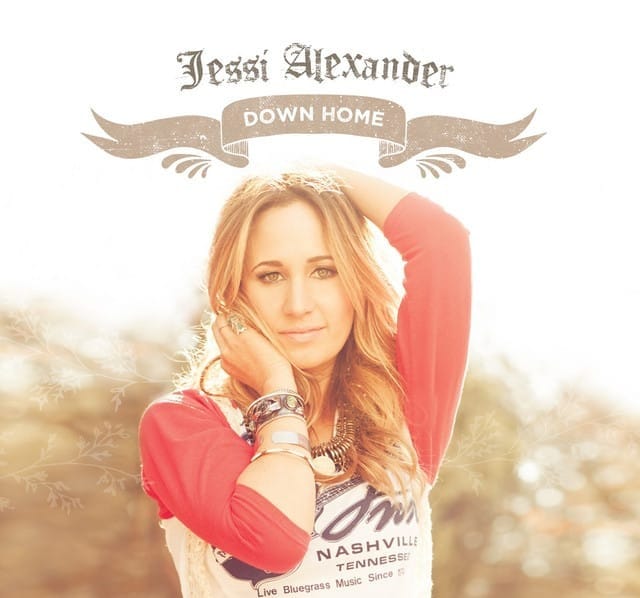
And the artist refused to die. In 2014 she released "Down Home" on the tiny Lonesome Vinyl label, co-produced with Randall and Gary Paczosa, with Dierks Bentley dropping in, an album whose own liner notes thank Sheryl Crow and Paczosa "for talking me into finally doing this." Six years later came the one she'd been circling since that 2004 questionnaire, where she'd wished aloud for a roots record leaning on her traditional country and blues raising. "Decatur County Red," released March 27, 2020, was built exactly there. "I was born in Jackson and lived in different towns throughout West Tennessee, and I spent a lot of time at my grandmother's cabin on the Tennessee River in Decatur County," she told her hometown Jackson Sun. The cabin is hers now, and everything the album is made of got played there first: "I passed a lot of time in the summer evenings listening to old vinyl records my dad would play from traditional country to gospel to R&B to delta blues to bluegrass. They're all influences for me, and they're all on this album." Chris Stapleton, Sheryl Crow, Bentley, Brothers Osborne and Randy Houser all showed up to help. Writing it required unlearning her day job. "When you're writing for others, you don't get to be as specific as I was in this song because you have to be able to make a broad pitch that multiple artists could latch on to," she said. "I really tapped into my own biography."
Timing, as ever, had its joke ready. The album arrived the week the world shut down; the same page of the Jackson Sun that announced it carried the governor deploying the National Guard to drive-through virus testing. The release party happened on Instagram. The industry has never once been ready when one of its great writers steps up to the microphone.
JACKSON
Then came the surge, and it made everything before it look like a warm-up. Scotty McCreery's "In Between" went No. 1 in 2020. Cole Swindell and Lainey Wilson's "Never Say Never" went No. 1 in 2022. In 2022 Morgan Wallen released "Don't Think Jesus," written by Alexander, Chase McGill and Mark Holman with Wallen on their minds, and it debuted at No. 1 on Hot Country Songs while landing inside the top ten of the all-genre Hot 100 in its first week. Justin Moore and Priscilla Block's "You, Me, and Whiskey" hit No. 1 in 2023. So, later, did Dustin Lynch and Jelly Roll's "Chevrolet." Luke Combs cut "5 Leaf Clover." Ashley McBryde, with Alexander and the ever-present Connie Harrington, made "Light On in the Kitchen" a standard-in-waiting. Megan Moroney's breakout album carried three Alexander co-writes, including "No Caller ID."
The capstone came out of a tornado. "Ain't No Love in Oklahoma," the lead single from the "Twisters" soundtrack, spent two weeks at No. 1 in 2024 and became Combs's 18th chart-topper. He wrote it with Alexander and Jonathan Singleton, and here the story rhymes one more time: Alexander and Singleton are both from Jackson, Tennessee. The kid named after an outlaw record grew up to write blockbuster movie music with a hometown neighbor, and Hollywood came to her twice, once for a teenager's anthem and once for a storm.
The industry finally ran out of ways not to say it. MusicRow named her Female Songwriter of the Year in 2023 and again in 2024. The National Music Publishers' Association crowned her its top female songwriter of 2024. When the Grammy nominations came out that November, she was up for Songwriter of the Year. Amy Allen took it home, but the nomination stays on Alexander's name for good. The ACM nominated her for its songwriter prize in 2025, Variety toasted her at its Power of Women event in Nashville, and the Country Music Hall of Fame sat her down for a Songwriter Session to explain herself. In 2026 she helped write "Lighter," the first single from the official World Cup album, with a writing room that included her husband.
Which returns the story to April 20, 2026, and the deal with Warner Chappell and Perfect Game Creative, the company run by Jessi Vaughn Stevenson, who started her career working alongside Alexander and now builds her publishing division on her. "To say this moment feels full circle is an understatement," Stevenson said. The circle is even bigger than she means: it runs from a business-page brief in the spring of 2000, through a dropped artist deal that turned out to be a scholarship, through a truck in Massachusetts and a cabin on the Tennessee River, all the way back to the same publisher, now announcing one of the all-time greats.
There is one more image worth keeping. The influence list on Alexander's old artist website ran through Emmylou Harris, Patsy Cline, Tom Petty, Bonnie Raitt — and Matraca Berg. In October 2008, at the Nashville Songwriters Hall of Fame dinner, one of the singers performing the catalog of that night's inductee, Matraca Berg, was a songwriter still a few years shy of her own avalanche: Jessi Alexander. That is how the trade actually works. The women who write the songs sing each other in, and the town catches up whenever it catches up. A friend once mailed in the tape without telling her. It has been answering for her ever since.
SELECTED SONGS
"Honeysuckle Sweet" — Jessi Alexander (2005)
Country Music Hall of Fame & Museum Songwriter Session (2025)
"The Climb" — Miley Cyrus (2009)
"Drink on It" — Blake Shelton (2012)
"I Drive Your Truck" — Lee Brice (2012)
"Mine Would Be You" — Blake Shelton (2013)
"Damn Country Music" — Tim McGraw (2015)
"The Daughters" — Little Big Town (2019)
"Never Say Never" — Cole Swindell & Lainey Wilson (2021)
"No Caller ID" — Megan Moroney (2024)
"Ain't No Love in Oklahoma" — Luke Combs (2024)
MORE FROM GENERATION COUNTRY
 Generation Country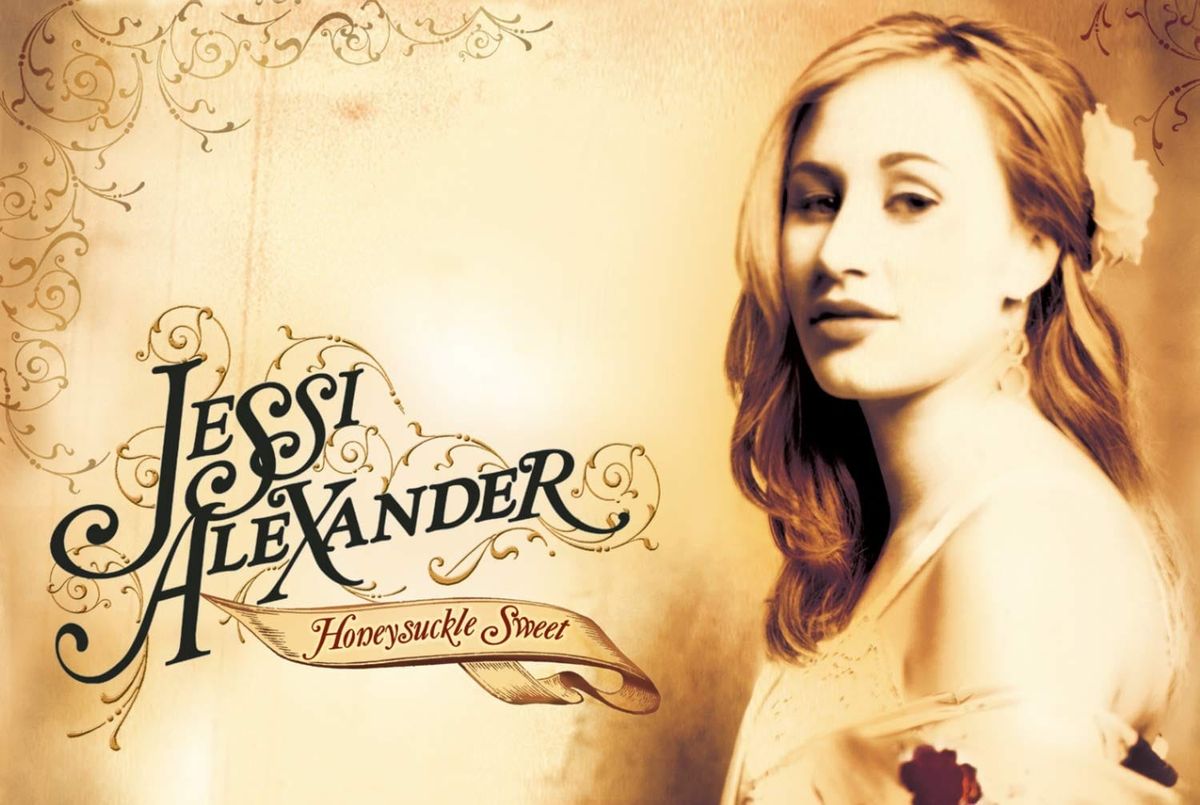
 Generation Country