He wrote "Old Flame," "Two Dozen Roses," "Thank God for You" and "Back Where I Come From," and then stood off to the side while other people sang them. Twelve top tens. Four number ones. Ten CMA trophies. And an album called A.K.A. Nobody.
There is a microphone on the stage that nobody uses.
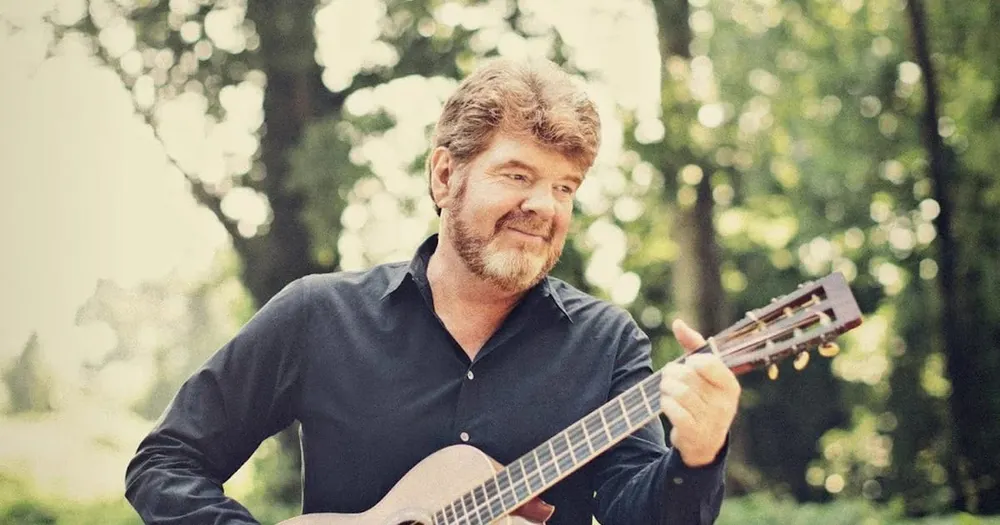
It stands where it always stood, dead center, and the band plays around it. Mac McAnally is stage left, where he has been since 1994, playing guitar and singing the harmony part and looking at the spot where Jimmy Buffett is supposed to be.
He has explained the microphone more than once, and he explains it the same way every time. Buffett's guitar came to him. So they set up a stand, he told Holler in 2025, in case the man decided to turn up.
Fifty years into a career, standing in the biggest room he will ever stand in, and he is still building the arrangement around somebody else's absence. He has been doing versions of this since he was a teenager in Muscle Shoals, playing the part that makes the record work while the name on the sleeve belonged to somebody else.
The songs went out into the world without him. Alabama took one to No. 1 in 1981. Shenandoah took one to No. 1 in 1989, then took the same one back to No. 1 thirty-four years later with Luke Combs riding shotgun. Sawyer Brown built a decade on him. Kenny Chesney found a song about a water tank in a town of nine hundred people and turned it into a career signature.
Nobody in Nashville has been voted Musician of the Year more times, and that includes Chet Atkins.
THE STATE LINE
Lyman Corbitt McAnally Jr. was born July 15, 1957, in Red Bay, Alabama, by family lore in the same doctor's office as Tammy Wynette, and raised across the state line in Belmont, Mississippi. His father ran schools. His father was also named, by the son's telling, after a boxer and a preacher — first name boxer, second name preacher — and his mother played piano at the First Baptist Church and for the visiting gospel quartets.
The church handed him the keyboard and the harmony. He has traced his instinct for narrative back to the Baptist association meetings of his childhood, where a boy might sit through nine sermons in a row and absorb the shape of a story that has to pay off before the last verse. The other early texts, by his own accounting, were gospel music, William Faulkner and Flannery O'Connor — and he described Belmont to a Memphis reporter in 1978 in exactly those terms: "It was slow, which was good — good for a writer, 'cause there's no chance of doing anything else. It's right out of a Faulkner book." Twelve years on he gave Robert K. Oermann the demography: a population that "vacillated between 900 and 1,000, as we'd multiply, leave or die. Those are the only three factors in the population census, I guess." And the local economy: "Spare time is the major export in Mississippi and I partook gladly."
He was working the roadhouses along the Mississippi–Tennessee line at thirteen — rooms with names like the Plowboy Club and the Tri-Counties Music Barn, playing what he called "a Jerry Lee Lewis type of piano" in other people's bands. Belmont sat in a dry county, and he understood the clientele early: "I pretty much always heard the people went to clubs to drink and rev up chainsaws and hurt one another. I was pretty religious and remained that way, but I was runnin' with people who were not really that at all. So I didn't really have a great group to identify with. I was always off to myself, I guess. Hence, the songwriter." Belmont returned the wariness — the town kept a 10 p.m. curfew, and he was a night person: "They thought that anyone who stayed out late was a drug dealer, a homosexual or a communist. I was considered a combination of all of them." Nobody ever carded him: "I've always had a beard. I think I was born with one."
By fifteen he was writing songs — the first one was called "People Call Me Jesus." He wrote them at night, and the whisper that carried him through five decades of records started as a practical matter: "My parents were always asleep. That's how my real soft guitar style came out of it." He rated them "pretty good for someone who worked on the highway, but that's all. I really didn't know they were songs."
His father was not just an educator. He was the assistant principal, and the high school's designated counselor to students thinking about dropping out. His own son brought him a business proposal. "I mainly just made the presentation to my dad that if he allowed me to quit school it would be saving him money," he told Oermann — no clothes to buy, no books, no lunch money, "and he wouldn't have to sell pecan logs to try to raise money for whatever extracurricular groups I was involved in for Christmas. He didn't buy that at all. But he was so impressed with my presentation, the actual effort that had gone into it, he allowed me to stop school." The father's one condition, in the son's telling: if he could handle being a dropout statistic, he could quit. In the eleventh grade he left for Muscle Shoals, which in the middle 1970s was the most improbable hit factory in America and was staffed, in large part, by whoever was good enough to walk in the door.
He was good enough. He played on Hank Williams Jr.'s "Family Tradition" before he could legally drink, and he played on whatever else came through the room, and one day on a break from somebody else's session he played some of his own material where the wrong people could hear it. Clayton Ivey and Terry Woodford had come out of Motown and were running Wishbone. "I didn't really consider my songs a commercially-marketable thing," McAnally said the following year. "I was really playing my songs just for the sake of letting them hear 'em. And for some reason or another, they freaked out over 'em. Terry, he's a lyrical nut, and I'm a lyrical nut. So we clicked right from the beginning." They listened to the kid and made a phone call.
IT'S A CRAZY WORLD
Ariola signed him in 1977 and released an album with his name on it. "It's a Crazy World" climbed to No. 37 on the Hot 100, and Mac McAnally, nineteen years old, went out on the road opening for Randy Newman — having essentially never performed his own material in his life. "I'd never even played my songs live, at all. I wouldn't have subjected 'em to the Plowboy Club," he told the Commercial Appeal. "I didn't play a concert until last May." The hit existed before the performer did. The syndicated columnist Kurt Lassen caught him that September, playing New York's Bottom Line, and filed the portrait: "The 19-year-old, burly entertainer has a massive head topped by an amazing shock of red hair, and he sports an equally red beard and mustache, all of which serve to accent sensitive, shy eyes."
That December, Belmont threw a Mac McAnally Day, and the honoree went home nervous: the songs were populated with actual townspeople — "They're either exact characters that I know or they're a conglomeration of a couple. They're not any that I made up" — and there was the matter of a deeply religious region and a song called "People Call Me Jesus." Nobody was offended. And back in Belmont, the dropout counselor spent that season showing his son's album to the neighbors. The honoree measured his celebrity by the town's scale: "The first time I went back home, after I'd left, the family and friends treated me like Marco Polo, like I had really done something. Most people never leave; never even move 50 miles away."
Not a country package tour. Randy Newman. The industry's first instinct was that he belonged onstage with the driest and most literary songwriter in American pop, and that instinct was correct and then immediately useless, because there was no format for what he was. Robert Christgau reviewed the debut and noted, with some surprise, that a Mississippi singer-songwriter sitting on royalty money had no business being that outspoken.
The almost-stardom wound down over three albums. No Problem Here followed in 1978, Cuttin' Corners came out on RCA in the spring of 1980, and he toured behind them with Willie Nelson, John Prine, Leon Redbone, Jerry Jeff Walker and Kenny Loggins while the session work carried the household — in June of 1980 he told a Birmingham reporter he was about to cut with George Martin, the man the paper helpfully identified as the producer of the Beatles: "Talk about being excited! Man, I couldn't pass that up." What he declined to do, loudly and in print, was worry. "I don't see myself in the music business anyway. I see it as a hobby," he told The Montgomery Advertiser three days before his twenty-third birthday, conceding only that the hobby had to "meet the house payments." And he had already collected the royalty he ranked above all the others, the one with no money attached: a schoolteacher in Savannah called to say that "Real People" — a song about a Belmont boy who was supposed to die of a tumor, and didn't — had stopped a classroom from tormenting a sick boy of its own. "I'll never get a royalty check that could mean as much to me as that call."
David Geffen made him one of the first artists on his new label and told him he intended to operate as a patron of the arts in the old-fashioned sense. He signed him because he thought he was a real artist. It is a phrase McAnally has been repeating for forty years.
Two Geffen records came and went. Pop had decided he was country, country had not decided anything at all, and in the gap between them a young man with a family worked out that the reliable way to eat was to write songs and hand them to people who could sell them.
THE FRISBEE
Donny Lowery was a fisheries ecologist who wrote songs on the side. He and McAnally had a rule. They would throw a frisbee back and forth until they made a hundred catches in a row, and only then would they go inside and write.
Lowery has told the story publicly. They made the hundred. They went into Lowery's living room. They wrote a country song.
Alabama cut it on December 14, 1980, and released it that January as the first single from Feels So Right. Lowery was driving to Guntersville to go fishing when he first heard it come out of the radio. Eight weeks later "Old Flame" was No. 1, where it stayed for a month, and Alabama had its third chart-topper off the album that made the band the biggest act in the format. McAnally was twenty-three.
Lowery would go on to write "Why Does It Have to Be Wrong or Right?" for Restless Heart and "Stand a Little Rain" for the Nitty Gritty Dirt Band, both No. 1 records.
FAME
The catalog that followed ran back through Muscle Shoals, and it ran through Rick Hall.
"Two Dozen Roses," written with Robert Byrne — McAnally worked out the chorus on his front porch after putting his children to bed — was cut at FAME in 1988 with Hall and Byrne producing, and Columbia held it back as the fourth single from Shenandoah's The Road Not Taken. It reached No. 1 on December 16, 1989, the band's third straight. The song puts a man at a door he has no right to be standing at, doing arithmetic on a gesture that cannot possibly cover what he owes, and Marty Raybon sings him with enough sympathy that you catch yourself pulling for him. In 2023 Shenandoah re-cut it with Luke Combs and took it back to No. 1.
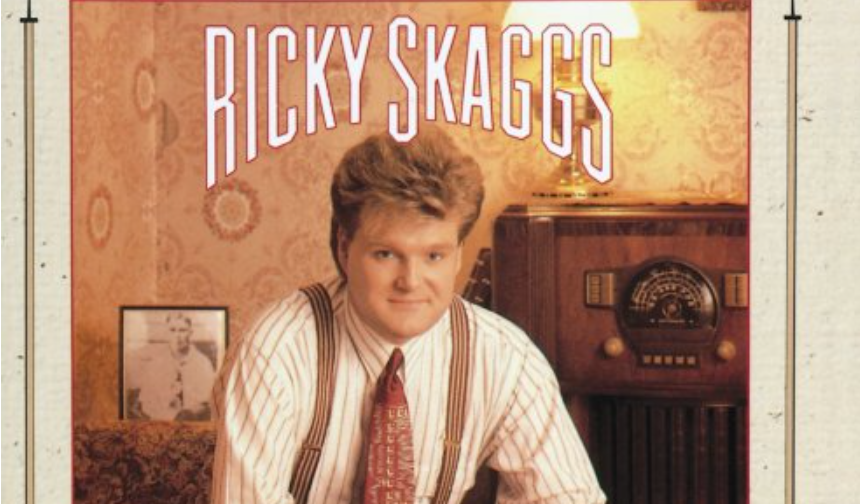
Hall came back for "You're My First Lady," a McAnally solo write that he produced for T.G. Sheppard in 1987 and that peaked at No. 2. Sheppard had already taken "One Owner Heart," written with Walt Aldridge and Tom Brasfield, to No. 4 in the winter of 1984. Ricky Van Shelton took "Crime of Passion," another Aldridge co-write, into the top ten in 1987. Charley Pride charted "I'm Gonna Love Her on the Radio." Ricky Skaggs cut "Simple Life" on My Father's Son, an album McAnally happened to be producing, which meant Skaggs was singing the title track off the producer's own last record and both men were too well raised to mention it.
SAWYER BROWN
McAnally moved into the producer's chair with The Dirt Road and stayed for the rest of the decade, and the band that had won Star Search and spent five years being condescended to turned into a serious concern. "Cafe on the Corner" went top five. "The Boys and Me" and "This Time," both written with Mark Miller, went top five and top two. "Thank God for You," also with Miller, went all the way in 1993.
The one that lasted is "All These Years." He recorded it himself first, on Live and Learn in 1992. Sawyer Brown released it that November, produced by Miller and Randy Scruggs, and took it to No. 3 — over its author's objection, more or less: Miller heard the demo, flipped, and insisted on cutting it as a single, and McAnally thought he was nuts. His concession, years later: "I never saw the universality in that song that Mark saw, so he gets some credit for that." It is a song about a marriage at the hour it could go either way, and it declines to tell you which way it went.
Thirty-three years later, at the Ryman, Amy Grant sang it back to him in a room full of people who write for a living.
THE WATER TANK
In 1990 he made a record for Warner Bros. called Simple Life and put on it a song about the town he came from, which had a water tower and about nine hundred people.
"Back Where I Come From" got to No. 14 for him. He has said he knew it was a hit, and that he wanted to be the one who said it first. "That song is as much my life as you can get into a song," he told Oermann while it was on the charts. "You can have a pretty accurate opinion of Mac just listenin' to that one song."
What the song is actually made of, he supplied once, from the year he was twelve. His father was rushed to the hospital in Tupelo with a ruptured ulcer; the doctors did not expect him to live; the family spent two months driving between home and hospital while the farm went untended. His father lived. "At the end of the whole ordeal, we came home and I went out walking," McAnally said. "Everything we normally did was planted and up. People, without saying anything about it, knew what we planted, that we had X number of rows of peanuts and X number of rows of potatoes. We still to this day don't know who did it. I was glad to be in a place where that happened, because I don't think there's a lot of that left." That is the town in the song. He had been carrying the story for a long time before the song existed — he told it to The Birmingham News in the summer of 1980, sitting at a table before a show in faded overalls, a T-shirt and tennis shoes, ten years before he wrote it down: "They didn't say anything to us about it; they just came over and planted it. It was the natural thing to do ... any other family in town would have done it for them."
Kenny Chesney cut it in 1996. It went gold, and it became the thing Chesney reaches for when he wants to remind a stadium where he's from. McAnally shrugs the point away: Chesney saw what he didn't and sold twenty-five million records, so he is disinclined to argue. He has said he wrote the song for the nine hundred people who would get the reference and that it turned out to be unintentionally universal. It rode in Buffett's show for years, too — Buffett was Mississippi-born, and the two of them sang it together, trading a look every night on the line "I'm an old Mississippian." Belmont, for its part, keeps up its end of the correspondence: after he mentioned the town's one traffic light on television, letters arrived informing him the town had bought a new one — secondhand, from Tupelo.
The same album carried "Down the Road." He wrote it on a Christmas morning, thinking about what his two daughters' lives were going to look like. The first verse is a boy walking up to a girl's house to face her father. The second verse is the same man twenty years on, standing on his own porch, watching a boy come up the road for his daughter and understanding at last what his father-in-law had been doing to him. He lets her go. McAnally has since had a third daughter.
It went to No. 70. Eighteen years later Chesney called and asked him to sing it with him, and in February 2009 "Down the Road" went to No. 1. Mac McAnally was fifty-one, and it was the first chart-topping single with his own voice on it, and it got a Grammy nomination. It remains the best chart position he ever posted as a singer. He needed a friend to hand it to him, and he will tell you so cheerfully. The friend's accounting came from the stage of the Sphere in 2025, with McAnally standing beside him: there is "nobody else on the planet like that man right there."
THE NOTE
The Buffett relationship began in the mail. Somebody put the 1977 debut into Jimmy Buffett's hands, and Buffett wrote to a stranger to say that they were both from Mississippi, they were both storytellers, and they were going to be friends. That is McAnally's memory of a handwritten note rather than a transcribed quote, and it should be read that way.
He was right about the friendship. "It's My Job" arrived on Coconut Telegraph in 1981, McAnally's alone, and became one of the songs the Buffett catalog rests on. They wrote together across four decades — some thirty songs, by McAnally's count. "Coast of Carolina," which McAnally has described flatly as a sequel to "Come Monday." "Love in the Library." "Delaney Talks to Statues." "Changing Channels." "Last Man Standing." The title track of License to Chill, with Chesney on the record and the album at No. 1. And "Oysters and Pearls," which closes Beach House on the Moon, and which McAnally recorded himself in April of 2024.
He joined the Coral Reefer Band outright in 1994 and ended up co-producing the records with Michael Utley. His first full exposure to the Parrothead phenomenon left the loner from Belmont blinking: "It was like a dream. I'd never seen that kind of hero worship." His accounting of the partnership was simpler: "I'm more of a Baptist than Jimmy, but we're both sort of Southern storytellers." The fuller ledger came out after Buffett was gone: "He took me under his wing really early, and he believed in me before I believed in myself. He had enough confidence for a large crowd of people, and I was not born with a great deal of it, so I wouldn't be on any stage ... had he not taken the step of believing in me first." There is a version of this story in which the finest songwriter of his generation gets absorbed into somebody else's beach and never comes back.
"It's My Job" was the first song the two of them ever sang together. It was also the last.
Buffett died in September 2023 and left instructions to keep the party going, and so the man who spent fifty years declining to stand at the front of anything is now standing at the front. His reason is not complicated: "I love the guy. He was my big brother." The Coral Reefers played the Hollywood Bowl tribute in 2024 as the house band behind McCartney, the Eagles, Chesney and Brandi Carlile. In 2025 they went out with the Doobie Brothers. And every night there is a microphone in the middle of the stage that nobody uses.
THE MAGIC AND THE WORK ETHIC
Ask him how he writes and you get two answers that appear to contradict each other.
The first is that he never tried. The songs fell out of him, he has said, and only later did he start working at it.
The second is that he will not force one. He wants a song born of inspiration, some light that has to come on before he'll proceed, and he is unwilling to surrender the magical part of it. But he has no objection at all to applying the work ethic to the magic. Which is another way of describing a hundred catches in a row. He put it best in 1990: "I'm like the don'ts of songwriting. I pretty much plan my life like I'm never going to write another song. I've got stuff to do all the time, but occasionally these ideas or emotions literally sit me down and throw me off schedule."
He builds songs on the guitar because he does not trust his own singing. He has said it in about those words: he was always trying to get a guitar part to carry a whole arrangement, because he couldn't count on the voice to carry it. The songs come out engineered to survive being sung by somebody who is not him, and four of them went to No. 1 for four other artists.
On the discipline of not repeating himself, he has pointed out that you cannot write the sequel to "It's My Job," and that you therefore have to go out of your way to avoid saying the thing you would naturally say.
He is, by his own account, a better host than co-writer, and still considers himself an apprentice at it.
A.K.A. NOBODY
The Nashville Songwriters Hall of Fame took him in 2007. Beginning in 2008 the CMA handed him Musician of the Year, then did it again the next year, and again — eight straight, a year off in 2016 while he was on the road with Buffett, then two more — and by 2018 he had ten and had broken the record he'd been sharing with Chet Atkins. Not Songwriter of the Year. Musician. The people who actually play on the records kept voting for the guy who was never the reason anyone bought a ticket.
He had diagnosed his own condition decades earlier, in 1990, arriving for a newspaper interview in a Ford Taurus station wagon and a work shirt with a Gulf gasoline patch on one pocket and "Mac" on the other: "When I have a hit, it will almost always be against the odds, because I don't go out and seek attention. I've got this porcupine of a name and I'm kind of a visual liability, so it puts a lot of pressure on my songs. As far as the machinery of the business works, it's tooled up for people who want to be famous more than anything else. I don't have any of that. I mean zilch-o."
In 2025 the ACM gave him the Poet's Award. Amy Grant sang "All These Years," and he accepted by quoting one of his own lyrics, the gist of which is that when everything has been said and done, he intends to keep on trying anyway.
He has kept on — and somewhere along the way he became the man Nashville hands its most fragile records. In 2014 he produced Jesse Winchester's final album, A Reasonable Amount of Trouble, carrying it home on Winchester's own instruction when the cancer returned and the singer handed him the baton. In May 2026 he produced Amy Grant's The Me That Remains, her first album of new original material in thirteen years, made in the aftermath of open-heart surgery and a bicycle accident that took a piece of her memory with it. He co-wrote the title song about exactly that. He wrote her "(Nothing Like A) Sunny Day." He wrote another with Caroline Jones.
Grant has told how it started. She called him to cut two songs. One night in, he informed her that if making music isn't fun then something has gone wrong with the world, and some sessions later he looked up and told her she had a record. He has said that the most devout atheist alive knows Amy Grant is an angel.
He is on the road as this goes to press, out on a tour he is calling All the Way Around, working theaters instead of sheds, mostly solo or in a duo, playing the songs he gave away and telling the rooms where they came from.
He called the album A.K.A. Nobody as a joke. Everyone in Nashville got it, and nobody laughed very hard, because the joke has been running for fifty years and the songs are all still out there working under other people's names.
Sources: Kurt Lassen's syndicated column, September 1977; Walter Dawson, The Commercial Appeal, April 16, 1978; Laura Eipper, The Tennessean, October 26, 1979; Bill E. Burk, the Memphis Press-Scimitar, May 16, 1980; Charlie Burttram, The Birmingham News, June 28, 1980; Mark J. Skoneki, The Montgomery Advertiser, July 12, 1980; the Clarion-Ledger, August 24, 1980; Robert K. Oermann, The Tennessean, April 7, 1990; The Birmingham News, June 17, 1990; Chrissie Dickinson, the Chicago Tribune, August 22, 2003; Billboard chart archives and Joel Whitburn's Top 40 Country Hits*; the Nashville Songwriters Hall of Fame; the Country Music Association; the Academy of Country Music; Country Weekly; Holler, 2025; American Songwriter; Variety, 2026; Robert Christgau's Consumer Guide; Donny Lowery, as told to Our Southern Souls; the Grand Ole Opry's Stories Behind the Song; artist, label and venue materials.*
RECOMMENDED LISTENING & VIEWING
"Two Dozen Roses" - Shenandoah
"Old Flame" - Alabama
"All These Years" - Sawyer Brown
"Back Where I Come From" - Kenny Chesney
"Down the Road" - Kenny Chesney with Mac McAnally
"Thank God For You" - Sawyer Brown
"Crime of Passion" - Ricky Van Shelton
"Simple Life" - Ricky Skaggs
"It's My Job" - Jimmy Buffett and Mac McAnally
"The Trouble With Diamonds"
ALBUM REVIEWS (produced by Mac)
 Generation Country
 Generation Country