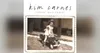
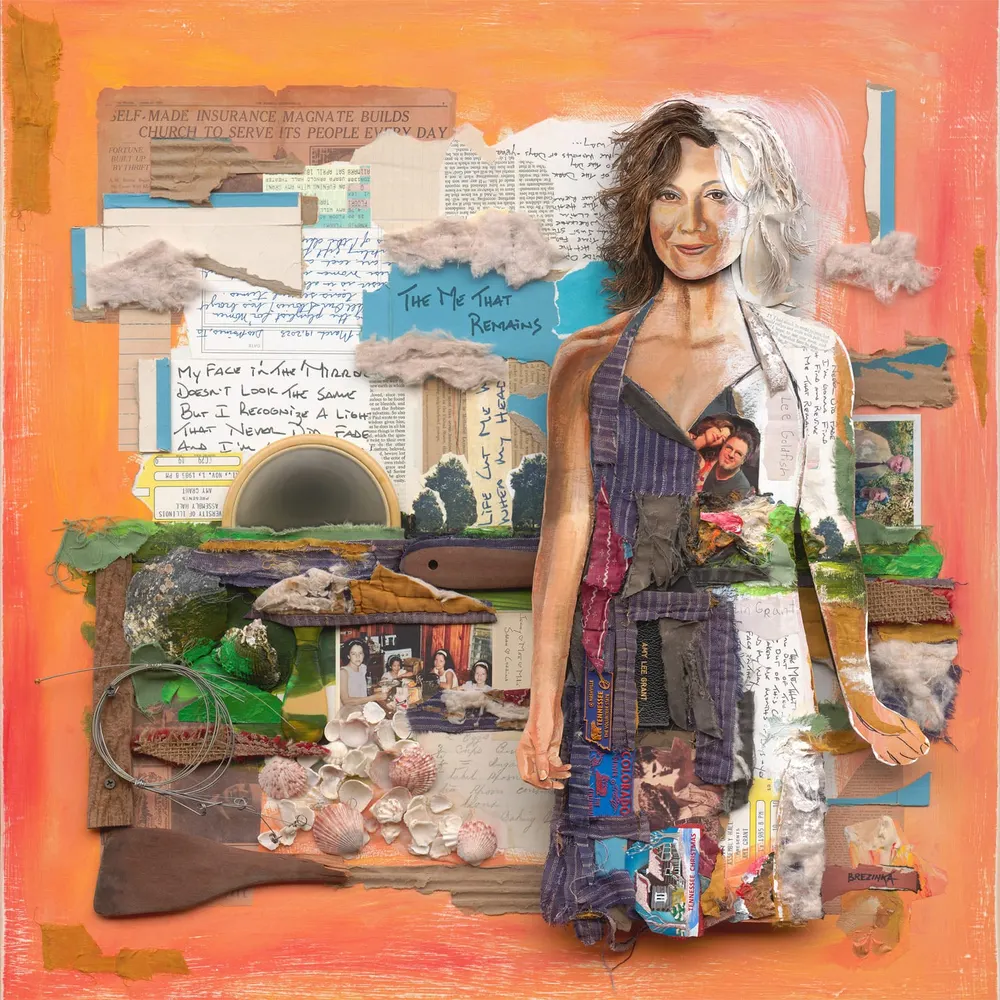
The cover of Amy Grant's The Me That Remains is a collage. Wayne Brezinka assembled it out of the actual debris of her life: family snapshots, a scrap of a quilt she's kept for decades, seashells, a ticket stub from one of her own shows back in the eighties, the Bible she carried as a girl, a yellowed clipping about the self-made insurance magnate who built a church to serve its people every day, her great-grandfather. Sit with it a minute and you've understood the album before a note plays. Here is a woman who went through the drawer looking for proof she'd been here, and pinned what she found to a board.
The Me That Remains is that same gesture turned into sound. It arrives May 8 on her own imprint through Thirty Tigers, the first record she's released without a Christian label co-signing it, and her first batch of new songs in thirteen years. The gap is the point. Twice in those years the body tried to file the paperwork. In 2020 surgeons opened her chest to reroute a vein that had been plumbed wrong since before she was born. Two summers later a bicycle threw her onto pavement and took the recent layer of her memory, the layer that holds a melody in place long enough to finish it. She survived the first and outlasted the second. Before any new song there was the old catalog to win back — fifty years of it, relearned from nothing, sung for a while off a teleprompter with her balance gone and, in her own words, scared to death. When she finally sat down to write, she found she could still catch the words but not always the tune. So she called in people to help her hold the notes. In a beautiful way, she has said, our limitations make the path. What's pinned to this board is what came back up the path with her.
Start with the fragments that aren't even hers, because she did. A comeback record is supposed to open on a statement, and Grant opens on a stranger's song. "The 6th of January (Yasgur's Farm)" was written start to finish by Sandy Emory Lawrence, a near-invisible writer who reportedly carried it years before it found a mouth. It doesn't narrate the riot. It asks a stranger for the road to Yasgur's farm — to Woodstock, to all that wide-eyed hope — and gets told the crowd "scattered all to hell and Harper's Ferry on the 6th of January," the date standing in as the gravestone for an idea of the country. The whole song is a trail of broken American promise read off in passing: John Brown's Harper's Ferry, Lennon's "Imagine" worn down to grocery-store Muzak with the words stripped out, Marvin Gaye on the car radio, and the one line that says everything, is it right on red or left on MLK. A navigation question that's also the only question. Grant doesn't editorialize. A strumstick rings under her and she lets the road stay lost. Later she hands a whole track to McAnally's pen, "(Nothing Like A) Sunny Day," the one deliberate shaft of daylight a record this heavy needs to let in. Plenty of listeners want the album dark the whole way down. They've misremembered what surviving feels like. Mostly it feels like Tuesdays you didn't expect to be alive for.
The man holding the frame around all of it is Mac McAnally, and the hire tells you the register she wanted. He's won CMA Musician of the Year ten times, a record. None of that prepares you for the restraint he plays with here. The job on these songs is the reverse of virtuosity. He disappears. A guitar, a piano mostly left alone, an organ breathing behind a curtain somewhere. The production runs so unhurried it sounds like a man who walked in, looked at what she'd been through, and decided the only decent move was to get out of the way of it. He has his own word for what he was chasing, and it isn't polish. He went after humanity over perfection. "Clocks tick in time and xylophones are in perfect tune," he said, "but nobody pays to listen to either one." She booked the session meaning to cut two songs. They surfaced with ten. Nobody, you can hear, was watching the clock.
Then there are the fragments that turned out to be people. "How Do We Get There From Here" is the Covenant School song, and it exists because Grant's nephew dared her into writing it. Burton Verner — a guitar player and songwriter who'd spent time on the road with her when he was younger — had taken up a standing challenge between them to trade song ideas, finished or not, and the one he sent reminded her she'd never held up her own end. The Nashville shooting was the thing she hadn't found a way to say. "I'm not getting out of this chair," she decided, "until I've got something to sing about that experience." She co-wrote what came out with Ruby Amanfu, who sings on it, and put it out on March 27, the anniversary. Amanfu doesn't blend with her so much as prop her up, one voice carrying the grief while the other carries the spine it takes not to look away. There's no swell toward uplift, no chorus that resolves — only the title asked over and over, how do we get there from here, stacked into the outro until the question wears down to a prayer. The song won't pretend to an answer. It hangs the colored ribbons, names the only stakes that matter — will we have been part of the problem or a part of how we heal — and leaves the room still shouting.
Her husband is in here too. "Friend Like You," a Chris Eaton song, is a duet with Vince Gill, and there's no hearing it as anything but two people who built a life singing at each other across the back half of it. It reads as friendship on the page, the vow to come running at midnight or first light, but with these two voices it's plainly a marriage, golden years coming on, the best view the one looking back at me and you. Gill's harmony does the thing Gill's harmony has always done, sliding in at the one altitude that takes your legs out, and the fit between the voices is the unforced kind you only get from years of finishing the other person's sentences. And her daughters close the record. "The Other Side of Goodbye," reaching back to her mother's death in 2011, sets Sarah Cannon and Corrina Gill behind her at the microphone. It comes from Tom Douglas, who wrote "The House That Built Me," the great song about going home to the place that made you. Here he hands Grant its mirror, a song about the doorway out. It watches the last breath as wonder rather than loss: her mother lighting up at the end like a kid on a carnival ride, Disneyland without any lines, fireworks on the 4th of July. Then it turns the same hope on herself, eyes open wide for whatever comes next. Watch the shape of the whole album resolve in that one move. It began with a stranger's song about a country that lost its better self. It ends with Grant's own blood gathered around her, singing her toward the people who went on ahead. She started the record as a witness to a stranger's loss. Her own children close it singing her home, and she's the one who got to stay.
The last fragment is the hardest, because it's her body, and it's the title track. It came out of a room one of her kids talked her into making. Vince had the home studio; she'd never had a space past the kitchen and the pass-through she used as an office, so in the summer of 2024 she cleaned out the walkthrough room, stuck thirty years of her own paintings to the cork board wall, set a turntable and the 45s she'd been given beside it, and called it craft-topia. She sat down in there one day and wrote what she took for a poem, and it was the lyric to "The Me That Remains" — a song that says the part you'd expect a wiser singer to bury: life cut her open, her head met the ground, it wasn't her time, the soul simply stuck around. Out of almost any other mouth that would be a greeting card; she files it as a field report instead. The voice carries a grain now that the Lead Me On years never had, a fragility right at the edges of the held notes, and rather than smooth it away McAnally built the song around the flaw. When he played her the finished mix she didn't believe it, and asked what computer tricks he'd run on her voice. None, he told her; he didn't know any. Piano, an organ sighing low, open air everywhere else. The damage became the instrument. But the song refuses to stay in the wreckage. It climbs out of the cave, finds "a light in my eyes that never did fade," and reaches for an ending a lesser writer would have flinched from. There's no triumphant homecoming, only a smile in the mirror that's "enough for today," the last chorus swapping its promise from finding the me that remains to being kind to her. She figured that out, and she had the nerve to print it.
The middle of the record is where the old gift comes back to work. Grant has always known how to make the sacred sound domestic, like something worked out at a kitchen table rather than announced from a height. Jon Foreman helps her build "Please Don't Make Me Beg" out of one plea that keeps changing hands. Please don't make me beg, she sings first, for a partner's time and attention. Then it slides off her and onto a man on the corner with an angel voice and an empty guitar case — please don't make him beg — and the personal becomes the thing we owe anyone gifted and broke. Then it belongs to the Son in the garden, must I drink from this cup, the same three words now Christ's, his death offered as everyone's redemption. Three speakers, one ask, climbing from a bedroom to Calvary, and the chorus folds them into a single line: we want the same thing, to be loved. She doesn't preach the ending. She turns and asks you — can't you hear Him saying, just don't run from love. And the moment the acoustic comes in under her you know whose hands those are: Vince Gill, playing his wife toward the mercy she's asking for, two tracks before he opens his mouth to sing. "The Saint," written with Michael W. Smith, who has been in her orbit since both were kids learning what a hook was for, is the harrowing one, and the friendship is what gives it its nerve: two people who've known each other forty years going somewhere this dark together. A woman lost to cocaine, the door slammed where forgiveness should have been, six months in darkness that cost her the kids, the numbing by alcohol and pills, and the turn that saves her isn't mercy but a death: it took the man with the fists dying to make her do anything not to end up like this. The chorus pulls back to the only question that fits — does anybody see her, does anybody care — and the outro asks the one no CCM station would dare: stripped of everything, covered in grace, maybe the addicts are really the saints. It's the boldest thing on the record, and she sings it without a flicker of judgment.
"Beautiful Lone Companion" carries a Mike Reid co-write, and Reid is worth a sentence on his own: an All-Pro defensive end for the Bengals who walked away from football for a piano bench and went on to write "I Can't Make You Love Me." He gives Grant a melody that settles low and stays put, and she takes it conversational, nothing pushed anywhere in it — which only makes the lyric stranger, a half-seen Christ foraging for human pain in the marrow of despair, moving through ancient contradictions "with the grace of a sacred machine," a companion no one's ever seen. It's the strangest, most haunting thing here, a mystery sung like a lullaby. And then there's "'Til We Get It Right," a Caroline Jones co-write, and the pairing is less random than it looks. Jones is one of the most talented rising stars working right now, a generation down the road from Grant, the first woman ever made a full member of the Zac Brown Band and a multi-instrumentalist and genuine guitar heroine out to drag Nineties pop-country back into the light. She came up through Jimmy Buffett's Mailboat label too, which means she arrives from the same Buffett orbit McAnally has anchored for decades. Grant didn't reach for a peer here. She reached down a generation for the brightest writer she could find, and the youngest voice in the room turns out to share a bloodline with the producer. What they hand her is the one place the album lets itself grin: a groove and a love song that owns up to its own faults, maybe I come on a little too strong, it's gonna take a little R&D and a whole lot of TLC, we're gonna hold each other tight until we get it right. Out of a younger singer that's a cute hook. Out of a woman two near-deaths and a long marriage deep, hold your temper, talk it over, apologize, we ain't ever gonna quit carries the weight of someone who has actually done the work. It's the move Kathy Mattea has always made on her warmer, mid-tempo material — "Come from the Heart," wisdom for living delivered as conversation, the alto riding close to speech and never selling the line. Grant gives it to you barely above a murmur, each line left to settle on its own, a woman who knows exactly what it costs to keep holding on and recommends it anyway.
What keeps all of this a record instead of a recovery memoir with chords is that nobody reaches for it. The arrangements stay close and built from wood and breath, and they trust her to hold the middle of a quiet room. She holds it. The instrument that once moved millions on the strength of its brightness has weathered into something better, a voice that got frightened twice and decided, against the available evidence, to keep going. Place it next to Rosanne Cash's Black Cadillac and you find the same gesture, a survivor building a portrait out of her dead, taking her own measure against the people who went on ahead. Bonnie Raitt is in here too, that late conversational restraint that lets a song sit still; no accident Mike Reid handed Grant a melody, given what he once handed Raitt. And there's Wrecking Ball in it, the nerve it takes for a singer the world loved for her brightness to walk into her own weathering on purpose. But the honest comparison is internal. This is the Lead Me On instinct grown old and done being afraid, folk-pop that trusts the listener completely and never lifts its voice to be believed.
And it is, plainly, a pleasure to have her back. Thirteen years is a long silence to sit through, and there's something refreshing in a return this unshowy, a voice that picks up mid-conversation as if it never left the room. She's been missed more than the sales figures will ever register.
She had every license to come back loud. Healed, triumphant, here to prove the body lost. She came back quiet instead, still a little scared, and she let you hear it. That's the whole collage. Snapshots, a quilt scrap, seashells, a child's Bible, a voice with a crack running through it. The drawer tried to close on her twice. What remained turned out to be the part that was always worth keeping.
VERDICT: A survivor's record that flatly refuses to perform its survival. Grant returns from two near-fatal years not with triumph but with witness, assembles the album like a collage of everything that made it back up the path with her, and trusts a vanishing master at the board to stay out of the way of a voice that has earned every flaw in it. The most quietly arresting thing she's made in decades.
Essential tracks: "How Do We Get There From Here," "Beautiful Lone Companion," "Please Don't Make Me Beg," "'Til We Get It Right," "The Me That Remains," "Friend Like You"