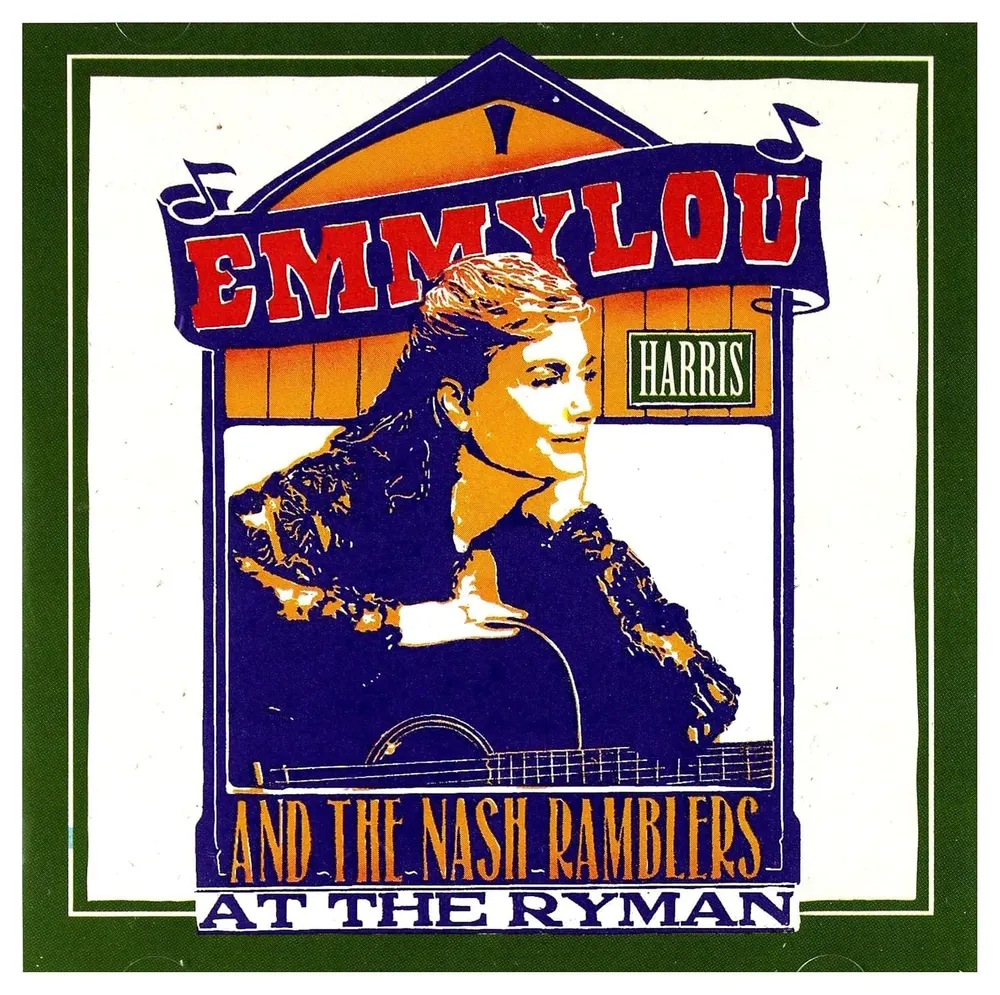
By 1991, the Ryman Auditorium was a building waiting to be torn down. The Grand Ole Opry had left for its new home in 1974, and in the years since, the old Union Gospel Tabernacle had sat mostly empty on lower Broadway, its paint peeling and its balcony structurally condemned, its future reduced to a demolition vote — WSM president Irving Waugh proposing the materials be repurposed for a chapel at Opryland, while Roy Acuff simply wanted the old building leveled. The Mother Church of Country Music was dying of neglect, and most of Nashville had made its peace with that.
Emmylou Harris hadn't. She booked three nights there at the end of April, brought a five-piece acoustic band she'd been road-testing for less than a year, and played to crowds of two hundred people seated in the lower pews because the balcony couldn't safely hold anyone. What she recorded over those three nights won a Grammy and forced the building's owners to commit $8.5 million to a full restoration. The New York Times called it her finest moment. Days after the album's release, Harris was inducted into the Grand Ole Opry on January 25, 1992, tying her permanently to the legacy of the Mother Church she'd just rescued. The Ryman reopened in June 1994. It is now a National Historic Landmark. None of that happens without this album.
Harris had spent the previous fifteen years fronting the Hot Band, one of the great electric country-rock ensembles — a group that at various points included Rodney Crowell, Ricky Skaggs, Albert Lee, Vince Gill, and Barry Tashian. But the volume had taken a toll on her voice, and by the late eighties she was looking for a way to strip things back. John Starling, her old collaborator from the Seldom Scene days, mentioned that Sam Bush had recently left New Grass Revival. Harris built the Nash Ramblers around Bush's mandolin and fiddle, adding Al Perkins — who joined the Flying Burrito Brothers in late 1971, after Parsons had already left, and later backed Parsons on his solo albums GP and Grievous Angel — on dobro, banjo, and guitar, Roy Huskey Jr. on upright bass, a young guitarist named Jon Randall Stewart, and Larry Atamanuik on a deliberately minimal drum kit — brushes and restraint, just enough pulse to keep the groove alive without burying the strings. She called the transition "going back to bluegrass school."
The band spent months on the road before recording anything. Their official Nashville debut came at the Tennessee Performing Arts Center in September 1990, a concert that was taped and then shelved for three decades before surfacing in 2021 as Ramble in Music City: The Lost Concert. That set leaned on acoustic reworkings of Harris's catalog. The Ryman shows were different — almost entirely new material the band had never played for an audience. The songs were fresh and the arrangements untested. And the building itself, half-empty and half-ruined, was listening. Harris felt it from the stage. "Isn't this a great place to sort of feel the hillbilly dust?" she told the crowd, and that dust — the residue of every Opry night and tent revival and Hank Williams encore that had ever happened inside those walls — is all over the recording.
The setlist is an argument about what American music actually is when you pull the wiring out. Steve Earle's "Guitar Town" opens the album stripped of its electric swagger, rebuilt as an acoustic sprint with Perkins's dobro and Bush's mandolin trading licks where the electric guitars used to be. Curley Williams's "Half as Much" (made famous by Hank Williams) gets the reverence it deserves — Huskey's upright bass and Perkins's acoustic guitar holding a spare, heartbroken frame while Harris sings it straight, no ornament, no modern inflation. Tex Owens's "Cattle Call" floats on Harris's yodeling and Bush's fiddle, and when Perkins's dobro slides in underneath sounding like a distant train whistle, you can hear the room itself resonating around the notes.
Johnny Cash's "Guess Things Happen That Way" turns the spotlight on the vocal blend the band had spent months building on the road. Before it, Harris told the crowd they used to sing in a triad, "but then we added a fourth voice, so we called it a crawdad." The joke lands light and the song lands heavy, and Harris carries both without breaking stride.
The emotional center of the first half is Stephen Foster's "Hard Times Come Again No More," published in 1854 and performed here with the weight of every year since. Harris opens it a cappella, alone in the Ryman's silence, and one voice in that old tabernacle pulls the room back to what it was built for — a place of worship. The band enters with a four-part harmony so controlled and so warm it barely disturbs the air.
Bruce Springsteen's "Mansion on the Hill" gets transplanted from Nebraska's lo-fi isolation into acoustic country-folk, Bush's fiddle replacing the harmonica, the class-conscious ache of the lyric deepened by the setting — a crumbling building full of history that the money people wanted to knock down. The Everly Brothers' "Like Strangers" becomes a slow country ballad built on the close-harmony blend between Harris and Jon Randall, whose high, clear tenor wraps around her lead vocal until you can't tell where one voice ends and the other begins. It recalls the duets she sang with Gram Parsons twenty years earlier, and it remains one of the most quietly devastating performances she has ever recorded.
"Calling My Children Home" is sung entirely a cappella — Harris, Bush, Randall, and Huskey gathered around a single microphone, Huskey's rich bass vocal holding the foundation while Bush and Randall stack the bluegrass gospel harmony above him. When it ends, Harris says into the silence: "Thank you, Mr. Roy Huskey on the bass vocal." Huskey died of lung cancer in 1997 at forty. He was the son of the legendary Grand Ole Opry bassist Roy Madison "Junior" Huskey, and Marty Stuart called him truly irreplaceable. Drummer Larry Atamanuik would go on to join Alison Krauss and Union Station, winning more Grammys in that band.
Bill Monroe's "Walls of Time" is dark and relentless — Perkins's banjo and Bush's mandolin building tension while Huskey's bass anchors the rhythm. Monroe receives the heaviest single-songwriter tribute on the album — three of his compositions — and during the filming of the companion concert video, the eighty-year-old father of bluegrass himself walked onto the Ryman stage and buck-danced alongside Harris during his instrumental "Scotland." On the album's audio, though, the buck-dancing you hear is Harris's own, her feet keeping time while Bush works the fiddle. Either way, the old man handed the music across to her in the same room where he'd spent his life playing it. John Fogerty's "Lodi" gets recast as a banjo-led bluegrass number, brighter and more communal than CCR ever played it. "Get Up John," the Monroe instrumental with lyrics by Marty Stuart and Jerry Sullivan, requires Bush to retune his mandolin to Monroe's open-D cross-tuning to execute the double-stop slides that define the piece. The technical demands of the setlist are enormous, and the Nash Ramblers meet every one of them while keeping the song, not the playing, out front.
The album closes — in its original release — with "Smoke Along the Track," a rockabilly train song that lets Bush's fiddle and Perkins's banjo trade solos at full speed, the sound of a steam engine built entirely from wood and strings. The 2017 reissue added two tracks from the same sessions: "Rollin' and Ramblin'," a narrative about Hank Williams's death, and "The Nash Ramble," a collective instrumental that lets every player stretch.
What At the Ryman proved in 1992 was that acoustic roots music didn't need amplification to compete. In a country radio landscape that was accelerating toward the polished, compressed production of the Garth Brooks era, Harris and the Nash Ramblers made an album that sounded like it came from another century and felt more alive than anything else on the shelf. The Grammy voters heard it. Entertainment Weekly gave it an A, and the building got saved.
And a young singer and guitarist named Jon Randall, barely into his twenties, spent those three nights playing and harmonizing beside Emmylou Harris on the stage of the Ryman Auditorium, absorbing everything the room and the band and the history had to teach him.
Emmylou Harris and the Nash Ramblers · At the Ryman · Reprise Records 9 26664-2 · 1992
Produced by Richard Bennett and Allen Reynolds
Recorded live at the Ryman Auditorium, Nashville, Tennessee · April 30 – May 2, 1991
Grammy Award: Best Country Performance by Duo or Group with Vocal, 1993