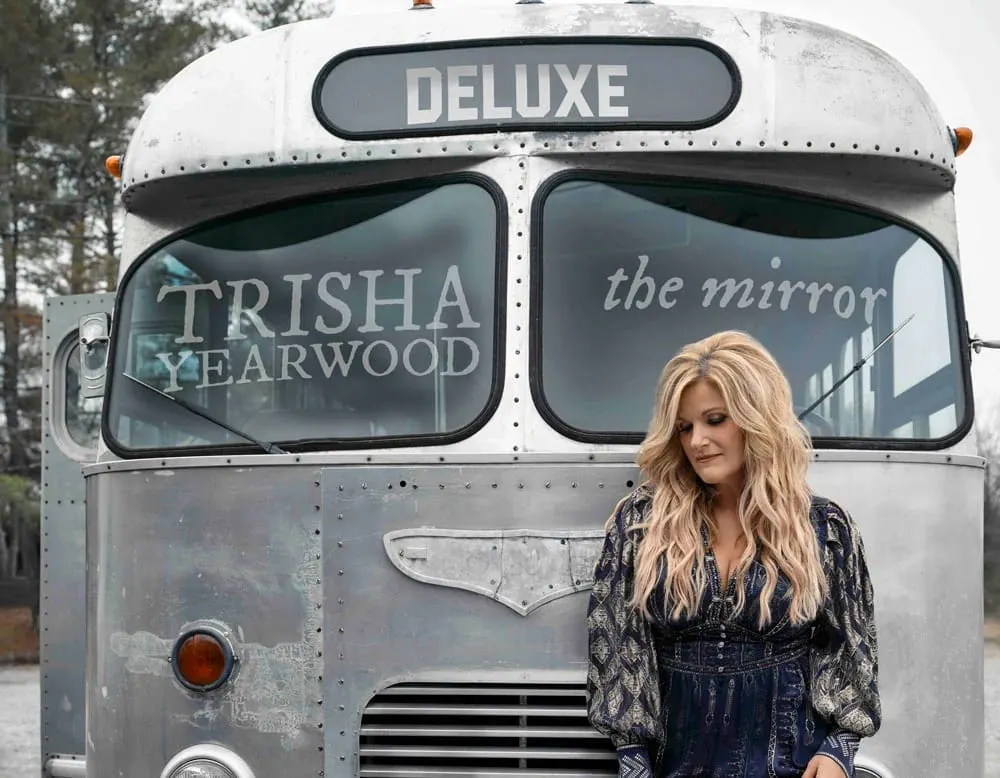
At nineteen, in her Belmont days, someone told Trisha Yearwood she wasn't a songwriter, and she let that be the truth for about forty years. Time enough to build one of the great interpretive catalogs in country music out of other people's words — to become the singer Music Row handed its hardest material to when a song needed somebody who could make it bleed. The Mirror is the sound of her setting that old verdict down. It is the first album of her life on which she co-wrote every song, and the first she has ever co-produced. The most trusted voice in any room she walks into finally walked into the writing room and stayed.
The story of how she got there runs through Leslie Satcher. It was Satcher who pulled Yearwood into a session in 2022 and refused to let her stand at the edge of it, and her name appears on more of this record than anyone's but Yearwood's own. The Texan who gave George Strait "Troubadour" and Martina McBride "When God-Fearin' Women Get the Blues" writes the way a stonemason lays a wall: every piece bearing a load, nothing set there to be admired, the whole thing holding up under pressure without a seam showing. When she and Yearwood get a melody under a lyric, the song doesn't sound composed so much as recovered, like it had been somewhere all along waiting to be sung. Satcher is the spine of The Mirror, and the record stands straight because of her.
None of this is the ear arriving late. For thirty years Trisha Yearwood was the singer other people trusted with their best songs — the one with the taste to hear a thing nobody had made a hit yet and know just what it was. Matraca Berg gave her "Wrong Side of Memphis" and, with Alice Randall, "XXX's and OOO's." She cut Gretchen Peters's "On a Bus to St. Cloud" when it was too literary for radio to know what to do with it, Beth Nielsen Chapman's "Down on My Knees," Karyn Rochelle's "Georgia Rain." On her self-described signature "The Song Remembers When," and across a catalog mined from writers like Berg and Chapman, she kept reaching for the song over the showcase, harmonizing in the studio with Emmylou Harris and Don Henley rather than crowding them out. And the writers she loved she tended to keep close — Jessi Alexander, years before "The Climb" and "I Drive Your Truck" made her a household name in the credits, wrote "Baby Don't You Let Go" for Yearwood's Jasper County, came back with "Nothin' 'Bout Memphis" on the very next album, and handed her the title cut of PrizeFighter. She always knew who the great writers were. The Mirror is that same ear turned on a new room and, for the first time, on herself.
The conceit Yearwood settled on was letters to her younger self, and the company she kept to write them tells you what kind of record she wanted. She built it largely with women — Satcher, Erin Enderlin, Sunny Sweeney, Makayla Lynn, Rebecca Lynn Howard, Maia Sharp, Emma-Lee, Bridgette Tatum, Melissa Fuller, Rachel Thibodeau, and her own sister, Beth Bernard — and the room shows in the songs, which talk to the listener the way old friends talk across a kitchen table after the dishes are done. Steve Dorff, Jim "Moose" Brown, Brett Boyett, Matt Rossi, Bobby Terry, Chad Carlson, and the Warren Brothers round out the credits, but the center of gravity is female and generational, and unmistakably hers.
She made it with Chad Carlson, and the choice of producer is the hinge the record turns on. For most of her career Yearwood was produced by Garth Fundis, and Carlson — who came up as Fundis's chief engineer at Sound Emporium and won two Grammys engineering Taylor Swift's Fearless — is the man who ran the board on her records going back twenty years, so handing him the chair only looked like a leap; she'd been standing next to him at the console all along. He's spent a career in service of women's voices, Alison Krauss to Brandy Clark to Maddie & Tae, which makes him the right pair of hands for a record built the way this one is. She has called it venturing out with a safety net, and you can hear the safety and the venturing both. At Allentown Studios the band sounds caught live and close, no gloss laid over the grain. Rob McNelley's electric guitar bites where the line needs an edge and disappears where it doesn't. Greg Morrow plays drums like a man who's decided the song is the only thing that matters. Dan Dugmore — whose pedal steel shaped the ache on records people have been crying to since before some of this album's younger writers were born — does the weeping so Yearwood never has to oversell it. The arrangements trust her, and she repays it on every cut.
"Bringing the Angels" opens the album as a fight song dressed in gospel muscle. Somebody's been throwing stones and dragging her name through the dirt, and her answer is to call down reinforcements: let the devil bring whatever he's got, she's bringing the angels, and she's done standing on shaky ground. She even reaches back for Haggard — the fightin' side of me — and means every inch of it. Beth Bernard, Satcher, and Bridgette Tatum built it, and the title came off the cuff in the writing room when Bernard told the table they were bringing the angels that day. Yearwood sings it like a woman done being talked about, and the band kicks behind her with the conviction of people who believe the same thing she's saying.
The literacy arrives early, on "The Wall or the Way Over," and it belongs to Maia Sharp. Sharp is one of the most accomplished writers in American song — a woman whose pen has put words in the mouths of Bonnie Raitt and Cher while she went on making her own clear-eyed records on the side — and what Yearwood wrote with Emma-Lee and Maia Sharp here is a question aimed straight at whoever's standing next to a woman who won't be tamed: be the wall she runs into, or the way over it. The bridge holds the image that lodges and stays — try to rein a woman like this in, the song warns, and you've put a saddle on the wind. Yearwood delivers it without a wasted breath, and the song's gift is that it never once announces how smart it is.
"Little Lady," third in the running order and written by Yearwood with Satcher and Tatum, is the album's pure swagger — a parking-lot kiss-off to a stranger who eyes the ring, coos that she's his little lady now and ought to settle down and quit that music thing, and talks herself half to death before Yearwood gets a word in. When she does, it lands: I own that Chevy and I put the gas in the tank, I drive it right downtown, cash the checks at my own bank, a man like mine spends his time on a woman full-grown — I ain't nobody's little lady but my own. By the last chorus the Chevy's a Dually and the gloves are off, Crazy Pam warned not to mess with her no more before the Tombstone snap — let me tell, I'm your huckleberry, if it's a fight you're looking for. It's a whole lot of her mama, no patience for drama, and it sets the table for everything the record will say about who she answers to.
"The Mirror" itself is the thesis. Satcher and Tatum wrote it with Yearwood, and it does the simplest, hardest thing a song can do: a woman catches herself envying somebody else's life — the boy, the pretty house up on the hill — only to have that somebody look her straight in the eye and tell her she's always been the girl in the mirror. The reflection talks back, and what it says is the kindest line on the record: you're tender and you're tough and you're beautifully enough. There's no trick to it and no flinch in it. Yearwood has spent a career lending other people's truths her voice. This time the truth is hers, and the difference between a beautiful performance and a confession is the difference you hear.
Makayla Lynn is the youngest name in these credits, and she more than earns the ink. She co-wrote "Fearless These Days," where Yearwood looks back at a twenty-five-year-old halfway down the aisle, feeling it in her bones — drop the flowers, run back home — and not yet strong enough to turn away, because nobody had told her it was okay to rock the boat. The song forgives her for it. Lynn turns up again on "The Ocean and the River," carried on Dugmore's painterly steel — proof a writer barely out of the gate can put two songs this sure on a record this personal, and Yearwood clearly heard it.
Erin Enderlin moves through the album like weather. The Arkansas writer behind Alan Jackson's "Monday Morning Church" and Lee Ann Womack's "Last Call" is one of the deadliest pens working in Nashville, the kind who slips the knife in before you've registered the hand, and her fingerprints are all over the back half of The Mirror. "Goodnight Cruel World," written with Sunny Sweeney, is a pedal-steel ballad that grants itself permission to quit for the night without quitting the war: no answers today, but no surrender either, just a burden laid down long enough to sleep and try again tomorrow. Yearwood sings it that way, no harder. "So Many Summers," with Jim "Moose" Brown, nearly didn't make the record until Garth Brooks talked her into keeping it; it reaches toward a lost friend and chooses, hard, to keep living. Enderlin writes the kind of line you don't feel coming until it's already gone through you, and Yearwood has the restraint to let it.
The guests show up to serve the songs, never to take them. Charles Kelley's harmony on "The Record Plays On" blends so close it sounds like one instrument with two souls inside it — a vocal stack that makes you stop and check who's singing. Hailey Whitters turns "Drunk Works" into the most fun thing here, the comedy of drunk logic narrated dead straight — calling the ex, burning one cigarette, did little old me just save the world, we're so smart — until the hook calls the bluff: that ain't how drunk works. In a fairer landscape, it's the kind of infectious, sharp-tongued track that coasts to a multi-week run at No. 1 and a video with views in the millions. It practically storyboards its own clip — Hailey and every woman who had a hand in this record crowded into one booth, the songwriters and the friends and the sisters all in on the same round. Jim Lauderdale is the inspired call on "The Shovel" — a songwriter's songwriter and one of the warmest harmony voices in the music, he answers Yearwood from the next stool over, tucking his ad-libs into the corners and lending the whole thing a lived-in, two-hander ease that no studio pro could fake. His grain against hers is half the song's pleasure, and the only complaint is that it's over too soon, leaving you hungry for more biscuits and gravy. Jenee Fleenor's fiddle saws underneath, and "Girls Night In" throws the door open on the safe room where women come as they are and admit it's okay to not be alright. "Fragile Like a Bomb" is the record's argument about women compressed into three minutes: a woman sweet as Tupelo honey who makes her own damn money and can smell right through your bullshit, a rhinestoned suit of armor who might cuss you like a sailor or say bless your heart — and then the turn, the part nobody bothers to see, the her in the moonlight when she's lonely and can't sleep, whose heart breaks like anyone's. If you think it won't, honey, you'd be wrong.
And then the record closes the standard album on its summit. "When October Settles In" was the first song of this entire era that Yearwood wrote — with Satcher and Steven Dorff — and it gave her the nerve to keep going. October arrives in it as a person, an uninvited guest she opens the door to because there's nothing else to do, lost in the dreams of what might have been. Where the rest of us see red and gold she sees blue, and that one swapped color tells you the whole song. It's set against a chamber arrangement of piano and a string quartet that grieves without ever tipping into sentiment. Yearwood has said she can feel it in her body when the weather turns and the leaves come down, and the performance carries every ounce of it — the bodily knowledge of a loss the calendar keeps handing back. It is the most fully earned moment on a record full of them.
The deluxe edition doesn't remix or rethink any of that. It adds five, and the additions are no afterthought. "Different Kind of Hard," written with the Warren Brothers, Brad and Brett Warren, and "You're Gonna Love It Here," another Carlson and Melissa Fuller cut, deepen the record's reckoning with what matters now versus what mattered then. "Undone," written with Satcher, slips the leash entirely — the one piece of straight-up desire on the album, all spinning rooms and doubts left at the foot of the bed. And then the two that send it out at full height. "Country Music Herstory," written by Yearwood with Makayla Lynn and Leslie Satcher, is a rocking, Emmylou-shaped salute that draws its heroines as outlaws rather than saints — a "high-heeled thunderstorm" Jolene wished had never been born, a sweet Evangeline who could tear you apart with a song in a Delta key, "her and Linda running with the boys, making a Southern California noise." The bridge names the ghosts and tags each one to her signature — Loretta's cold blue moon, Patsy's crazy pain, Tammy standing by her man, and "Tanya, wild as that mustang" — and the chorus turns it into a dare: come on, baby, let her sing. By the last verse it's the album's nerve in a couplet — "You left Texas, and I left Georgia, and she left Arkansas / 'Cause you ain't living if you ain't willing to go out and risk it all." Yearwood sings it grateful to be in the line and a little startled to find herself near the front of it now.
The deluxe saves its truest card for last. "Put It in a Song," written with Erin Enderlin and Jim "Moose" Brown, is the one Yearwood debuted at the 2024 CMT Music Awards the same night she was handed the inaugural June Carter Cash Humanitarian Award, and it is the album's mission boiled down to a single song: when the words are too hard to say out loud, you reach for the pen and pour it onto the page — and find, in the melody, proof that you were never the only one who felt this way. There is no irony anywhere in it. It is a woman telling you, plainly, how she survives — and putting it, of course, in a song.
What ties all twenty of these together is the instrument at the center, and the discipline behind it. Yearwood's voice has always been chest-rooted and unhurried, built for truth rather than for fireworks, and here she keeps it close to the ground where the feeling lives. That it's one of the great voices in American music needs no arguing — pull up the clip of her singing "Don't Know Much" with Aaron Neville at the 2019 Kennedy Center Honors, in tribute to Linda Ronstadt, the singer who made her want to sing, and try not to be gobsmacked. Ronstadt, who can no longer sing herself, was dabbing her eyes before Yearwood reached the first line. That's the whole case, and it doesn't need a second exhibit. The kinship with Ronstadt is real, too — the same unforced clarity, the same instinct to serve the song rather than show off above it — and it's no false flattery to put Yearwood's instrument in that company. It's a voice that can go from soft and restrained, all beauty and held breath, to powerful and feisty inside the same song and never strain at either end. Carlson's production answers in kind: fingerpicked acoustic guitar, Billy Justineau's keys, Steve Mackey's bass holding the floor, Dugmore's steel commenting from the wings, the strings arriving only when October does. Nothing is hidden behind effects because nothing needs to be. The difference this time is that the songs she's serving so beautifully are her own — and the cleaner she keeps the line, the more of the hurt and the hope gets through.
This is the album Trisha Yearwood was always going to make once she let herself believe she could. It is generous to the women who wrote it beside her — to Satcher's stonework, to Enderlin's gut-punch economy, to Sharp's literacy, to Lynn's early certainty — and it is, finally and completely, hers. Play it loud, play it twice, and then go find somebody at nineteen and tell them they have no idea yet what they're capable of.
VERDICT: Amazing — and a long time coming. The Mirror is the most personal, self-possessed record of Trisha Yearwood's career: the album where the greatest interpreter of her generation became a writer worthy of her own voice, surrounded by the finest women on Music Row and carrying every song home herself. She spent thirty years making other people's truths sound lived. Here she tells her own, and proves she should have been doing it all along.
Essential tracks: "Little Lady," "The Mirror," "When October Settles In," "The Shovel," "Drunk Works," "Country Music Herstory," "Put It in a Song"