A bumper sticker in Alabama, a theory about old men's waistbands, and a country single that put dementia and a one-line grave on the radio — and drew, by Bobby Braddock's own count, more reaction than anything he'd ever written.
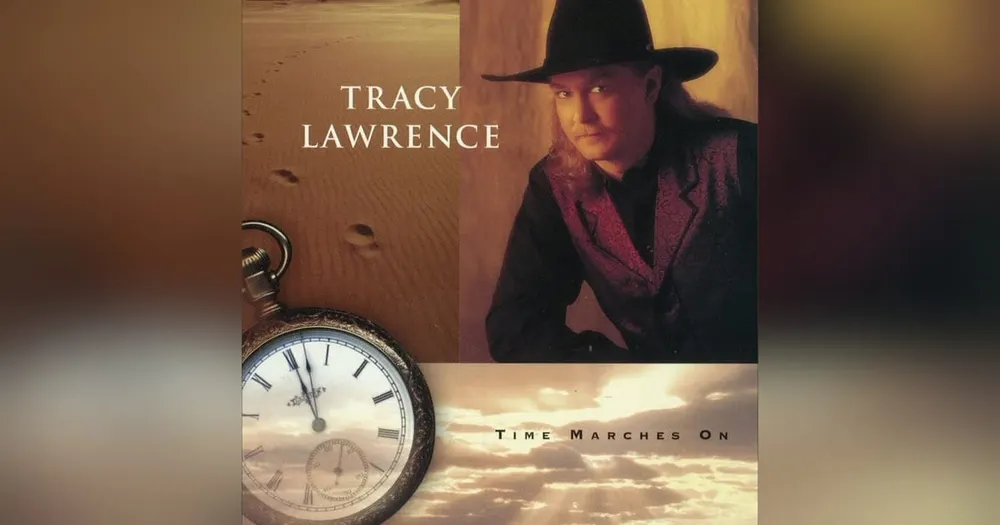
"Time Marches On" — Tracy Lawrence
From Time Marches On (Atlantic, January 23, 1996) · Single released March 18, 1996
Written by Bobby Braddock · Produced by Don Cook
© 1995 Sony/ATV Songs LLC (BMI), administered by Sony/ATV Music Publishing
Bobby Braddock went home to Central Florida and did some arithmetic he had not meant to do.
The people who had been young when he was young were middle-aged. The people who had been middle-aged were old. The old ones — the citrus men, the schoolteachers, the deacons, the faces he would have known on the street as a boy — were not there at all anymore.
"I was just looking around, seeing people who used to be young, middle-aged, and people who used to be middle-aged, old, and the old ones not around anymore," he told The Tennessean the week the song hit No. 1. He said he had no particular inspiration for it. He said it was "just sort of a tribute."
The modesty is real. The simplicity is not.
THE PANTS
The town had turned over twice. Braddock grew up in a Central Florida that was, as he put it, "very, very deep Southern." The kids he went to school with were born in South Georgia, South Alabama, or rural North Florida, or their parents were. Then the men left to find work — Detroit and the auto plants, Chicago and the steel mills — and while they were gone Disney World opened thirty miles up the road and the retirees started coming down from the places the men had gone to. Two migrations passing each other on the same highway over the course of one lifetime.
That is the sociology. Braddock got there another way.
What he noticed, going home to Auburndale (he spells it Orburndale, the way the natives said it, and put it on the cover of a memoir), was the difference between the old crackers and the transplants from Illinois and Wisconsin and New Jersey. What he noticed about the difference was their trousers. "When Southern men get older, their pants get lower and lower and lower, and their tummies stick out over their belt," he told Terry Gross on Fresh Air in 2007. "Northerners, as they get older, their pants get higher and higher and higher till they're finally wearing them up to the chest area."
Then, without a pause: "And that inspired the bridge of that song."
The South moves north, the North moves south / A star is born, a star burns out / The only thing that stays the same is everything changes, everything changes.
Gross told him she was not sure the empirical record supported him. Braddock didn't argue. "It may be a little exaggeration," he said, "but I do have a flair for the dramatic."
He is not joking about the pants. An unprovable observation about old men in Polk County goes up through demography and mortality and comes out the other end as a line about stars burning out. "So the song kind of started really from a line in the bridge," he has said, and that explains how it is put together. Most songs are built outward from a hook. This one was built outward from a thesis. Braddock had the philosophy before he had the family, and then he had to invent four people to prove it on.
THE FAMILY
He gave himself a hard container: a whole human lifetime in two minutes and forty seconds. Sister, Brother, Momma, Daddy. Three details apiece, three times through. That is the cast and the inventory.
Verse one is a house in the early fifties. Sister crying in her baby bed, brother running in with feathers on his head, Momma learning how to sew, Daddy drinking beer and listening to the radio. Hank Williams sings "Kaw-Liga" and "Dear John."
Verse two, the kids are teenagers and the house has gone bad. Sister's using rouge and clear complexion soap. Brother's wearing beads and he smokes a lot of dope. Momma is depressed, barely makes a sound. Daddy's got a girlfriend in another town. Bob Dylan sings "Like a Rolling Stone."
Verse three is the reckoning, and it arrives without one word of comment. Sister calls herself Sexy Grandma. Brother's on a diet for high cholesterol. Momma's out of touch with reality. Daddy's in the ground beneath the maple tree. And the angels sing an old Hank Williams song.
Read the four of them down the column instead of across and you can see the machine working. Each character gets the same slot in every verse, so the song never has to announce that time has passed; it just comes back around and the slot has changed. Sister goes baby, teenager, grandmother without a birthday in sight. Momma goes from learning to sew to depressed to gone from her own mind, three stages of a disappearance nobody in the song ever names. Daddy drinks a beer, gets a girlfriend, dies. The brother's arc is the joke that turns: feathers, then dope, then a cholesterol diet, which is the sound of the counterculture getting a physical.
And the writing gets no help from a chorus. There is nowhere to hide, no hook to fall back into, no place for a listener to rest and be reassured. Just the same four people, further along, and the title coming around like the hand of a clock.
Braddock knew what he was smuggling. "I just got the idea of writing a song about this family that just spends their whole lifetime in about 2 minutes and 40 seconds," he told Bart Herbison of the Nashville Songwriters Association International in 2016, "and put some things in there that we're not supposed to put in country songs, like dementia." Herbison read him the dope line back. Braddock: "Yeah, about drug use." The affair? "Yeah, well, of course, affairs have always been okay for country music."
The Sexy Grandma line he did not invent. His first wife's sister had it on a tag on the back of her car down in Alabama. He thought it was funny and he took it.
HANK, DYLAN, HANK
The three musical references are the clock face.
Hank Williams places you. Dylan tells you a wall came down in that house and in the country at the same moment, and Braddock knew that was a trespass too. "Bob Dylan," he told Herbison, "we usually don't put Bob Dylan in country songs." Then Hank returns at the graveside, sung by angels, which is either a joke or the least funny thing in the song depending on how you are sitting when it reaches you.
The whiplash is engineered, and Braddock had a model for it. Asked in 1996 how a record that dark could work on country radio, he said it was "balanced out by having a little groove that goes with it. And part of it is tongue-in-cheek." Then he reached for a movie. Bonnie and Clyde: "It was almost slapstick," he told USA Today, "and all of a sudden it was very serious, with dead bodies and people in serious trouble."
Which is the whole problem of "Time Marches On" stated in one sentence. Keep them loose enough to laugh at the feathers and the bumper sticker, then take the floor out from under them at the maple tree. He built the melody to hold that. "I kinda wanted to write it where it felt like it was to the rhythm of a clock," he said. "Ya know, tick tock, tick tock."
THE DEMO
Braddock has cut his own demos for decades, and this one shaped the record. The Hammond organ that swells in under the Dylan line was his idea, on the demo session. Don Cook heard it and kept it, and put Dennis Burnside on the B-3 to play it.
It is the one moment on the record where the arrangement takes a side. The verses move along on acoustic guitar and Lonnie Wilson's drums, dry and steady as the clock the song keeps, Rob Hajacos's fiddle and Bruce Bouton's steel filling the gaps between lines the way they would on any Nashville record that year — and then Dylan's name arrives and the organ comes up underneath it, warm and churchy and out of period, and for a few seconds the record sounds like the sixties happening to a country song. Then it lets go and the guitar figure resets, and the clock is running again.
One thing Cook did not keep. On the demo, when Hank Williams's name arrived, Braddock had the steel player quote a Don Helms lick — Helms being the steel guitarist on the original Hank Williams records, the high lonesome tuning that is the sound of 1952. "I'm kind of a steel guitar aficionado," Braddock said. "I love steel guitar."
A small loss, and a measure of how far down the obsession went. He wrote a song about time passing and then tried to make the steel guitar time-travel inside it.
TRACY
Braddock already had a relationship with Lawrence; he'd written "Texas Tornado," which took him to No. 1 in 1995. But "Time Marches On" made the rounds first, and it got turned down. "There were a couple of (other artists) I won't say who heard the song and passed," Braddock told Herbison. Then, without a trace of grievance: "And that's fine, I think this was a meant-to-be moment for Tracy."
The names have gotten garbled over the years, including by Lawrence, who for a long time told people Brooks & Dunn had been circling it. Braddock texted him to set it straight, and Lawrence has since corrected himself on the record: the hold was Tim DuBois at Arista, who had it for Diamond Rio and for Alan Jackson. "Brooks and Dunn didn't like the song at all," Lawrence said in 2021, "and Ronnie never heard it."
Lawrence, by then, had left James Stroud, who produced his first three albums, and gone to Don Cook — partly for the sound Cook was getting on Brooks & Dunn, and for the players he was getting it with. A few months after the writing, Cook had it cut.
"Tracy Lawrence, perfect artist for that song," Braddock said. "Something about the character of the song that just fit Tracy Lawrence to a tee. He's a great interpreter."
What he means by interpreter is the Bonnie and Clyde problem. The trap in this song is a singer who tries to sell the sad parts. Lawrence doesn't. He delivers "Momma's out of touch with reality" in the same register he delivers "feathers on his head," and the listener does the rest. Braddock, in 1996, said it plainly: Lawrence sings the song perfectly because he knows "when to lighten up and when to get very serious."
Lawrence knows what he was handed. "This lyric to me is an epitome of country music," he said in 2023. "It's a work of art." He has called it the best lyric of anything he ever recorded, and said flatly that it took his career to another level.
THE TROUBLE HE EXPECTED
Braddock was braced for a fight. He assumed radio would balk, mostly at the brother who smokes a lot of dope, a line no country programmer in 1996 had any obvious reason to defend.
Lawrence was braced for it too, and cut the song anyway — cut it, in fact, because of the risk. "The thing that made me cut that song specifically," he said in 2021, "was 'Smokes a Lot of Dope,' because I knew it would shock people." He was clear about the arithmetic. "I knew it would either be the biggest record that I've ever had or kill my career. But there was no in between." He had reason to think so: radio had already come after him over the word "cuss" in "If the World Had a Front Porch."
They were both wrong, and the scale of it seems to have startled Braddock. Programmers took it, listeners took it, and it went further than anything he'd done. "It got more reaction than anything I've ever written," he said that September. A country station in Tucson refused to air it, which the local paper thought worth a mention in April, and that was about the extent of the resistance. Lawrence's read on why: the record "was so big that [they] couldn't stop it."
What Braddock had misjudged was his own format, and he had misjudged it toward pessimism — assuming country radio in 1996 was more squeamish than it turned out to be, or more squeamish than one good record could talk it out of being.
It went to No. 1 in Billboard in June and stayed three weeks, the longest run of Lawrence's career, and the reason the two of them threw a Fan Fair No. 1 party two years running. "I'm hoping we can start an annual Tracy Lawrence Billboard No. 1 party," Braddock said. It also drew a CMA Song of the Year nomination in two consecutive years, 1996 and 1997, and lost both times, to Vince Gill's "Go Rest High on That Mountain" and then to Deana Carter's "Strawberry Wine." Braddock did not seem to mind the first one. "Vince was telling me how much he liked 'Time Marches On.' He said, 'If mine doesn't win, I hope yours does.' And I said, 'Well, I feel the same way about yours.' So when they announced Vince Gill, I didn't feel bad about it at all."
THE NERVE
By September 1996 the trades had a word for what was happening to him: renaissance. He was fifty-five. He had written something like two thousand songs, half of them published. He had "D-I-V-O-R-C-E" and "Golden Ring" and "Thinking of a Rendezvous," and, with Curly Putman, "He Stopped Loving Her Today," a song that had already taken CMA Song of the Year twice and was on its way to being voted the greatest country record ever made. Out of all of it — the whole catalog, five decades of it — only two Braddock songs have ever been played three million times on American radio. One is Toby Keith's "I Wanna Talk About Me." The other is this one.
He had also had a decade nobody wanted to bring up. After "Faking Love" — the 1983 No. 1 he wrote with a teenager named Matraca Berg, her first cut and his last hit for a long while — Braddock did not have another big one until Mark Chesnutt cut "Old Flames Have New Names" in 1992. Nine years. In a town that measures staff writers by the quarter, that is a long time to keep showing up at the same publisher — Tree, then Sony/ATV, the deal he signed in 1966 and never left.
Something changed in him in the interval, and it is the same thing the song is about. "Years ago I could write a hit song one day and a piece of crap the next day and not know the difference," he told USA Today. "Now if I write a song and it's not any good, I pretty much know it."
He said one other thing in that interview, sitting on a No. 1, a week out from the CMA Awards, with the whole industry returning his calls. He said his new streak of hits reinforced his belief that people "are a lot nicer to you when you're successful." That is a man who remembers 1984 through 1991 clearly. It is also, turned slightly, his own song.
Ask him to name a favorite out of a catalog that includes George Jones's masterpiece and he splits the question in half. "My favorite song I've written that was a hit," he told Terry Gross, "was Tracy Lawrence's record of 'Time Marches On.'"
And the one that wasn't a hit? A George Strait album cut called "The Nerve." Never a single. Nobody remembers it. He wrote it after reading Einstein's Dreams, Alan Lightman's book of small fictions about time, every chapter a world running on a different physics of the clock. Braddock's description of the song is four words long: "physics put to music."
So when he told Herbison he had "always been interested in time and physics and the 'what-ifs' of life," he was not reaching for a way to sound deep about a country single. He'd read the book, he'd written the song, and it sank without a trace, and it is the one he loves best.
"Time Marches On" is the same preoccupation with a family attached — the version people actually heard, with the beer and the dope and the bumper sticker and the maple tree, a whole life in the time it takes to drive across a small town. Braddock's favorite line in it has nothing to do with the sister or the brother or the father in the ground. It is the place where the song stops narrating and states its terms.
The only thing that stays the same is everything changes.
"How could there be happiness," he asked that summer, "if everything was sunshine yellow?"
Tracy Lawrence · "Time Marches On" · written by Bobby Braddock · from Time Marches On (Atlantic, 1996) · produced by Don Cook · recorded at Sound Shop, Nashville · 2016 interview quotes courtesy of Bart Herbison and the NSAI's Story Behind the Song series, as published in The Tennessean, July 17, 2016, compiled by Dave Paulson; additional Braddock quotes from Fresh Air with Terry Gross (NPR, 2007), Backstory Song, USA Today (David Zimmerman, September 26, 1996), and The Tennessean (Walter Carter, June 16, 1996); Tracy Lawrence quotes from BobbyCast (Bobby Bones Presents), Episode 324, November 12, 2021; airplay figure per Braddock's 2011 BMI Icon Award citation; session credits per Atlantic 82866-2; KIIM airplay note per the Tucson Citizen, April 11, 1996.