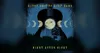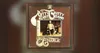
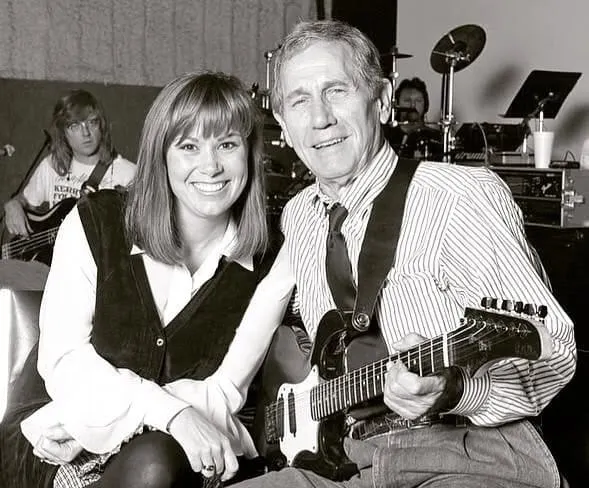
What does a man do once he's already helped invent the sound of modern Nashville? If he's Chet Atkins — at 70, long past needing another hit, his fingerprints on records by Waylon Jennings and Dolly Parton and Don Gibson and a hundred others — he clears the calendar, calls up a singer he's believed in since before she had a record deal, and makes the album he actually wants to make. Simpatico, released in October 1994, is that album. It would be the last to put Atkins on Billboard's country chart, and it remains one of the most quietly generous records either artist ever set their name to.
For Bogguss the timing was its own crossroads. She'd come up fast at the start of the decade, Aces going platinum with Voices in the Wind and Something Up My Sleeve close behind it in gold, and the momentum that launches a new artist eventually turns into a question about what she intends to do with it. Her answer was to take the board herself. Stepping out from under longtime producer Jimmy Bowen, she co-produced Simpatico with engineer John Guess — her real coming-of-age as a producer rather than only a voice. Her work behind the board sounds clean and unfussy and, decades on, still fresh, and she caught her own instrument at the peak of its powers: the singing across this record is as strong and supple as anything in her prime. And Atkins, one of the most decorated producers the format has ever had, had by this point largely set producing aside; he was happy to leave the chair to Bogguss and simply play, letting the record be hers to run.
Because that is finally what Simpatico is: a friendship disguised as a duet album. The two had been trading guest spots and, more tellingly, swapping songs on Atkins's back porch for years before anyone booked a studio. The project crystallized when Atkins left a voicemail under his old joke alias — "Suzy? Chuck Akers. I found a song I think we could make a hit out of" — and Bogguss, hearing it, knew he was hooked. She took months away from the business to write and woodshed with Mr. Guitar before tracking began. You can hear that unhurried apprenticeship in every cut. This is a record made by two people who already liked each other's company and simply turned the tape on.
Atkins built the Nashville Sound and kept tastes that ran from country through pop into jazz, so it follows that Simpatico never settles for a single lane. He works here mostly as a featured accompanist, sliding a harmony or a dry aside in between his picking, and anyone who wonders whether the legend could still play need only sit with the runs he lays under these songs. The vocal heavy lifting belongs to Bogguss, whose tone he once described as sparkling like crystal water — a singer who, as he put it admiringly, never sneaks up on a note.
The album is surest when it keeps things basic. It opens on Jimmie Rodgers's 1928 chestnut "In the Jailhouse Now," a 1955 hit for Webb Pierce, taken at a loose rockabilly shuffle with Pat Bergeson's harmonica curling around the vocal — the warmest possible front door. Deeper in comes the record's emotional summit, a full-band reading of Johnny Cash's "I Still Miss Someone" — acoustic guitar, bass and drums holding the floor, Mark O'Connor's fiddle threading lightly through the lines, and Vince Gill's harmony floating in at exactly the right altitude. Bogguss states the song plainly and lets the ache carry it, and her reading stands with the best the song has ever drawn.
The originals hold their own beside the standards. "Wives Don't Like Old Girlfriends," from the pens of Randy VanWarmer and Shane Fontayne, is blues-drenched and grinning, the kind of marital comedy Bogguss sells with a raised eyebrow. "One More for the Road" is the one that started it all — the song from Atkins's voicemail, the only Atkins–Bogguss–Crider co-write here, and the album's lead single. A rollicking blend of country, western swing, and jazz, it rides a swinging upright-bass-and-piano groove that's near impossible to sit still through; Bogguss works a rhythm guitar and a grin while Atkins answers her line for line with jazzy fills off his red hollow-body, the two of them plainly having the time of their lives. The lyric is an ode to not wanting the night to end — the truck's loaded for Memphis, but nobody's ready to pack it in, so they play one more. It's all foot-tapping forward motion, and the playful video carried the feeling straight over, turning a grand hotel lobby into a spontaneous, high-flying tap-dance party while the band swung away in the middle of it. It deserved a far better fate at radio than it got.
Then there are the two cuts that prove how far the record is willing to travel. "Two Shades of Blue," written by Deborah Allen, Bobby Braddock and Rafe Van Hoy, is a Spanish-hued ballad carried by Flaco Jiménez's concertina, and Bogguss meets it by shifting her whole delivery — less crystalline country soprano, more the warm Spanish-torch register Linda Ronstadt found on Canciones de Mi Padre. The closer, "This Is the Beginning," is the album's true wild card. It came from Pat Donohue, the fingerstyle champion from A Prairie Home Companion, a writer Atkins admired enough to say he'd "played the hell out of it on guitar" when he first heard the song. Atkins loved the tune and figured Bogguss would shine on it, and here the band wraps it in a bouncing, syncopated groove with the bright, polyrhythmic lift of Paul Simon's Rhythm of the Saints. Flaco's reedy concertina drifts across the top, and Bogguss rides the whole thing so easily that its left turn out of country feels completely natural — the most adventurous moment on the record, and the most joyful.
The record's softer center is just as deliberate. "Sorry Seems to Be the Hardest Word," the Elton John and Bernie Taupin ballad chosen as the second single, gets David Campbell's restrained string arrangement and the kind of tasteful, adult-contemporary patience that lets Bogguss's phrasing breathe. "When She Smiled at Him," a father-daughter ballad from Joanie Beeson and Michael Johnson, glows with the warmth of 1970s AM radio. R.L. Kass's "Forget About It" leans most toward contemporary country radio, and Bogguss sings the daylights out of it — a song strong enough that Alison Krauss would later cut it herself. And "You Bring Out the Best in Me," co-written by Bogguss with Doug Crider and Steve Dorff, closes the circle of gratitude the album keeps drawing.
Heard now, Simpatico sounds like a forerunner of something the format wouldn't fully embrace until later — the across-the-eras duet of mutual respect that the same Alison Krauss would turn into a sensation years on, beside Robert Plant on Raising Sand. It refuses the chart math entirely and is the better for it. Atkins liked to joke that the title would send country listeners to the dictionary; simpatico, he'd explain, just means we get along. You can hear exactly that on every track — two players from different generations meeting in the middle of a song and discovering they speak the same language. Decades on, it hasn't dated a day.
VERDICT: A labor of love that turned out to be evergreen — Chet Atkins's last bow on the country chart and Suzy Bogguss's quiet declaration that she could run her own room, made by two friends with nothing to prove and everything to say.
Essential tracks: "In the Jailhouse Now," "I Still Miss Someone," "Wives Don't Like Old Girlfriends," "One More for the Road," "Forget About It"